Minnesota · Mille Lacs County
Mille Lacs Lake Fishing guide
Mille Lacs Lake covers 128,250 acres in Mille Lacs County, Minnesota, reaching 42 ft at its deepest point. Average water clarity runs about 11 ft. The Minnesota DNR has surveyed the lake 37 times, most recently in 2025, with walleye, largemouth bass, smallmouth bass and northern pike in the nets.
DNR survey data
Fish species
WalleyeLast stocked 2018Excellent numbers11.9per gill net6"Typical28"Biggest
Lengths measured · 7713 fish
Recent · 2021 + 2022 + 2023 + 2024 + 2025Lengths measured · 907 fish
2025Lengths measured · 2818 fish
2024Lengths measured · 1172 fish
2023Lengths measured · 1496 fish
2022Largemouth bassJust a few0.8per hr (electrofishing)3"Typical19"Biggest
Lengths measured · 176 fish
Recent · 2021 + 2022 + 2023 + 2024 + 2025Lengths measured · 19 fish
2025Lengths measured · 42 fish
2024Lengths measured · 39 fish
2023Lengths measured · 54 fish
2022Smallmouth bassGood numbers34.4per hr (electrofishing)15"Typical22"Biggest
Lengths measured · 2034 fish
Recent · 2021 + 2022 + 2023 + 2024 + 2025Lengths measured · 566 fish
2025Lengths measured · 565 fish
2024Lengths measured · 131 fish
2023Lengths measured · 450 fish
2022Northern pikeJust a few1.6per gill net25"Typical45"Biggest
Lengths measured · 1897 fish
Recent · 2021 + 2022 + 2023 + 2024 + 2025Lengths measured · 398 fish
2025Lengths measured · 693 fish
2024Lengths measured · 91 fish
2023Lengths measured · 429 fish
2022MuskellungeLast stocked 2025Present, stockedPresent and managed by the DNR.
Present and managed by the DNR.
Lengths measured · 78 fish
Recent · 2021 + 2022 + 2023 + 2024 + 2025Lengths measured · 20 fish
2025Lengths measured · 52 fish
2024Lengths measured · 2 fish
2023Only 2 fish measured that year — too few to read as a shape.
Lengths measured · 3 fish
2022Only 3 fish measured that year — too few to read as a shape.
BluegillPresent0.1per gill net3"Typical9"Biggest
Lengths measured · 46 fish
Recent · 2021 + 2022 + 2023 + 2024 + 2025Lengths measured · 8 fish
2025Only 8 fish measured that year — too few to read as a shape.
Lengths measured · 19 fish
2024Lengths measured · 5 fish
2023Only 5 fish measured that year — too few to read as a shape.
Lengths measured · 6 fish
2022Only 6 fish measured that year — too few to read as a shape.
CrappiePresent0.1per gill net3"Typical14"Biggest
Lengths measured · 67 fish
Recent · 2021 + 2022 + 2023 + 2024 + 2025Lengths measured · 11 fish
2025Lengths measured · 16 fish
2024Lengths measured · 13 fish
2023Lengths measured · 14 fish
2022Yellow perchElite fishery53per gill net5"Typical14"Biggest
Lengths measured · 24762 fish
Recent · 2021 + 2022 + 2023 + 2024 + 2025Lengths measured · 5360 fish
2025Lengths measured · 5876 fish
2024Lengths measured · 2934 fish
2023Lengths measured · 7010 fish
2022Rock bassGood numbers2per gill net7"Typical11"Biggest
Lengths measured · 570 fish
Recent · 2021 + 2022 + 2023 + 2024 + 2025Lengths measured · 147 fish
2025Lengths measured · 121 fish
2024Lengths measured · 115 fish
2023Lengths measured · 58 fish
2022Rates come from standard DNR survey gear (gill nets, trap nets, electrofishing), judged against statewide benchmarks for the same gear, so the same number of fish per net can read differently for two species. Where the standard gear can't count a species reliably, only presence and size are listed. Typical is the middle fish of those measured. Open a row for the full length spread, survey by survey.
How to fish Mille Lacs Lake through the year
Walleye
- Spring
- Walleye are shallow, on and just off the spawning flats and the first green weeds. At 11 ft of clarity, fish them deeper and lighter than usual.
- Early summer
- Walleye are setting up on the outside weed edge, points and shallow structure.
- Summer
- Walleye are working the weed edge, points and any wind-blown structure. On a lake that drops to 42 ft, check the deep edge of that structure too.
- Fall
- Walleye are packing onto the sharpest breaks and points as the water cools, in big schools with short windows.
Smallmouth bass
- Spring
- Smallmouth are on shallow rock, gravel and sand where they spawn. At 11 ft of clarity, fish them deeper and lighter than usual.
- Early summer
- Smallmouth are post-spawn on rock points, gravel bars and the adjacent breaks.
- Summer
- Smallmouth are on rock humps, points and hard-bottom breaks. On a lake that drops to 42 ft, check the deep edge of that structure too.
- Fall
- Smallmouth are bunched tight on deep rock, so find one and you have found the school.
Season patterns for each species. Open the live map for today's wind, light and water temp.
Size history
Biggest fish by survey year
| Survey year | Walleye | Smallmouth bass | Largemouth bass |
|---|---|---|---|
| 2025 | 28" | 22" | 18" |
| 2024 | 26" | 21" | 19" |
| 2023 | 26" | 20" | 6" |
| 2022 | 25" | 20" | 19" |
| 2021 | 25" | 21" | 15" |
| 2020 | 27" | 20" | 17" |
| 2019 | 29" | 20" | 4" |
| 2018 | 28" | 21" | 11" |
Longest fish measured by DNR survey crews in each year's nets. Survey gear samples the population, so the lake usually holds larger fish than any survey measured.
Suggested tackle
What to bring
Top presentations for this lake's structure and clarity:
Walleye · Live bait
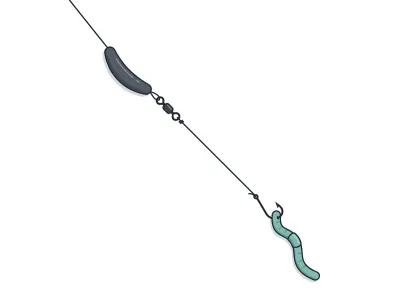
Live-Bait (Lindy) Rig + Leech/Crawler
jumbo leech or half a nightcrawler
Walleye · Jigs & bladed
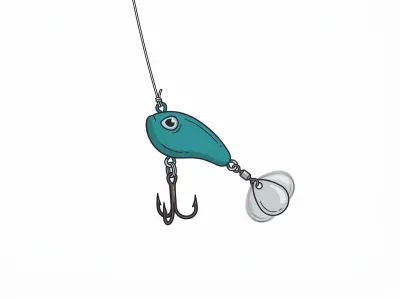
Tail Spinner
Compact lead body with a free-spinning blade on the tail
Smallmouth bass · Soft plastics
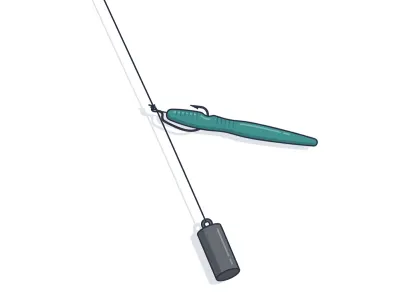
Drop Shot (Finesse Plastic)
4" finesse worm or 3" minnow-profile plastic
Smallmouth bass · Jigs & bladed
Tail Spinner
Compact lead body with a free-spinning blade on the tail
Largemouth bass · Soft plastics

Texas-Rigged Worm
7" ribbon-tail or straight-tail plastic worm
Largemouth bass · Soft plastics
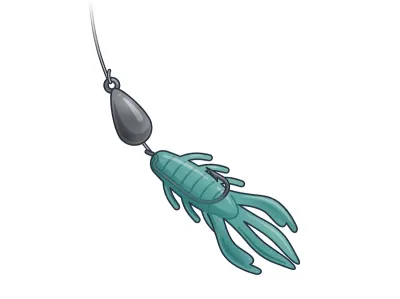
Free Rig
Creature bait or magnum finesse worm
Full setups, including hooks, weights and line, are on the live map. As an Amazon Associate I earn from qualifying purchases.
DNR stocking records
Stocking history
| Year | Species | Stocked |
|---|---|---|
| 2025 | Muskellunge | 723 yearlings · 40 adults |
| 2024 | Muskellunge | 3,000 fingerlings |
| 2022 | Muskellunge | 3,000 fingerlings |
| 2020 | Muskellunge | 1,000 yearlings |
| 2018 | Muskellunge | 3,000 fingerlings |
| 2018 | Walleye | 10,000,000 fry |
| 2017 | Walleye | 10,150,000 fry |
| 2016 | Muskellunge | 3,061 fingerlings |
| 2016 | Walleye | 10,000,000 fry |
MN DNR · in their words
From the 2025 survey
Sampling Programs
Mille Lacs Lake is one of ten lakes in Minnesota's Large Lake Program. These lakes have annual sampling of the fish populations, and frequent creel surveys. Specific to Mille Lacs Lake, sampling programs focusing on Walleye, Yellow Perch, Smallmouth Bass, and Northern Pike are conducted annually. Additionally, we have annual summer and winter creel surveys to document angler use and fish harvest.
Read the full DNR narrative
Walleye
Walleye management on Mille Lacs Lake is conducted cooperatively with the eight Tribes signatory to the Treaty of 1837. A safe harvest level for Walleye is determined annually and is based on information collected through various sampling programs. For the 2026 fishing year (December 2025 through November 2026) the state's allocation of the safe harvest level was set at 105,300 pounds, which is around a 7% decrease from 2025 and is based on a similar percentage of decrease in the lake's adult Walleye biomass over the same time period. The reduction in Walleye biomass occurred, in part, due to a weak age-class (2023) of fish recruiting into the fishable stock and a reduction in condition (plumpness) for medium sized (14"-20") Walleye due to reduced levels of forage for small and medium sized fish. By agreement, neither the Tribal nor State fishery harvest may exceed their respective quota. Fishing regulations are selected that offer the maximum opportunity to participate in the fishery (minimize likelihood of closures) and to offer opportunity to harvest, when possible, while staying within the quota. Despite the reduction in quota, summer Walleye regulations were actually liberalized because we were observing relatively low 2026 winter Walleye harvest rates. Regulations for the summer are a three fish bag limit, with a minimum size of 17 inches, with only one fish over 20 inches.
During mid-summer of 2025 we began observing angler Walleye catch rates begin to increase. It is more common to observe Walleye catch rates decrease in July due to new forage that becomes large enough for Walleye to easily find and consume, so observing the opposite where catch rates are increasing is a strong indicator that new forage in the form of age-0 Yellow Perch is not available. Forage gill nets that were set in early September showed age-0 Yellow Perch levels in the fall of 2025 were the lowest observed. The same forage gill net assessment confirmed a high abundance of age-1 Yellow Perch and age-1 Tullibee. The age-1 fish are suitable forage prey for Mille Lacs Walleye over 20 inches, although previous diet studies have indicated a preference for the age-0 Yellow Perch, if available. Angler reports in the summer creel indicated that the majority of Walleye catch was from fish under 12 inches; another sign that age-0 forage was lacking and that larger Walleye were likely still feeding on age-1 Yellow Perch and Tullibee. Walleye catch rates continued increasing to the highest ever observed during the winter of 2025-2026; however, most of the catch again consisted of fish from the 2024 year-class that were under 13 inches. Winter Walleye catch rates are highly correlated to catch rates observed the following spring, therefore, the increased winter catch rates suggest that 2026 spring fishing for Walleye is also likely to be relatively high but will consist of mainly smaller fish.
Anglers should expect to catch Walleye ranging in size from 6 to 28-inches long due to respectable numbers of fish from all year classes, with the exception of the 2023 cohort. Anglers are likely to see exceptional numbers of smaller 6-12 inch Walleye in their catch from the strong 2024-year class, which were sampled in the fall as at a level near the highest observed. This year class was commonly reported as being caught by winter anglers, in part, due to their high abundance, but also because they are the first age class of Walleye to run low on forage due to gape limitations restricting the abundance of prey that can be readily consumed. Fall electrofishing and fine-mesh forage gill net sampling indicated that 2024 median age-1 Walleye length was relatively small for the fall, due to the absence of forage. Harvestable sized fish in the 17-20 inch range will also likely become easier to catch earlier in the open-water season as the smallest 2024 year-class Yellow Perch continue to be cropped off as forage and as the remaining fish continue to grow beyond the gape limitations of moderate sized Walleye. We are unable to predict age-0 forage availability which typically becomes available in July. If the forage hatch is relatively normal, we would expect to see Walleye catches decline into the latter summer months; however, if new forage does not develop, we should see catch rates dramatically improve on the larger (>20") Walleye and continue increasing on the smaller Walleye.
Yellow Perch
Yellow Perch from the 2018 through 2024-year classes were sampled near or well above median in the fall survey nets with the age-1 fish being sampled at the highest ever recorded. Anglers begin to harvest Yellow Perch when they attain lengths over 9 inches. We've been sampling more of these larger sized fish since 2021; however, catch rates had remained relatively weak overall, until the winter of 2025, when anglers had good ice conditions and were able to harvest fish from the deeper offshore areas of the lake. In fact, the 2025 winter harvest of Yellow Perch was the highest observed since 2011. The winter Yellow Perch harvest in 2025 exceeded the state's annual quota, which prompted a more conservative regulation change to a five fish bag limit that will remain in place through November 2026. We expect additional fish from the 2022 through 2024 year-classes to continue to grow into the fishable stock over summer which should help continue providing fish for harvest.
Smallmouth Bass
Smallmouth Bass are managed to provide a high-quality fishery, and they are the second most common fish species that anglers pursue on Mille Lacs Lake. Current Mille Lacs regulations require anglers to release Smallmouth Bass longer than 17-inches. Spawning Smallmouth Bass are usually sampled during late May/early June using electrofishing gear. This is a sampling technique that allows fish to be released unharmed after they have their length measured. Smallmouth Bass were sampled from 7 May through 30 May in 2025 and ranged in length from 3.5 inches to 22.2 inches. Most fish were between 13 and 20 inches and showed an indistinct mode at 19 inches, presenting an impressive balance in length that indicates new fish that are available to recruit to quality size and older fish that compose a large trophy component that attracts anglers from across the country. Smallmouth Bass are also sampled in the annual fall gill nets, which are set in the latter half of September. Although the gill nets are not particularly efficient at sampling bass over 15 inches, we did observe several fish from 16 to just under 21 inches, indicating that we continue to maintain a high-quality population that appears to be still increasing in Mille Lacs.
Northern Pike
Like Smallmouth Bass, Northern Pike are managed to provide a high-quality fishery. Pike are managed with a 30-inch maximum size limit. Northern Pike are sampled in the spring, during spawning, using trap nets. Sampling fish with trap nets allows us to release the fish unharmed after we collect length and sex. We have found that very few male pike grow longer than 30-inches, while females will grow to be longer than 40-inches, with the largest specimens growing to over 45 inches. Of the 259 fish sampled in 2025 the largest male was just under 33 inches, and the largest female was 41.5 inches. About 24% of the fish we sampled were over 30-inches long, and 2% were trophy sized at over 40-inches in length.
Zebra Mussels, Rusty Crayfish, and Zooplankton
Zebra mussels were first observed in Mille Lacs in 2005. Peak density occurred in 2012 after which abundance began decreasing. By 2017, densities had declined to about one half of their peak abundance, and for the last several years abundance has been at about a quarter to a third of their peak.
Zooplankton abundance began dropping in 2010 but then showed increasing numbers from 2017 to 2021; however, in 2022 we again saw densities begin to decrease. While all functional groups of zooplankton have shown declines in abundance, small cladocerans, cyclopoids, and calanoids have shown the most acute decreases in density. These smaller sized zooplankton are important components in the food web, particularly for larval game fish as well as many of the smaller forage species. Much of the declines in zooplankton can be attributed to Zebra Mussels and Spiny Water Flea. Zebra Mussels remove mass quantities of phytoplankton (algae), which is the main food for smaller zooplankton. Spiny Water Flea are an active predator that preys directly on the smaller zooplankton and thus competes with larval and smaller fish for this food supply.
Rusty crayfish eDNA from water samples taken in 2021 indicated that this aquatic invasive species was now in Mille Lacs. Visual confirmation occurred that same year when two specimens were observed near the Father Hennepin State Park swimming beach. In 2023 we observed our first specimen in DNR sampling gear (standard fall gill nets) in the southwest quadrant of the lake and continued to observe relatively low numbers in the 2024 and 2025 fall sampling. A total of seven Rusty Crayfish were observed in the 2025 gill nets. Our population of Rusty Crayfish appears to still be relatively small; however, as the population continues to increase, we may see aquatic plant beds consumed throughout the lake by this invasive crustacean.
Narrative text from the Minnesota DNR lake survey.
Recent reports
Mille Lacs Lake fishing reports
Recent reports on Mille Lacs Lake from guides, tournaments and regular anglers. Anything posted in the last two weeks also bumps the matching spots on the live map, so you'll see a "matches a recent report" tag on them.
Open the live map → Fished it lately? Write a report
All Mille Lacs Lake fishing reports → · Mille Lacs County reports
Public water access
Getting on the water
- Mille Lacs Lake, Cedar Creek (trailer launch)
- Mille Lacs Lake, Cove Bay (trailer launch)
- Mille Lacs Lake, Father Hennepin SPK (E) (trailer launch)
- Mille Lacs Lake, Father Hennepin SPK (W) (trailer launch)
- Mille Lacs Lake, Liberty Beach (trailer launch)
- Mille Lacs Lake, Malmo (trailer launch)
- Mille Lacs Lake, North Garrison Bay (trailer launch)
- Mille Lacs Lake, Pike Point, Garrison (trailer launch)
- Mille Lacs Lake, Shah-bush-kung (trailer launch)
- Mille Lacs Lake, Wahkon (trailer launch)
- Mille Lacs Lake, Wealthwood (trailer launch)
- Mille Lacs Lake, Co Hwy 37 (carry-in)
- Reddy Creek (carry-in)
- City of Wahkon Fishing Pier (fishing pier)
- Mille Lacs Lake Fishing Pier (fishing pier)
- Mille Lacs Lake Fishing Pier (fishing pier)
- Mille Lacs Lake, Isle Fishing Pier (fishing pier)
DNR bathymetry
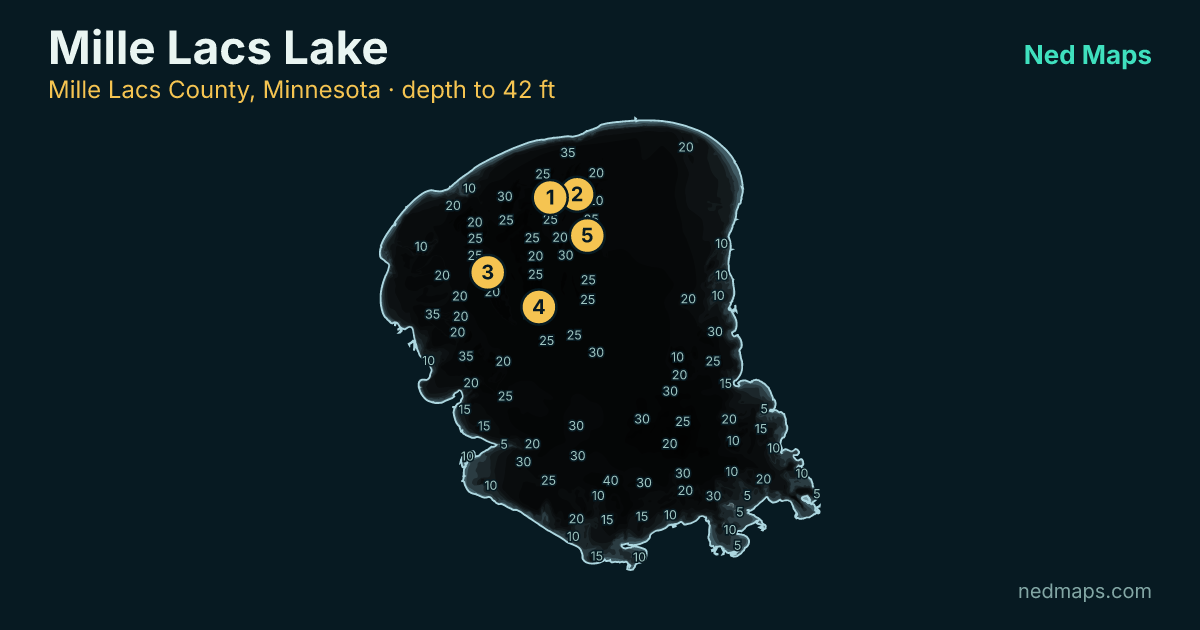
Mille Lacs Lake depth map
Within 30 miles
Nearby lakes
- Black Bass Lake · 32 ac · 8.2 mi
- Shakopee Lake · 584 ac · 9.7 mi
- Cedar Lake · 249 ac · 9.7 mi
- Whitefish Lake · 709 ac · 10 mi
- Holt Lake · 164 ac · 11 mi
- Big Pine Lake · 638 ac · 12 mi
- Round Lake · 737 ac · 12 mi
- Smith Lake · 491 ac · 12.2 mi
Quick answers
Frequently asked questions
How deep is Mille Lacs Lake?
Mille Lacs Lake reaches 42 ft at its deepest point with a mean depth of 28.5 ft; about 26% of the lake is littoral (15 ft or shallower).
How big is Mille Lacs Lake?
Mille Lacs Lake covers 128,250 acres with about 105.5 miles of shoreline.
How clear is the water in Mille Lacs Lake?
DNR Secchi readings on Mille Lacs Lake average 11 ft of visibility, clear water for a Minnesota lake.
What fish are in Mille Lacs Lake?
Minnesota DNR surveys (most recently 2025) record walleye, largemouth bass, smallmouth bass, northern pike, muskellunge, bluegill, crappie, yellow perch, rock bass.
Is Mille Lacs Lake stocked?
Yes. The DNR stocked muskellunge in 2025; the stocking table on this page lists every year back to 2016.
Does Mille Lacs Lake have a public access?
Yes. Mille Lacs Lake has 17 public access sites, including Mille Lacs Lake, Cedar Creek (trailer launch).
How big do walleye get in Mille Lacs Lake?
The biggest walleye measured in recent DNR surveys taped 28"; the size-history table on this page tracks the biggest fish in each survey back to 2018.
When was Mille Lacs Lake last surveyed?
The Minnesota DNR last surveyed Mille Lacs Lake in 2025, the most recent of 37 surveys on record.
Page updated .

Featured guide spot
Your guide service here
One featured guide per lake, with your photo, your writeup and a link straight to your booking page. Free through December 31, 2026.
Then $20 a month from January. Cancel any time.
The live map adds today's conditions and ranked spots for Mille Lacs Lake, plus a trip plan you can share:
Open Mille Lacs Lake on the live map → Fished it lately? Write a report