Minnesota · Aitkin County
Big Pine Lake Fishing guide
Big Pine Lake is a 638-acre lake in Aitkin County, Minnesota, reaching 78 ft at its deepest point. Average water clarity runs about 16.5 ft. The Minnesota DNR has surveyed the lake 12 times, most recently in 2024, with walleye, largemouth bass, smallmouth bass and northern pike in the nets.
DNR survey data
Fish species
WalleyeLast stocked 2025Fair numbers2.3per gill net17"Typical27"Biggest
Lengths measured · 69 fish
Recent · 2021 + 2024Lengths measured · 13 fish
2024Lengths measured · 56 fish
2021Lengths measured · 56 fish
2016Lengths measured · 64 fish
2013Largemouth bassFair numbers38per hr (electrofishing)10"Typical15"Biggest
Lengths measured · 191 fish
Recent · 2021 + 2024Lengths measured · 30 fish
2024Lengths measured · 161 fish
2021Lengths measured · 37 fish
2016Lengths measured · 37 fish
2013Northern pikeJust a few3.3per gill net21"Typical38"Biggest
Lengths measured · 88 fish
Recent · 2021 + 2024Lengths measured · 27 fish
2024Lengths measured · 61 fish
2021Lengths measured · 37 fish
2016Lengths measured · 65 fish
2013BluegillJust a few3.2per trap net5"Typical8"Biggest
Lengths measured · 86 fish
Recent · 2021 + 2024Lengths measured · 40 fish
2024Lengths measured · 46 fish
2021Lengths measured · 145 fish
2016Lengths measured · 17 fish
2013CrappieJust a few0.4per trap net9"Typical11"Biggest
Lengths measured · 35 fish
Recent · 2021 + 2024Lengths measured · 5 fish
2024Only 5 fish measured that year — too few to read as a shape.
Lengths measured · 30 fish
2021Lengths measured · 10 fish
2016Lengths measured · 11 fish
2013Rock bassGood numbers3.1per gill net7"Typical10"Biggest
Lengths measured · 80 fish
Recent · 2021 + 2024Lengths measured · 33 fish
2024Lengths measured · 47 fish
2021Lengths measured · 25 fish
2016Lengths measured · 59 fish
2013Rates come from standard DNR survey gear (gill nets, trap nets, electrofishing), judged against statewide benchmarks for the same gear, so the same number of fish per net can read differently for two species. Where the standard gear can't count a species reliably, only presence and size are listed. Typical is the middle fish of those measured. Open a row for the full length spread, survey by survey.
How to fish Big Pine Lake through the year
Walleye
- Spring
- Walleye are shallow, on and just off the spawning flats and the first green weeds. At 16.5 ft of clarity, fish them deeper and lighter than usual.
- Early summer
- Walleye are setting up on the outside weed edge, points and shallow structure.
- Summer
- Walleye are working the weed edge, points and any wind-blown structure. On a lake that drops to 78 ft, check the deep edge of that structure too.
- Fall
- Walleye are packing onto the sharpest breaks and points as the water cools, in big schools with short windows.
Largemouth bass
- Spring
- Largemouth are moving up into the warming bays and flats, staging around wood, docks and new weeds to spawn. At 16.5 ft of clarity, fish them deeper and lighter than usual.
- Early summer
- Largemouth are on the shallow spawning flats and protected bays, where beds go on firm bottom next to isolated cover.
- Summer
- Largemouth are in and along the weeds: cabbage and milfoil edges, matted cover and shade. On a lake that drops to 78 ft, check the deep edge of that structure too.
- Fall
- Largemouth are chasing bait back onto the flats and into the remaining green weeds, feeding hard and shallow before the freeze.
Season patterns for each species. Open the live map for today's wind, light and water temp.
Size history
Biggest fish by survey year
| Survey year | Walleye | Largemouth bass | Smallmouth bass |
|---|---|---|---|
| 2024 | 21" | 15" | — |
| 2021 | 27" | 15" | 8" |
| 2016 | 24" | 14" | — |
| 2013 | 25" | 15" | 20" |
| 2011 | 28" | 15" | 1" |
| 2007 | 27" | 14" | — |
| 2002 | 27" | 15" | 11" |
| 1996 | 27" | 14" | 14" |
Longest fish measured by DNR survey crews in each year's nets. Survey gear samples the population, so the lake usually holds larger fish than any survey measured.
Suggested tackle
What to bring
Top presentations for this lake's structure and clarity:
Walleye · Live bait

Live-Bait (Lindy) Rig + Leech/Crawler
jumbo leech or half a nightcrawler
Walleye · Trolling
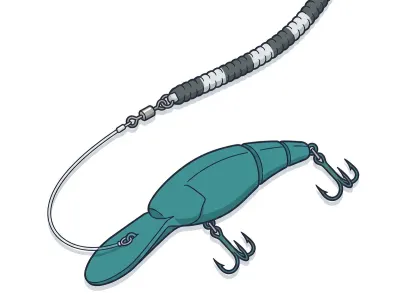
Leadcore Line + Crankbaits
4–5" mid-diving crankbait behind a long leadcore run
Largemouth bass · Soft plastics
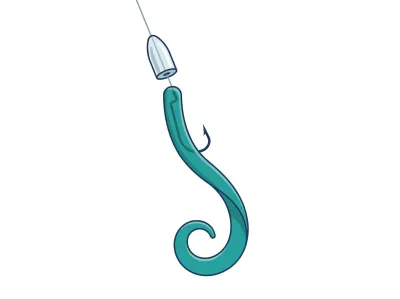
Texas-Rigged Worm
7" ribbon-tail or straight-tail plastic worm
Largemouth bass · Soft plastics
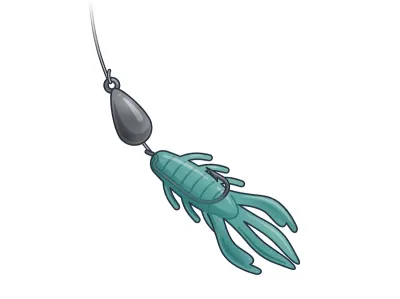
Free Rig
Creature bait or magnum finesse worm
Smallmouth bass · Soft plastics
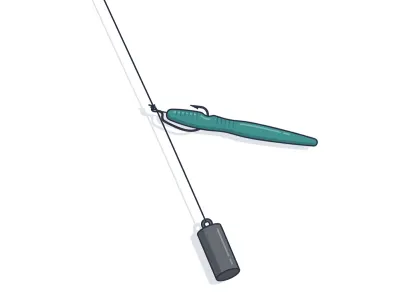
Drop Shot (Finesse Plastic)
4" finesse worm or 3" minnow-profile plastic
Smallmouth bass · Jigs & bladed
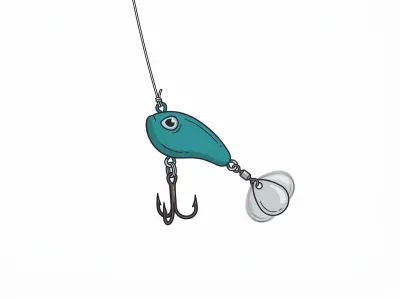
Tail Spinner
Compact lead body with a free-spinning blade on the tail
Full setups, including hooks, weights and line, are on the live map. As an Amazon Associate I earn from qualifying purchases.
DNR stocking records
Stocking history
| Year | Species | Stocked |
|---|---|---|
| 2025 | Walleye | 6,940 fingerlings |
| 2024 | Walleye | 5,161 yearlings |
| 2023 | Walleye | 6,969 fingerlings |
| 2022 | Walleye | 7,252 fingerlings |
| 2021 | Walleye | 4,132 fingerlings |
| 2020 | Walleye | 3,650 fingerlings |
| 2019 | Walleye | 5,512 fingerlings |
| 2018 | Walleye | 4,657 fingerlings |
| 2017 | Walleye | 9,583 fingerlings |
| 2016 | Walleye | 8,042 fingerlings |
MN DNR · in their words
From the 2024 survey
Big Pine Lake is a moderately clear water lake located in southwestern Aitkin County and is part of the Mille Lacs/Rum River watershed. There is a state-owned public access located on the south side of the lake. Big Pine Lake has a variety of habitats available to the angler from open, wind-swept gravel and rock to areas of heavy vegetation. Shorelines vary from areas with gentle slopes and shallow depths to areas with sharp drop-offs and deep water. Mid-water areas consist primarily of deep water, but there are several gravel bars with steep sides that rise to within a few feet of the surface. With the relatively recent observation of Zebra Mussels in Big Pine (2018), there is also uncertainty in changes to the ecology of the system as they become more abundant and so we encourage boaters and lake shore owners to follow good practices to prevent movement of Zebra Mussels out of the system. This targeted survey, employing only gill nets, was conducted to help evaluate the current Walleye stocking strategy.
Gamefish species available to anglers include Walleye, Northern Pike, Black Crappie, Bluegill and Largemouth Bass. Though there are some favorable spawning areas for Walleye, and minimal natural reproduction has been observed, historically the better year classes have been those supplemented by stocking. Walleye have been stocked with varying success in Big Pine Lake since the early 1900's and is currently managed with annual fingerling stocking.
Read the full DNR narrative
Prior to the 2024 survey, Walleye gill net catch rates were stable, averaging between 3.4 and 5.3 Walleye per gill net since 2011. The Walleye catch rate decreased substantially in 2024, dropping to a rate of only 1.1 per gill net. This rate was well below the management goal of 5 per gill net and near the bottom of the interquartile range for lakes of this class. The mean length of Walleye captured was 17.4 inches, with fish ranging from 12.6 to 21.3 inches. Captured Walleye ranged from 2 to 8 years old, with five year classes present. This met the management goal of at least three year classes present in the sample. Growth rates of Walleye improved slightly from the two most recent surveys, reaching lengths of just under 15 inches by age 4, which was similar to county and statewide averages.
The gillnet catch rate for Northern Pike was 2.3 per net, which was slightly below the long-term average of 3.4 per net, spanning 14 surveys back to 1956. This is normal for this lake type and meets the current management goal of 2 to 6 per net. A more compressed size structure was observed in 2024, compared to previous surveys, with Pike ranging in length from 16.0 to 29.7 inches, and averaging 22.4 inches. An average length of 22.4 inches did not meet the management goal (mean length = 24.0 inches), and only 22% of Pike attained lengths of 26.0 inches or larger. Growth rates of Pike were comparable to previous surveys and above state and county averages. Low abundances and good growth rates make Big Pine Lake a great candidate for catch and release of large Northern Pike, as recycling these fish will allow for greater angler opportunity at capturing quality-sized fish in the future.
Anglers can expect to find a stable population of Largemouth Bass at Big Pine Lake, as gill net catches were relatively unchanged from pervious surveys (2.5 per net). Previous electrofishing catch rates indicate sizeable Bass abundances, with fish sampled up to 15.6 inches. Some Smallmouth Bass have also been observed in Big Pine Lake; however, a targetable population does not exist at this point and none were sampled in 2024.
While gill nets are not the preferred sampling gear for assessment of Bluegill populations, catch rates in 2024 were above levels observed in the previous 5 surveys (3.3 per net). Captured Bluegill averaged 4.7 inches, and no Bluegill were captured greater than 8.0 inches. Comparatively, Hybrid Sunfish were captured at a lower overall rate than Bluegill (1.9 per net) but with more fish over 8 inches, accounting for 9% of Hybrid Sunfish sample.
Nice sized Black Crappies are also present in the fishery, but traditionally their abundance is low. In 2024, the gill net catch of Black Crappie decreased to 0.4 per gill net, down from 2.1 per net in the 2021 survey. Captured Crappie averaged 8.9 inches in length and ranged from 4.7 to 11.5 inches. A notable 2018 year class that was observed in the 2021 survey was not present in the 2024 survey. The oldest Crappie captured was 5 years old (2019 year class). Growth rates of Crappie in 2024, were similar to the 2021 survey and reached 9.3 inches in four years.
Narrative text from the Minnesota DNR lake survey.
Recent reports
Big Pine Lake fishing reports
Recent reports on Big Pine Lake from guides, tournaments and regular anglers. Anything posted in the last two weeks also bumps the matching spots on the live map, so you'll see a "matches a recent report" tag on them.
Public water access
Getting on the water
- Big Pine Lake (trailer launch)
DNR bathymetry
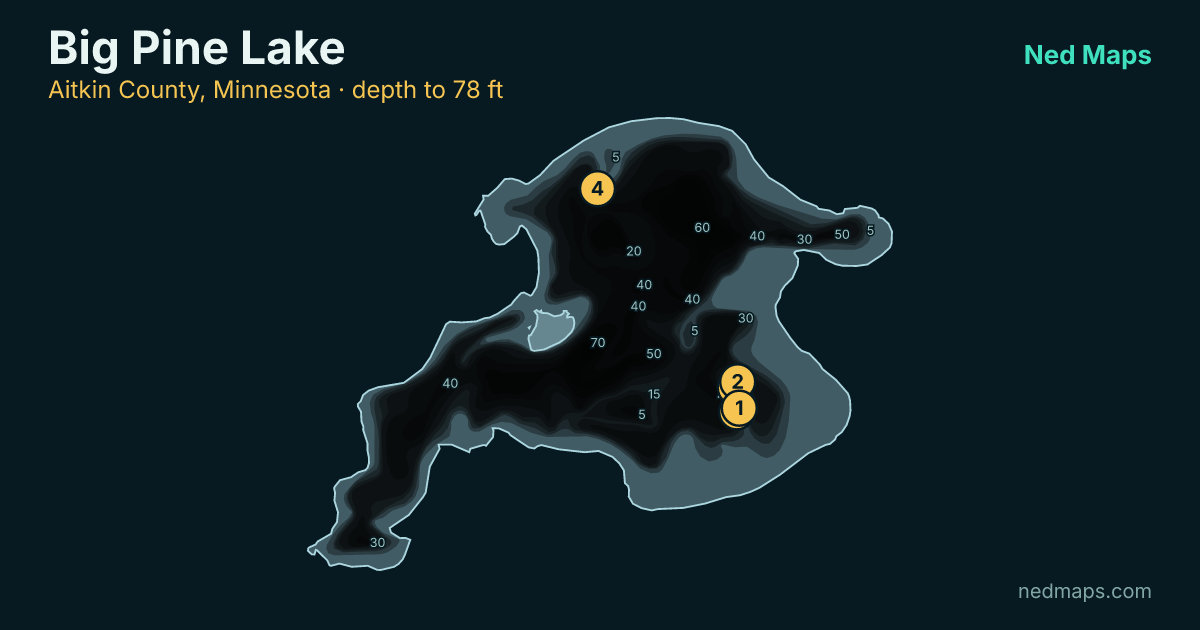
Big Pine Lake depth map
Within 30 miles
Nearby lakes
- Round Lake · 737 ac · 1.9 mi
- Turtle Lake · 108 ac · 2.3 mi
- Partridge Lake · 188 ac · 2.9 mi
- Bay Lake · 2,330 ac · 4.5 mi
- Farm Island Lake · 2,005 ac · 4.9 mi
- Borden Lake · 1,011 ac · 5.3 mi
- Sunset Lake · 221 ac · 5.8 mi
- Shirt Lake · 231 ac · 5.8 mi
Quick answers
Frequently asked questions
How deep is Big Pine Lake?
Big Pine Lake reaches 78 ft at its deepest point; about 41% of the lake is littoral (15 ft or shallower).
How big is Big Pine Lake?
Big Pine Lake covers 638 acres with about 6.4 miles of shoreline.
How clear is the water in Big Pine Lake?
DNR Secchi readings on Big Pine Lake average 16.5 ft of visibility, clear water for a Minnesota lake.
What fish are in Big Pine Lake?
Minnesota DNR surveys (most recently 2024) record walleye, largemouth bass, smallmouth bass, northern pike, bluegill, crappie, yellow perch, rock bass.
Is Big Pine Lake stocked?
Yes. The DNR stocked walleye in 2025; the stocking table on this page lists every year back to 2016.
Does Big Pine Lake have a public access?
Yes. Big Pine Lake has one public access site: Big Pine Lake (trailer launch).
How big do walleye get in Big Pine Lake?
The biggest walleye measured in recent DNR surveys taped 27"; the size-history table on this page tracks the biggest fish in each survey back to 1996.
When was Big Pine Lake last surveyed?
The Minnesota DNR last surveyed Big Pine Lake in 2024, the most recent of 12 surveys on record.
Page updated .

Featured guide spot
Your guide service here
One featured guide per lake, with your photo, your writeup and a link straight to your booking page. Free through December 31, 2026.
Then $20 a month from January. Cancel any time.
The live map adds today's conditions and ranked spots for Big Pine Lake, plus a trip plan you can share:
Open Big Pine Lake on the live map → Fished it lately? Write a report