Minnesota · Itasca County
Jack the Horse Lake Fishing guide
Jack the Horse Lake sits in Itasca County, Minnesota, and covers 364 acres, reaching 45 ft at its deepest point. The Minnesota DNR has surveyed the lake 5 times, most recently in 2004, with walleye, largemouth bass, northern pike and bluegill in the nets. That survey is 22 years old now.
DNR survey data
Fish species
The DNR last surveyed Jack the Horse Lake in 2004. Ratings need a survey from the last 20 years, so this page lists the species from that older record without numbers.
- Walleye
- Largemouth bass
- Northern pike
- Bluegill
- Crappie
- Yellow perch
- Rock bass
How to fish Jack the Horse Lake through the year
Walleye
- Spring
- Walleye are shallow, on and just off the spawning flats and the first green weeds.
- Early summer
- Walleye are setting up on the outside weed edge, points and shallow structure.
- Summer
- Walleye are working the weed edge, points and any wind-blown structure. On a lake that drops to 45 ft, check the deep edge of that structure too.
- Fall
- Walleye are packing onto the sharpest breaks and points as the water cools, in big schools with short windows.
Largemouth bass
- Spring
- Largemouth are moving up into the warming bays and flats, staging around wood, docks and new weeds to spawn.
- Early summer
- Largemouth are on the shallow spawning flats and protected bays, where beds go on firm bottom next to isolated cover.
- Summer
- Largemouth are in and along the weeds: cabbage and milfoil edges, matted cover and shade. On a lake that drops to 45 ft, check the deep edge of that structure too.
- Fall
- Largemouth are chasing bait back onto the flats and into the remaining green weeds, feeding hard and shallow before the freeze.
Season patterns for each species. Open the live map for today's wind, light and water temp.
Suggested tackle
What to bring
Top presentations for this lake's structure and clarity:
Walleye · Live bait
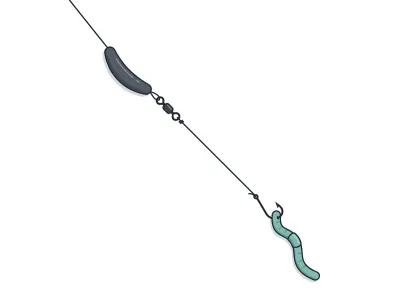
Live-Bait (Lindy) Rig + Leech/Crawler
jumbo leech or half a nightcrawler
Walleye · Trolling
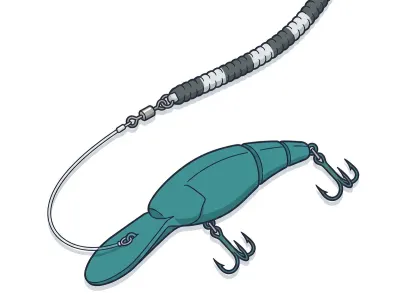
Leadcore Line + Crankbaits
4–5" mid-diving crankbait behind a long leadcore run
Largemouth bass · Hardbaits
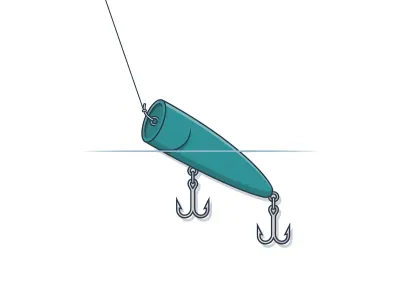
Topwater Popper
2.5–3" concave-face popper
Largemouth bass · Hardbaits
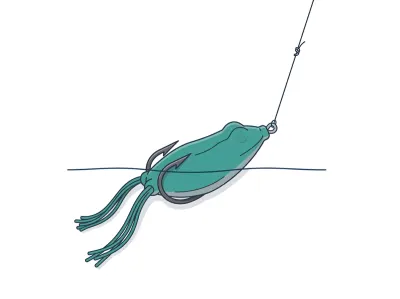
Hollow-Body Frog
3–3.5" hollow-body frog
Northern pike · Soft plastics

Paddletail Swimbait on Jighead
4–5" paddletail swimbait on a ball-head swimbait jighead
Northern pike · Muskie & pike
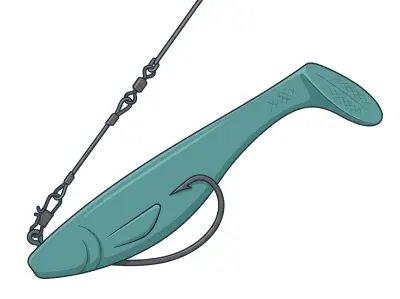
Soft Rubber (Bull Dawg / Medusa)
10" soft rubber body bait
Full setups, including hooks, weights and line, are on the live map. As an Amazon Associate I earn from qualifying purchases.
MN DNR · in their words
From the 2004 survey
Jack the Horse Lake is a 383 acre lake located northeast of Marcell, MN. The lake has a carry-in access off of U.S. Forest Service road 2182. There had not been a lake management plan developed for the lake at the time of this assessment.In 2004, the black crappie gill-net catch rate was 1.3/net while the trap-net catch rate was 1.0/net. Both gears sampled black crappie within the normal range for this type of lake. Fish sampled in gill nets ranged from 5.4 to 10.0 inches and had a mean length of 8.3 inches while trap net captured fish ranged from 4.7 to 8.9 inches and had a mean length of 6.3 inches. Five year-classes from age 2 to age 6 were sampled. Age-2 fish were the most prevalent, representing 41% of the sample. Growth was slower than the statewide average.The bluegill trap-net catch rate was 51.0 fish/net. The catch in 2004 was the highest on record and exceeded the upper end of the normal range. The fish ranged from 2.6 to 8.7 inches and averaged 5.3 inches. Eight year-classes were identified ranging from 3 to 13 years old. The 1998 year class represented 46% of the sample. Growth was slow through age 5 but average for older fish.In 2004, largemouth bass were sampled with spring night electrofishing. Thirty-eight largemouth bass were captured for a catch rate of 28.5 fish/hr. The fish ranged from 6.2 to 18.8 inches and averaged 12.3 inches. The population appeared to have fairly consistent but low reproduction. Eight year-classes were identified with the 1998 year-class representing 37% of the sample. It appears that conditions were favorable for bluegill and bass production in 1998 since that was the strongest age-class for both species.Northern pike gill-net catch rates have been stable in the last three assessments, ranging from 6.0 to 7.5 fish/net. However, the first two assessments in 1956 and 1972 documented catch rates of 2.3 and 3.3 fish/gill net. In 2004, the northern pike gill-net catch rate was 7.5 fish/net. The catch was above the lake average 5.3 fish/net. The sampled fish ranged from 14.0 and 34.3 inches and averaged 21.3 inches. Seven age-classes were sampled from two to eight years old. Recruitment appears to be consistent and moderate with age-3, age-4 and age-5 fish representing 30, 27, and 18% of the sample. Growth was similar to statewide averages for all ages. A population with moderate recruitment, a good prey base of tullibee, and average growth should be able to produce preferred-length fish on a consistent basis. It appears that northern pike size structure may be on the edge of being negatively affected by angler harvest. Tullibee are important prey for predators like walleye and northern pike. The presence of a healthy tullibee population is often associated with trophy predators. In the last four assessments since 1972 tullibee catch rates were above average. The gill-net catch rates have declined in each assessment from 31.1 fish/net in 1976 to 12.7 in 1982 and finally to 9.5 in 2004. Interestingly, the distribution of tullibee throughout the lake was essentially limited to two basins (one net captured 53 of the 76 fish sampled). The fish sampled in 2004 ranged from 6.0 to 13.1 inches and averaged 9.5 inches.Walleye have never been stocked in Jack the Horse Lake and only one had ever been sampled prior to 2004. Three walleye were sampled in gill nets for a catch rate of 0.4 fish/net. The fish ranged from 19.9 to 24.8 inches and averaged 22.2 inches. The three fish were from the 1996 and 1999 year-classes. Growth was similar to statewide averages. Yellow perch were sampled at a gill-net catch rate of 0.5 fish/net, which was below normal for this lake type. Gill-net catch rates have never exceeded 3.0 fish/net. The sampled fish ranged from 5.8 to 7.5 inches with a average length of 6.4 inches. The fish were all four or five years old and growth was slow compared to statewide averages.In order to maintain or improve fish and wildlife populations, water quality and habitat must be protected. People often associate water quality problems with large-scale agricultural, forestry, urban development or industrial practices in the watershed. In reality, the impact of land use decisions on one lake lot may be relatively small, yet, the cumulative impact of those decisions on many lake lots can result in a significant decline in water quality and habitat. For example, removing shoreline and aquatic vegetation, fertilizing lawns, mowing to the water's edge, installing beach sand blankets, failing septic systems and uncontrolled run-off, all contribute excess nutrients and sediment which degrade water quality and habitat. Understanding these cumulative impacts and taking steps to avoid or minimize them will help to insure our quality fisheries can be enjoyed by future generations.
Narrative text from the Minnesota DNR lake survey.
Recent reports
Jack the Horse Lake fishing reports
Recent reports on Jack the Horse Lake from guides, tournaments and regular anglers. Anything posted in the last two weeks also bumps the matching spots on the live map, so you'll see a "matches a recent report" tag on them.
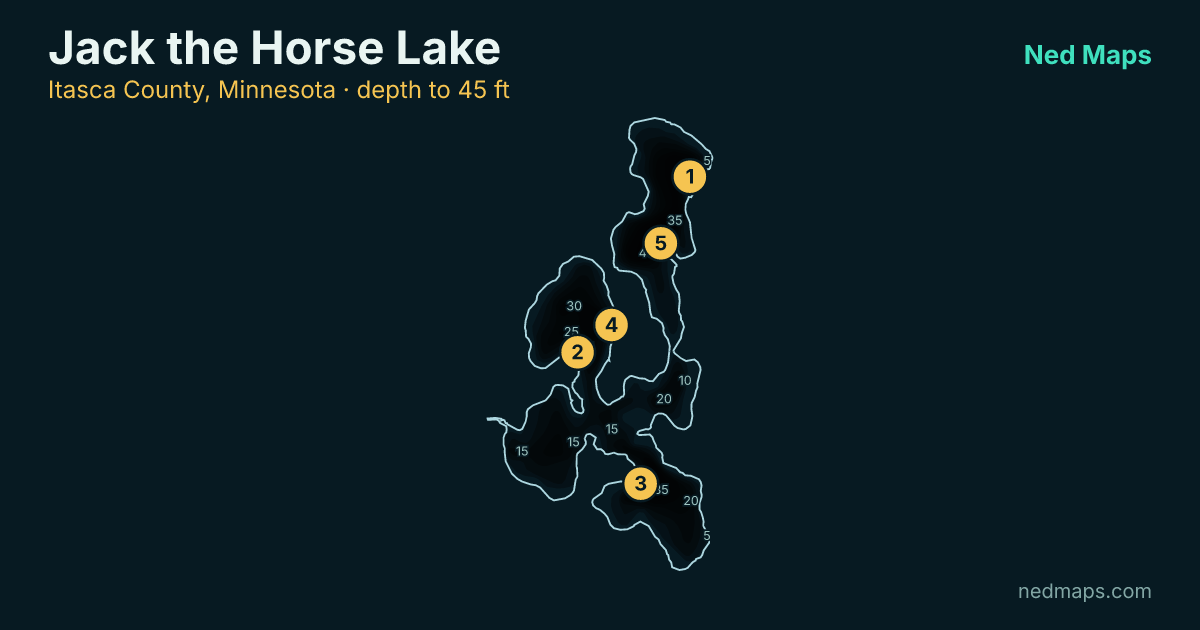
DNR bathymetry
Jack the Horse Lake depth map
Within 30 miles
Nearby lakes
- Johnson Lake · 304 ac · 1.2 mi
- Big Dick Lake · 260 ac · 1.2 mi
- Burns Lake · 181 ac · 1.5 mi
- Batson Lake · 114 ac · 2.2 mi
- Little North Star Lake · 55 ac · 2.9 mi
- Clubhouse Lake · 265 ac · 3.1 mi
- Big Ole Lake · 217 ac · 3.3 mi
- Three Island Lake · 250 ac · 3.4 mi
Quick answers
Frequently asked questions
How deep is Jack the Horse Lake?
Jack the Horse Lake reaches 45 ft at its deepest point with a mean depth of 11 ft; about 67% of the lake is littoral (15 ft or shallower).
How big is Jack the Horse Lake?
Jack the Horse Lake covers 364 acres with about 8.3 miles of shoreline.
What fish are in Jack the Horse Lake?
Minnesota DNR surveys (most recently 2004) record walleye, largemouth bass, northern pike, bluegill, crappie, yellow perch, rock bass.
Is Jack the Horse Lake stocked?
No stocking is on record for Jack the Horse Lake in the DNR's stocking database.
When was Jack the Horse Lake last surveyed?
The Minnesota DNR last surveyed Jack the Horse Lake in 2004, the most recent of 5 surveys on record. That is more than 20 years ago, so this page lists species without ratings.
Page updated .

Featured guide spot
Your guide service here
One featured guide per lake, with your photo, your writeup and a link straight to your booking page. Free through December 31, 2026.
Then $20 a month from January. Cancel any time.
The live map adds today's conditions and ranked spots for Jack the Horse Lake, plus a trip plan you can share:
Open Jack the Horse Lake on the live map → Fished it lately? Write a report