Minnesota · Watonwan County
Kansas Lake Fishing guide
Kansas Lake covers 403 acres in Watonwan County, Minnesota, reaching 7 ft at its deepest point. Average water clarity runs about 1.6 ft. The Minnesota DNR has surveyed the lake 16 times, most recently in 2025, with walleye, largemouth bass, northern pike and bluegill in the nets.
DNR survey data
Fish species
WalleyeLast stocked 2025One of the best around30.8per gill net5"Typical26"Biggest
Lengths measured · 478 fish
Recent · 2021 + 2022 + 2023 + 2025Lengths measured · 58 fish
2025Lengths measured · 57 fish
2023Lengths measured · 255 fish
2022Lengths measured · 101 fish
2021No recent survey rating.
Northern pikeLast stocked 2023Just a few2.2per gill net24"Typical31"Biggest
Lengths measured · 20 fish
Recent · 2021 + 2023 + 2025Lengths measured · 14 fish
2025Lengths measured · 1 fish
2023Only 1 fish measured that year — too few to read as a shape.
Lengths measured · 5 fish
2021Only 5 fish measured that year — too few to read as a shape.
Lengths measured · 12 fish
2017CrappieJust a few3.7per trap net5"Typical11"Biggest
Lengths measured · 178 fish
Recent · 2021 + 2025Lengths measured · 3 fish
2025Only 3 fish measured that year — too few to read as a shape.
Lengths measured · 175 fish
2021Lengths measured · 9 fish
2017Only 9 fish measured that year — too few to read as a shape.
Lengths measured · 96 fish
2009Yellow perchExcellent numbers24.4per gill net6"Typical10"Biggest
Lengths measured · 230 fish
Recent · 2021 + 2023 + 2025Lengths measured · 35 fish
2025Lengths measured · 68 fish
2023Lengths measured · 127 fish
2021Lengths measured · 87 fish
2017Rates come from standard DNR survey gear (gill nets, trap nets, electrofishing), judged against statewide benchmarks for the same gear, so the same number of fish per net can read differently for two species. Where the standard gear can't count a species reliably, only presence and size are listed. Typical is the middle fish of those measured. Open a row for the full length spread, survey by survey.
How to fish Kansas Lake through the year
Walleye
- Spring
- Walleye are shallow, on and just off the spawning flats and the first green weeds. In 1.6 ft of visibility, they sit shallower than you think.
- Early summer
- Walleye are setting up on the outside weed edge, points and shallow structure.
- Summer
- Walleye are working the weed edge, points and any wind-blown structure. With 100% of this lake 15 ft or shallower, the weed edge is the main event.
- Fall
- Walleye are packing onto the sharpest breaks and points as the water cools, in big schools with short windows. A 7-ft bowl cools fast, so the fall window comes early here.
Northern pike
- Spring
- Pike are in the shallow bays and along new weed growth. In 1.6 ft of visibility, they sit shallower than you think.
- Early summer
- Pike are on the outside weed edge and points.
- Summer
- Pike are on the deep weed edge and points near the coolest water they can find. With 100% of this lake 15 ft or shallower, the weed edge is the main event.
- Fall
- Pike are on the last green weeds and the breaks beside them, feeding heavily as the water drops. A 7-ft bowl cools fast, so the fall window comes early here.
Season patterns for each species. Open the live map for today's wind, light and water temp.
Size history
Biggest fish by survey year
| Survey year | Walleye | Northern pike | Yellow perch |
|---|---|---|---|
| 2025 | 26" | 31" | 10" |
| 2023 | 8" | 17" | 7" |
| 2022 | 17" | — | — |
| 2021 | 23" | 29" | 10" |
| 2019 | 14" | — | — |
| 2018 | 9" | — | — |
| 2017 | 27" | 34" | 10" |
| 2009 | 19" | 34" | 12" |
Longest fish measured by DNR survey crews in each year's nets. Survey gear samples the population, so the lake usually holds larger fish than any survey measured.
Suggested tackle
What to bring
Top presentations for this lake's structure and clarity:
Walleye · Live bait

Live-Bait (Lindy) Rig + Leech/Crawler
jumbo leech or half a nightcrawler
Walleye · Trolling
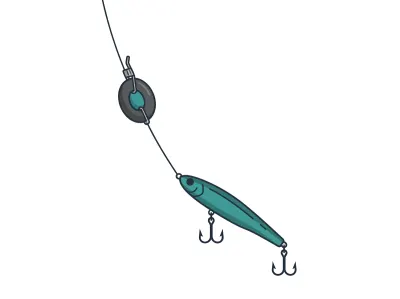
Snap Weights + Stickbaits
4–5" suspending or slow-floating stickbait
Northern pike · Jigs & bladed
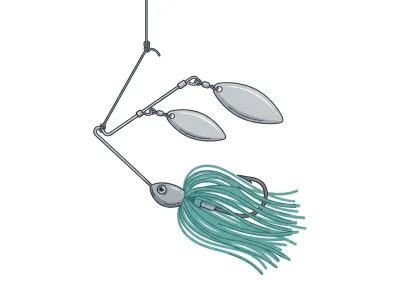
Spinnerbait
3/8–1/2 oz safety-pin spinnerbait with tandem willow-leaf blades
Northern pike · Jigs & bladed
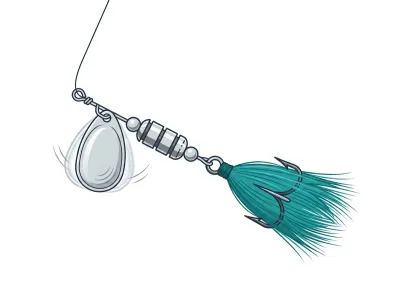
Inline Spinner (Mepps/Blue Fox)
#2–#4 in-line spinner
Yellow perch · Live bait
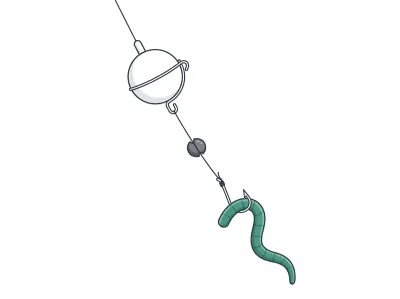
Clip-On Bobber + Worm
half to whole garden nightcrawler
Yellow perch · Soft plastics
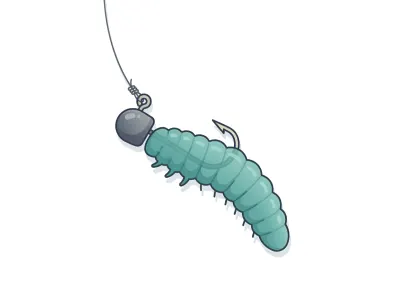
Tungsten Jig + Micro Plastic
1–1.5" micro plastic
Full setups, including hooks, weights and line, are on the live map. As an Amazon Associate I earn from qualifying purchases.
DNR stocking records
Stocking history
| Year | Species | Stocked |
|---|---|---|
| 2025 | Walleye | 100,500 fry |
| 2024 | Walleye | 100,500 fry |
| 2023 | Northern Pike | 497 fingerlings |
| 2022 | Northern Pike | 686 fingerlings |
| 2022 | Walleye | 199,000 fry |
| 2021 | Walleye | 199,000 fry |
| 2019 | Walleye | 199,000 fry |
| 2018 | Walleye | 199,000 fry |
| 2017 | Northern Pike | 1,695 fingerlings |
| 2016 | Walleye | 199,130 fry |
MN DNR · in their words
From the 2025 survey
Kansas Lake is a 398-acre lake, located in Watonwan County, approximately 5 miles southwest of the City of St. James. Kansas Lake has a mean depth of 5.0 ft. and a maximum depth of 7.0 ft. The watershed of Kansas Lake is quite large (30:1 Watershed to lake ratio) and dominated by row crop agriculture with many miles of pattern drain tile, likely resulting in large influxes of nitrogen and phosphorus, the latter of which may result in severe algae blooms. Historically, Kansas Lake has been prone to winterkill. Kansas Lake is managed primarily for Walleye, and secondarily for Northern Pike and Yellow Perch. Lower Mississippi Strain Walleye are present in Murray County's Lake Sarah, a lake that hasn't been stocked since 1991 because the Walleye population is sustained at high levels through natural reproduction. Sporadic natural reproduction occurs in Kansas Lake, thus LMS Walleye have been stocked because anecdotal evidence suggests that they may have a survival advantage and natural reproduction potential in southern Minnesota lakes. Northern Pike have also been stocked as needed in Kansas Lake, with the most recent stocking of fingerling in 2022 and 2023. A survey was conducted during the week of June 23, 2025, to monitor fish populations using three gill nets and nine trap nets.
Walleye catch rates in Kansas Lake have varied from 4.4 per gill net in 2001 to 53.5 per gill net in 2021 and have averaged 21.9 per gill net since 1984. In 2025, the Walleye catch rate was 15.7 per gill net which is near the upper end of expected catch rates for similar lakes (18.1 per gill net). Six-year classes of Walleye were sampled including age-1, age-2, age-3, age-6, age-9, and age-12 Walleye. Age-2 (2023) and age-3 (2022) Walleye were the most abundant year classes, accounting for 76 percent of aged Walleye. The 2023 year-class of Walleye was not stocked, indicating that natural reproduction occurred. To date, LMS fish appear to be winning the battle and may be the best suited strain to stock in Kansas Lake, with the hope that they will result in a naturally reproducing population. Lengths of Walleye in gill nets and trap nets ranged from 7.6 to 26.7 inches and averaged 14.9 inches. Growth of Kansas Lake Walleye was average as mean length at age-3 was 14.3 inches.
Read the full DNR narrative
The Northern Pike catch rate increased from 1.5 per gill net in 2021 to 2.7 per gill net in per gill net in 2025, which is within the expected range of catch rates for similar lakes (1.1 to 8.0 per gill net) and above the long-term average of 1.9 per gill net. Historically, Northern Pike catch rates have been just under 2.0 per gill net except in 2009 when the catch rate was 10.7 per gill net. Northern Pike lengths ranged from 15.2 to 31.6 inches and averaged 25.0 inches. Half of the sampled Northern Pike were harvestable fish (longer than 24.0 inches). The management goal was met because a fishable population exists. The current statewide regulation includes a provision for 2 Northern Pike above 24 inches for southern Minnesota. This regulation may help to increase the size of Northern Pike caught by anglers in Kansas Lake. Harvestable size fish are currently found within the population in Kansas Lake.
The Yellow Perch catch rate in 2025 was 11.0 per gill net, which is below the long-term average of 29.2 per gill net, but within the expected range of catch rates for similar lakes (2.7 to 25.0 per gill net). Lengths of Yellow Perch ranged from 5.4 to 10.5 inches and averaged 9.1 inches. The Yellow Perch population tends to be influenced by Walleye abundance because Yellow Perch are a preferred prey item of Walleye. A fishable population of Yellow Perch exists in Kansas Lake.
The 2025 Black Bullhead catch rate of 33.3 per gill net was near the long-term average of 35.8 per gillnet since 1984 and was near the lower end of expected catch rates for similar lakes (30.3 per gill net). Black Bullhead lengths ranged from 8.5 to 14.3 inches and averaged 10.0 inches. The Common Carp catch rate was 4.2 per trap net, which is within the expected range of catch rates for similar lakes (1.0 to 5.5 per trap net). Other species sampled included Bigmouth Buffalo (N=9), Black Crappie (N=3), Freshwater Drum (N=44), Hybrid Sunfish (N=1), and White Sucker (N=19).
Narrative text from the Minnesota DNR lake survey.
Recent reports
Kansas Lake fishing reports
Recent reports on Kansas Lake from guides, tournaments and regular anglers. Anything posted in the last two weeks also bumps the matching spots on the live map, so you'll see a "matches a recent report" tag on them.
Public water access
Getting on the water
- Kansas Lake (trailer launch)
- Kansas Lake Fishing Pier (fishing pier)
DNR bathymetry
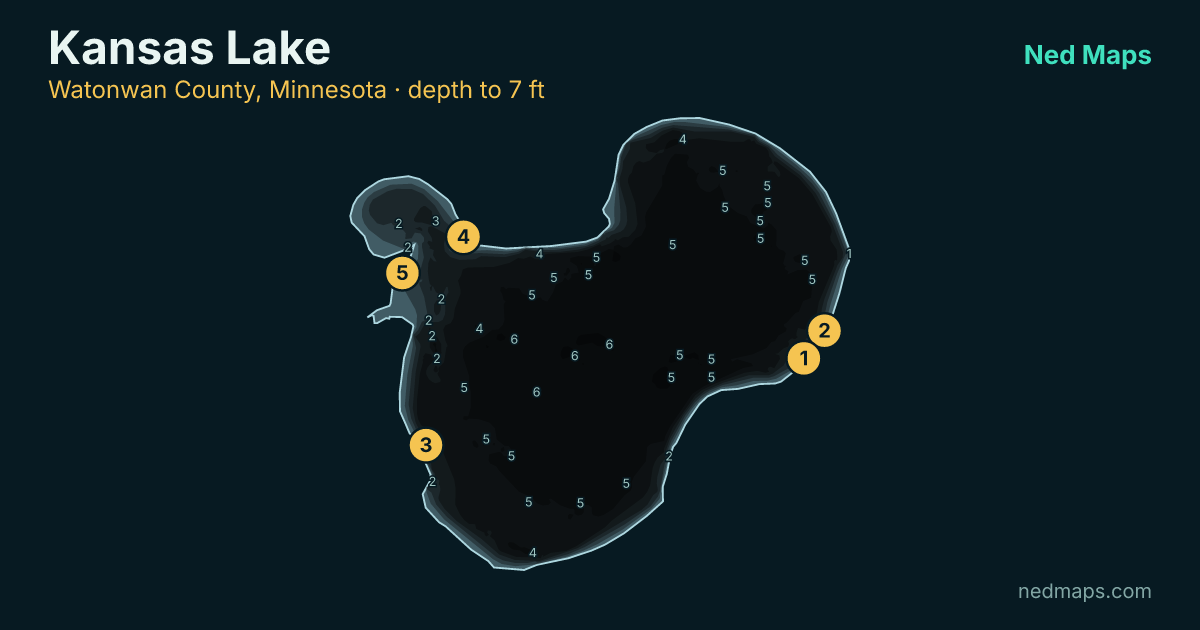
Kansas Lake depth map
Within 30 miles
Nearby lakes
- Long Lake · 263 ac · 2.6 mi
- St. James Lake · 203 ac · 4.7 mi
- Cedar Lake · 707 ac · 9 mi
- Mountain Lake · 230 ac · 12.2 mi
- Big Twin Lake · 461 ac · 12.8 mi
- Clam Lake · 71 ac · 12.9 mi
- Perch Lake · 174 ac · 14.1 mi
- Eagle Lake · 105 ac · 15.2 mi
Quick answers
Frequently asked questions
How deep is Kansas Lake?
Kansas Lake reaches 7 ft at its deepest point with a mean depth of 5 ft; about 100% of the lake is littoral (15 ft or shallower).
How big is Kansas Lake?
Kansas Lake covers 403 acres with about 3.9 miles of shoreline.
How clear is the water in Kansas Lake?
DNR Secchi readings on Kansas Lake average 1.6 ft of visibility, on the stained end for a Minnesota lake.
What fish are in Kansas Lake?
Minnesota DNR surveys (most recently 2025) record walleye, largemouth bass, northern pike, bluegill, crappie, yellow perch.
Is Kansas Lake stocked?
Yes. The DNR stocked walleye in 2025; the stocking table on this page lists every year back to 2016.
Does Kansas Lake have a public access?
Yes. Kansas Lake has 2 public access sites, including Kansas Lake (trailer launch).
How big do walleye get in Kansas Lake?
The biggest walleye measured in recent DNR surveys taped 26"; the size-history table on this page tracks the biggest fish in each survey back to 2009.
When was Kansas Lake last surveyed?
The Minnesota DNR last surveyed Kansas Lake in 2025, the most recent of 16 surveys on record.
Page updated .

Featured guide spot
Your guide service here
One featured guide per lake, with your photo, your writeup and a link straight to your booking page. Free through December 31, 2026.
Then $20 a month from January. Cancel any time.
The live map adds today's conditions and ranked spots for Kansas Lake, plus a trip plan you can share:
Open Kansas Lake on the live map → Fished it lately? Write a report