Minnesota · St. Louis County
Colby Lake Fishing guide
Colby Lake sits in St. Louis County, Minnesota, and covers 518 acres, reaching 30 ft at its deepest point. Average water clarity runs about 3.4 ft. The Minnesota DNR has surveyed the lake 12 times, most recently in 2025, with walleye, largemouth bass, northern pike and bluegill in the nets.
DNR survey data
Fish species
No recent survey rating.
Northern pikeJust a few1.1per gill net25"Typical34"Biggest
Lengths measured · 27 fish
Recent · 2025Lengths measured · 27 fish
2025Lengths measured · 28 fish
2020Lengths measured · 31 fish
2015Lengths measured · 22 fish
2010BluegillJust a few5.8per trap net6"Typical7"Biggest
Lengths measured · 53 fish
Recent · 2025Lengths measured · 53 fish
2025Lengths measured · 34 fish
2020Lengths measured · 126 fish
2015Lengths measured · 66 fish
2010CrappieJust a few4.3per trap net7"Typical9"Biggest
Lengths measured · 81 fish
Recent · 2025Lengths measured · 81 fish
2025Lengths measured · 175 fish
2020Lengths measured · 129 fish
2015Lengths measured · 63 fish
2010Yellow perchFair numbers1.2per gill net5"Typical8"Biggest
Lengths measured · 12 fish
Recent · 2025Lengths measured · 12 fish
2025Lengths measured · 9 fish
2020Only 9 fish measured that year — too few to read as a shape.
Lengths measured · 28 fish
2015Lengths measured · 101 fish
2010Channel catfishOne of the best around1.9per trap net19"Typical27"Biggest
Lengths measured · 25 fish
Recent · 2025Lengths measured · 25 fish
2025Lengths measured · 119 fish
2020Lengths measured · 37 fish
2015Lengths measured · 44 fish
2010Rates come from standard DNR survey gear (gill nets, trap nets, electrofishing), judged against statewide benchmarks for the same gear, so the same number of fish per net can read differently for two species. Where the standard gear can't count a species reliably, only presence and size are listed. Typical is the middle fish of those measured. Open a row for the full length spread, survey by survey.
How to fish Colby Lake through the year
Walleye
- Spring
- Walleye are shallow, on and just off the spawning flats and the first green weeds. In 3.4 ft of visibility, they sit shallower than you think.
- Early summer
- Walleye are setting up on the outside weed edge, points and shallow structure.
- Summer
- Walleye are working the weed edge, points and any wind-blown structure. With 73% of this lake 15 ft or shallower, the weed edge is the main event.
- Fall
- Walleye are packing onto the sharpest breaks and points as the water cools, in big schools with short windows.
Northern pike
- Spring
- Pike are in the shallow bays and along new weed growth. In 3.4 ft of visibility, they sit shallower than you think.
- Early summer
- Pike are on the outside weed edge and points.
- Summer
- Pike are on the deep weed edge and points near the coolest water they can find. With 73% of this lake 15 ft or shallower, the weed edge is the main event.
- Fall
- Pike are on the last green weeds and the breaks beside them, feeding heavily as the water drops.
Season patterns for each species. Open the live map for today's wind, light and water temp.
Size history
Biggest fish by survey year
| Survey year | Walleye | Northern pike | Channel catfish |
|---|---|---|---|
| 2025 | 22" | 34" | 27" |
| 2020 | 23" | 35" | 29" |
| 2015 | 21" | 30" | 24" |
| 2010 | 23" | 32" | 28" |
| 2005 | 18" | 37" | 22" |
| 2000 | 17" | 34" | 25" |
| 1995 | 21" | 34" | 28" |
Longest fish measured by DNR survey crews in each year's nets. Survey gear samples the population, so the lake usually holds larger fish than any survey measured.
Suggested tackle
What to bring
Top presentations for this lake's structure and clarity:
Walleye · Live bait

Live-Bait (Lindy) Rig + Leech/Crawler
jumbo leech or half a nightcrawler
Walleye · Trolling
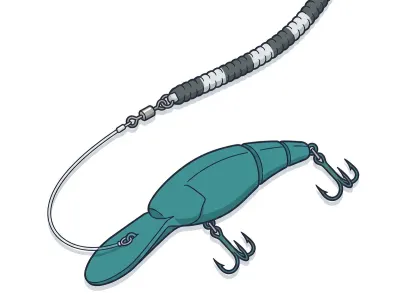
Leadcore Line + Crankbaits
4–5" mid-diving crankbait behind a long leadcore run
Northern pike · Soft plastics
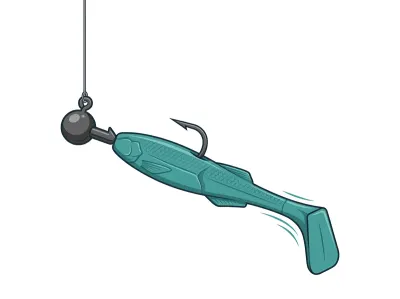
Paddletail Swimbait on Jighead
4–5" paddletail swimbait on a ball-head swimbait jighead
Northern pike · Muskie & pike
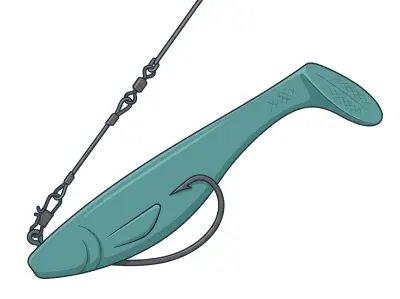
Soft Rubber (Bull Dawg / Medusa)
10" soft rubber body bait
Channel catfish · Live bait
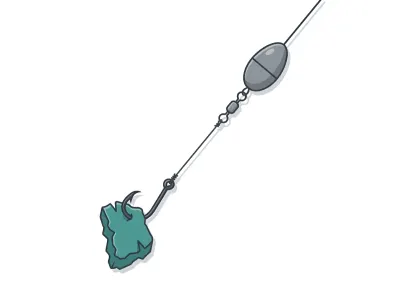
Sliding-Sinker Catfish Rig
cut sucker or shad
Full setups, including hooks, weights and line, are on the live map. As an Amazon Associate I earn from qualifying purchases.
MN DNR · in their words
From the 2025 survey
Colby is a 518-acre lake located immediately north of Hoyt Lakes. It is comparable to North and South Twin by Aurora, and Bailey's in downtown Virginia. The Partridge River runs through the lake and connects to the upper St. Louis River shortly downstream. This river connection makes Colby's fish community an outlier in the Tower Area. The lake was thermally stratified during the survey and had a surface temperature of 74 °F and a bottom temperature of 53 °F where the depth was 31 feet. Oxygen levels became inadequate for gamefish at 12 feet where the temperature was 63 °F. Secchi visibility was three feet, and the lake had a characteristically dark bog-stain. Aquatic vegetation is sparse in the west basin and relatively abundant in the eastern inlet bay. Shoreline substrates consist largely of boulder and rubble interspersed with areas of sand, muck, and gravel. Development is moderate for the Tower Area, with homes and cabins clustered on the southeast side of the lake adjacent to town along with the Laskin Energy powerplant on the northwest point. The remainder of the lake is largely undeveloped.
Total catch in gill nets (10.4/net) was below average compared to past surveys. Black crappie, northern pike, white sucker, and channel catfish represented the bulk of the catch. Walleye, bluegill, golden shiner, shorthead redhorse, yellow bullhead, and yellow perch were present in low abundances.
Read the full DNR narrative
Channel catfish abundance (0.9/gill net, 1.9/trap net) was above average for both gears but lower than in recent surveys. Lengths from combined gears ranged from 14.5 to 28 inches with an average length better than 19 inches. Channel catfish ranged from 4 to 15 years old, but almost all were greater than 10 years old. Colby and adjacent Whitewater provide a locally unique angling opportunity for the species, which is not present outside of the St. Louis River in northeast Minnesota.
Northern pike numbers (1.1/gill net) were slightly below average for Colby. Although fewer they were also larger, ranging from 23 to 31 inches with a solid average length of 26 inches the highest recorded out of Colby. The largest pike was sampled in a trap net at nearly 35 inches. Many of the pike sampled were infested with neascus, also known as black spot. It is a fish parasite harmless to humans and removed by cooking fish to temperature.
Walleye abundance (0.3/gill net) was below the long-term lake average, but typical for surveys since 2000 when fingerling stocking no longer contributed to the population. Lengths ranged from 11 to 22 inches with an average length approaching 17 inches. Walleyes ages ranged from two to seven years old. Walleye stocking was discontinued due to poor returns of fingerlings and evidence of natural reproduction.
Total catch in trap nets (16.1/net) was close to past surveys of Colby. Black crappie and bluegill were most common in the catch followed by northern pike and channel catfish. Low numbers of walleye, shorthead redhorse, hybrid sunfish, rock bass, white sucker, yellow bullhead, and yellow perch were also present.
The black crappie catch (4.3/trap net) was identical to the lake average but lower compared to the past two surveys. Sizes were typically small, ranging from 4 to 9.5 inches, with an average length of almost 8 inches which is in-line with past surveys. Gill nets sampled black crappie at a similar rate (4.3/net) with almost identical size structure. Ages ranged from one to nine years, with 2021 and 2019 the most abundant year classes. Growth was very slow for the Area, with mean length at age-4 below 7 inches.
Bluegill numbers (5.8/trap net) were average for Colby. Size structure continued a declining trend, with lengths ranging from 3.5 to 7 inches and an average length of less than 6 inches. Bluegill aged from scales ranged from 1 to 7 years with consistent recruitment. Growth was modest for the Area, with age-4 fish averaging 5 inches.
Narrative text from the Minnesota DNR lake survey.
Recent reports
Colby Lake fishing reports
Recent reports on Colby Lake from guides, tournaments and regular anglers. Anything posted in the last two weeks also bumps the matching spots on the live map, so you'll see a "matches a recent report" tag on them.
Public water access
Getting on the water
- Colby Lake (trailer launch)
DNR bathymetry
Colby Lake depth map
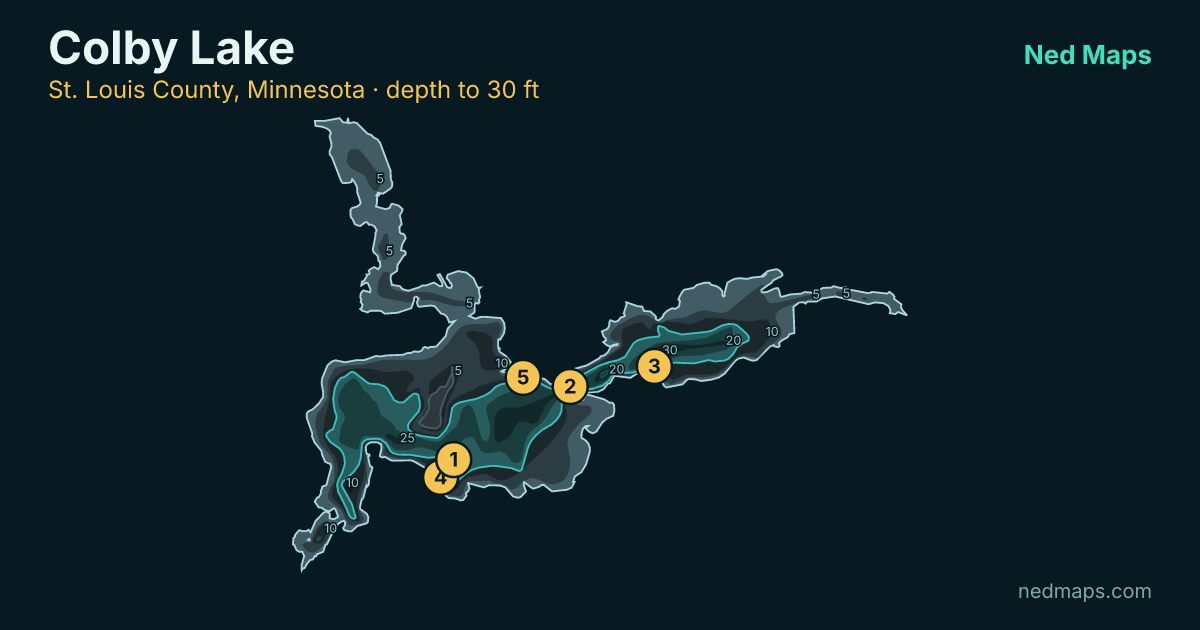
Within 30 miles
Nearby lakes
- Whitewater Lake · 1,212 ac · 1.9 mi
- St James Pit · 124 ac · 3.9 mi
- Bird Lake · 16 ac · 5.4 mi
- Sabin Lake · 156 ac · 6 mi
- Cedar Lake · 32 ac · 6.2 mi
- Wynne Lake · 279 ac · 6.8 mi
- North Twin Lake · 66 ac · 7.3 mi
- South Twin Lake · 118 ac · 7.3 mi
Quick answers
Frequently asked questions
How deep is Colby Lake?
Colby Lake reaches 30 ft at its deepest point; about 73% of the lake is littoral (15 ft or shallower).
How big is Colby Lake?
Colby Lake covers 518 acres with about 12 miles of shoreline.
How clear is the water in Colby Lake?
DNR Secchi readings on Colby Lake average 3.4 ft of visibility, on the stained end for a Minnesota lake.
What fish are in Colby Lake?
Minnesota DNR surveys (most recently 2025) record walleye, largemouth bass, northern pike, bluegill, crappie, yellow perch, rock bass, channel catfish.
Is Colby Lake stocked?
No stocking is on record for Colby Lake in the DNR's stocking database.
Does Colby Lake have a public access?
Yes. Colby Lake has one public access site: Colby Lake (trailer launch).
How big do walleye get in Colby Lake?
The biggest walleye measured in recent DNR surveys taped 22"; the size-history table on this page tracks the biggest fish in each survey back to 1995.
When was Colby Lake last surveyed?
The Minnesota DNR last surveyed Colby Lake in 2025, the most recent of 12 surveys on record.
Page updated .

Featured guide spot
Your guide service here
One featured guide per lake, with your photo, your writeup and a link straight to your booking page. Free through December 31, 2026.
Then $20 a month from January. Cancel any time.
The live map adds today's conditions and ranked spots for Colby Lake, plus a trip plan you can share:
Open Colby Lake on the live map → Fished it lately? Write a report