Minnesota · Rice County
Cedar Lake Fishing guide
Cedar Lake sits in Rice County, Minnesota, and covers 902 acres, reaching 42 ft at its deepest point. Secchi readings average around 2 ft of visibility. The Minnesota DNR has surveyed the lake 11 times, most recently in 2025, with walleye, largemouth bass, northern pike and bluegill in the nets.
DNR survey data
Fish species
WalleyeLast stocked 2025Fair numbers1.7per gill net22"Typical28"Biggest
Lengths measured · 40 fish
Recent · 2022 + 2025Lengths measured · 10 fish
2025Lengths measured · 30 fish
2022Lengths measured · 27 fish
2019Lengths measured · 61 fish
2016Largemouth bassFair numbers36.7per hr (electrofishing)8"Typical20"Biggest
Lengths measured · 141 fish
Recent · 2022 + 2025Lengths measured · 60 fish
2025Lengths measured · 81 fish
2022Lengths measured · 50 fish
2019Lengths measured · 48 fish
2016Northern pikeLast stocked 2023Just a few3.8per gill net24"Typical39"Biggest
Lengths measured · 86 fish
Recent · 2022 + 2025Lengths measured · 33 fish
2025Lengths measured · 53 fish
2022Lengths measured · 39 fish
2019Lengths measured · 62 fish
2016BluegillFair numbers46.6per trap net6"Typical9"Biggest
Lengths measured · 1610 fish
Recent · 2022 + 2025Lengths measured · 621 fish
2025Lengths measured · 989 fish
2022Lengths measured · 684 fish
2019Lengths measured · 859 fish
2016CrappieFair numbers15.8per trap net7"Typical13"Biggest
Lengths measured · 1212 fish
Recent · 2022 + 2025Lengths measured · 260 fish
2025Lengths measured · 952 fish
2022Lengths measured · 1120 fish
2019Lengths measured · 1002 fish
2016Yellow perchFair numbers1.2per gill net6"Typical8"Biggest
Lengths measured · 22 fish
Recent · 2022 + 2025Lengths measured · 14 fish
2025Lengths measured · 8 fish
2022Only 8 fish measured that year — too few to read as a shape.
Lengths measured · 49 fish
2019Lengths measured · 33 fish
2016Rates come from standard DNR survey gear (gill nets, trap nets, electrofishing), judged against statewide benchmarks for the same gear, so the same number of fish per net can read differently for two species. Where the standard gear can't count a species reliably, only presence and size are listed. Typical is the middle fish of those measured. Open a row for the full length spread, survey by survey.
How to fish Cedar Lake through the year
Walleye
- Spring
- Walleye are shallow, on and just off the spawning flats and the first green weeds. In 2 ft of visibility, they sit shallower than you think.
- Early summer
- Walleye are setting up on the outside weed edge, points and shallow structure.
- Summer
- Walleye are working the weed edge, points and any wind-blown structure. On a lake that drops to 42 ft, check the deep edge of that structure too.
- Fall
- Walleye are packing onto the sharpest breaks and points as the water cools, in big schools with short windows.
Largemouth bass
- Spring
- Largemouth are moving up into the warming bays and flats, staging around wood, docks and new weeds to spawn. In 2 ft of visibility, they sit shallower than you think.
- Early summer
- Largemouth are on the shallow spawning flats and protected bays, where beds go on firm bottom next to isolated cover.
- Summer
- Largemouth are in and along the weeds: cabbage and milfoil edges, matted cover and shade. On a lake that drops to 42 ft, check the deep edge of that structure too.
- Fall
- Largemouth are chasing bait back onto the flats and into the remaining green weeds, feeding hard and shallow before the freeze.
Season patterns for each species. Open the live map for today's wind, light and water temp.
Size history
Biggest fish by survey year
| Survey year | Walleye | Largemouth bass | Northern pike |
|---|---|---|---|
| 2025 | 28" | 20" | 34" |
| 2022 | 28" | 19" | 39" |
| 2019 | 27" | 21" | 30" |
| 2016 | 25" | 18" | 34" |
| 2012 | 26" | 20" | 29" |
| 2008 | 23" | 14" | 29" |
| 2001 | 24" | 17" | 27" |
| 1996 | 27" | 20" | 31" |
Longest fish measured by DNR survey crews in each year's nets. Survey gear samples the population, so the lake usually holds larger fish than any survey measured.
Suggested tackle
What to bring
Top presentations for this lake's structure and clarity:
Walleye · Live bait

Live-Bait (Lindy) Rig + Leech/Crawler
jumbo leech or half a nightcrawler
Walleye · Trolling
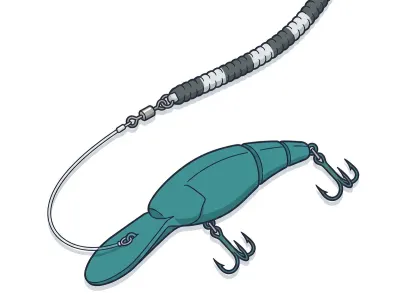
Leadcore Line + Crankbaits
4–5" mid-diving crankbait behind a long leadcore run
Largemouth bass · Soft plastics
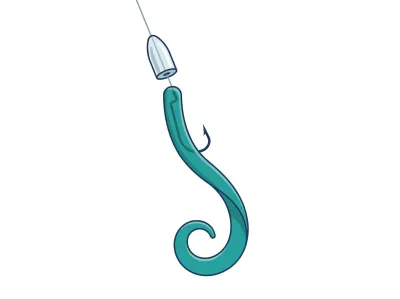
Texas-Rigged Worm
7" ribbon-tail or straight-tail plastic worm
Largemouth bass · Jigs & bladed
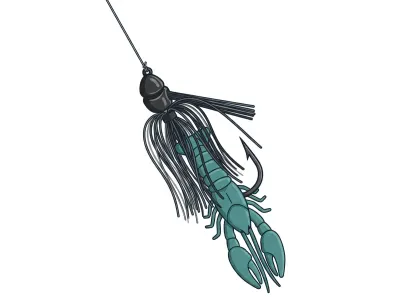
Skirted Casting Jig + Craw Trailer
3.5–4" craw-style trailer on a skirted casting/flipping jig
Northern pike · Soft plastics
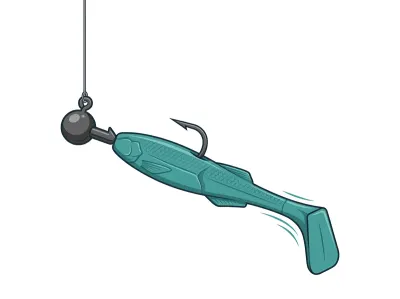
Paddletail Swimbait on Jighead
4–5" paddletail swimbait on a ball-head swimbait jighead
Northern pike · Jigs & bladed
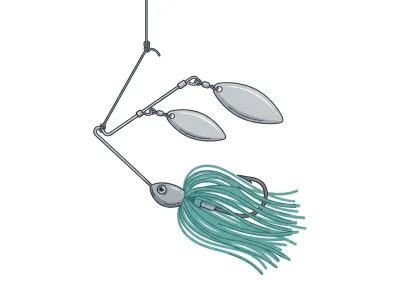
Spinnerbait
3/8–1/2 oz safety-pin spinnerbait with tandem willow-leaf blades
Full setups, including hooks, weights and line, are on the live map. As an Amazon Associate I earn from qualifying purchases.
DNR stocking records
Stocking history
| Year | Species | Stocked |
|---|---|---|
| 2025 | Walleye | 336,500 fry |
| 2023 | Northern Pike | 66,000 fry |
| 2023 | Walleye | 336,500 fry |
| 2022 | Northern Pike | 100,000 fry |
| 2022 | Walleye | 673,000 fry |
| 2021 | Northern Pike | 101,792 fry |
| 2019 | Northern Pike | 99,999 fry |
| 2018 | Northern Pike | 41,706 fry |
| 2018 | Walleye | 673,000 fry |
| 2017 | Northern Pike | 100,000 fry |
| 2016 | Northern Pike | 105,966 fry |
| 2016 | Walleye | 671,956 fry |
MN DNR · in their words
From the 2025 survey
Cedar Lake is a 902-acre lake located in Rice County west of Faribault. A DNR-maintained public access is located on the north end of the lake. The lake has a maximum depth of 42 feet. Cedar Lake is considered eutrophic with generally poor water clarity and frequent algae blooms caused by elevated nutrient levels. There are four islands located on Cedar Lake with the southern two maintained as public land. Although portions of Cedar Lake shoreline have been altered for residential development, the lake still offers quality fish habitat, including diverse aquatic vegetation, woody debris, and overhanging limbs. Cedar Lake is designated as an infested water body due to the presence of Eurasian Watermilfoil since 2001.
Cedar Lake is primarily managed for Black Crappie, Bluegill, and Largemouth Bass and secondarily for Northern Pike and Walleye. The management plan calls for stocking Walleye fry in odd years.
Read the full DNR narrative
Cedar Lake is designated as an Area tier-1 Lake and will be surveyed as part of a regularly scheduled monitoring program at a frequency of every 3 years. The 2025 survey was completed the week of July 28, 2025, using 8 gill nets, 12 trap nets, and 66 minutes of boat electrofishing. Water quality parameters were also measured.
Black Crappies were among the most abundant fish in the 2025 survey with a total of 133 sampled with gill nets for a catch rate of 16.6/net. Black Crappie ranged from 0.9 inches to 10.1 inches with an average of 8.0 inches. Black Crappie were also sampled in trap nets with a catch rate of 9.3/net with lengths ranging from 4.1 inches to 13.4 inches. Black Crappie from both gears ranged from age-1 to age-5 with 5 year-classes present. Black Crappie growth was relatively slow. Black Crappie recruitment remains high and consistent in Cedar Lake, but growth and size structure are poor.
Bluegills were the most abundant fish sampled with the trap nets with a total of 429 and a catch rate of 35.8/net. Bluegill ranged from 0.6 to 8.0 inches with an average of 5.2 inches. Bluegills were also common in the gill net sample with a catch rate of 24.1/net and lengths ranging from 3.9 to 8.0 inches. Bluegills ranged from age-1 to age-6 with 6 year-classes present. Age-2 to age-4 groups were all well represented, indicating strong and consistent recruitment. Bluegills are a draw to Cedar Lake for anglers looking for a meal of fish.
A total of 54 Largemouth Bass were sampled using targeted boat electrofishing during the spring of 2025 for a catch rate of 48.9/hour. Largemouth Bass catch rates rebounded in 2025 after steadily dropping in 5 previous samples from a high of 56.0/hour in 2004. Largemouth Bass ranged from 3.2 inches to 20.6 inches with an average of just 10.0 inches. Fish ranged from age-1 to age-6 with 6 year-classes represented suggesting recruitment was consistent year to year. Cedar Lake continues to support a strong Largemouth Bass fishery due to plentiful high-quality habitat and prey.
A total of 22 Northern Pike were sampled with gill nets for a catch rate of 2.8/net, down from 4.7/net in 2022. Catch rates have varied from 0.2/net to 11.2/net with an average of 3.2/net since 1996. Northern Pike ranged from 19.8 inches to 34.8 inches with an average of 24.3 inches. Although Northern Pike numbers may be lower than previous surveys, the quality size of these fish should draw anglers.
Walleye numbers remained low in 2025 with a catch rate of 1.0/net. Walleye ranged from 21.0 inches to 28.6 inches with an average of 24.0 inches. All Walleye were from the 2014 year class (age-11). Although Walleye numbers are low in Cedar Lake, there are some quality fish available to catch.
Very few Yellow Perch were sampled in 2025 with a trap net catch rate of 0.1/net and a gill net catch rate of1.8/net. Yellow Perch are an important prey species for predator fish, and their scarcity may be partially responsible for the ongoing struggles to improve the Cedar Lake Walleye fishery.
Yellow Bullhead were the most common of the bullhead species in 2025 (14.8/gill net) and Black Bullhead present at a rate of 0.3/ gill net. Yellow Bullheads averaged 11.9 inches with a maximum of 15.9 inches. Cedar Lake offers an excellent opportunity for those targeting large bullheads, if such an angler exists.
No Common Carp were sampled with gill nets and only 6 were sampled with trap nets in 2025. Catch ratches have remained low with an average of just 1.1/net since 1996. Negative impacts to lake habitat and water quality are likely negligible at such low levels but their presence remains a concern.
Other species sampled in 2025 include Bigmouth Buffalo, Bowfin (dogfish), Freshwater Drum (sheepshead), Golden Shiner, Pumpkinseed, White Bass, and White Crappie.
Water clarity was poor with a secchi depth of just 2.0 feet. Dissolved oxygen and water temperature readings ranged from 10.5 ppm and 80.1 degrees Fahrenheit at the surface to 0.1 ppm and 63.7 degrees Fahrenheit at 27 feet. A thermocline was detected around 15 feet.
Shoreline property owners also play an important role in the overall health of an aquatic ecosystem, including the fish population. Natural shorelines, including vegetation, woody debris, and bottom substrates, provide valuable habitat for fish and wildlife, help maintain water quality, and reduce bank erosion. Cattails and bulrushes are particularly beneficial for fish spawning, rearing, and feeding. By leaving natural shorelines unaltered or restoring them to natural conditions, shoreline property owners are doing their part to maintain or improve a healthy ecosystem in the lake and protect the resource for future generations.
-Tyler Fellows, fisheries specialist
Narrative text from the Minnesota DNR lake survey.
Recent reports
Cedar Lake fishing reports
Recent reports on Cedar Lake from guides, tournaments and regular anglers. Anything posted in the last two weeks also bumps the matching spots on the live map, so you'll see a "matches a recent report" tag on them.
Public water access
Getting on the water
- Cedar Lake (trailer launch)
DNR bathymetry
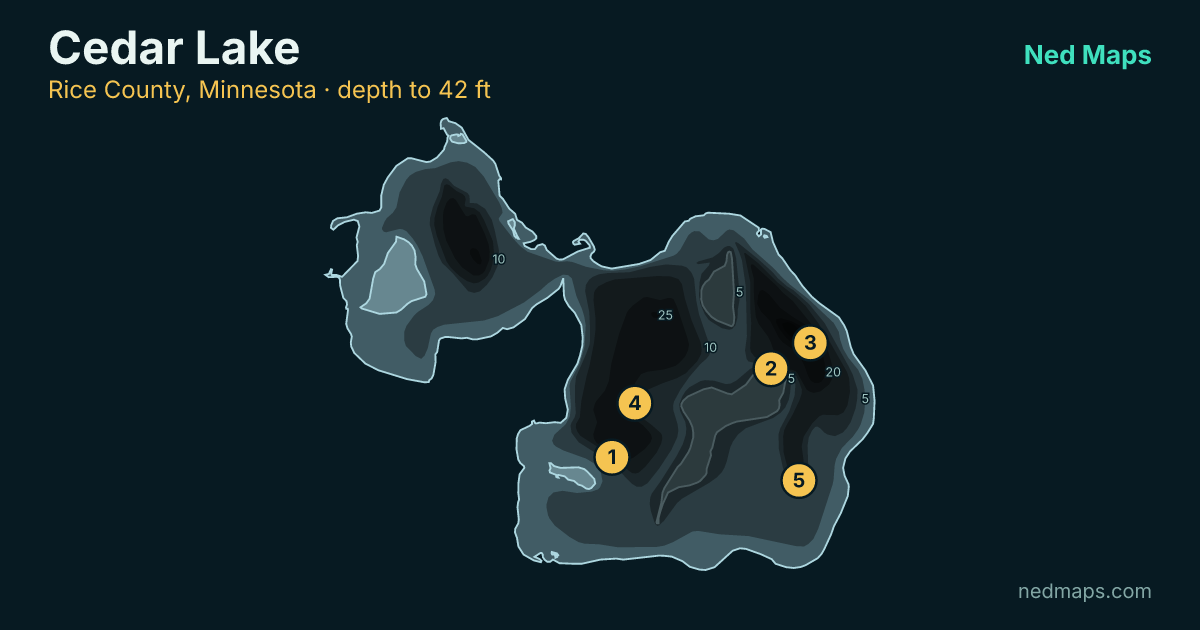
Cedar Lake depth map
Within 30 miles
Nearby lakes
- Caron Lake · 319 ac · 1.8 mi
- Hunt Lake · 176 ac · 2.5 mi
- Rice Lake · 331 ac · 3.3 mi
- French Lake · 876 ac · 3.6 mi
- Cannon Lake · 1,593 ac · 4 mi
- Roberds Lake · 632 ac · 4.9 mi
- Horseshoe Lake · 417 ac · 5 mi
- Shields Lake · 941 ac · 5.1 mi
Quick answers
Frequently asked questions
How deep is Cedar Lake?
Cedar Lake reaches 42 ft at its deepest point; about 75% of the lake is littoral (15 ft or shallower).
How big is Cedar Lake?
Cedar Lake covers 902 acres with about 11.3 miles of shoreline.
How clear is the water in Cedar Lake?
DNR Secchi readings on Cedar Lake average 2 ft of visibility, on the stained end for a Minnesota lake.
What fish are in Cedar Lake?
Minnesota DNR surveys (most recently 2025) record walleye, largemouth bass, northern pike, bluegill, crappie, yellow perch, white bass.
Is Cedar Lake stocked?
Yes. The DNR stocked walleye in 2025; the stocking table on this page lists every year back to 2016.
Does Cedar Lake have a public access?
Yes. Cedar Lake has one public access site: Cedar Lake (trailer launch).
How big do walleye get in Cedar Lake?
The biggest walleye measured in recent DNR surveys taped 28"; the size-history table on this page tracks the biggest fish in each survey back to 1996.
When was Cedar Lake last surveyed?
The Minnesota DNR last surveyed Cedar Lake in 2025, the most recent of 11 surveys on record.
Page updated .

Featured guide spot
Your guide service here
One featured guide per lake, with your photo, your writeup and a link straight to your booking page. Free through December 31, 2026.
Then $20 a month from January. Cancel any time.
The live map adds today's conditions and ranked spots for Cedar Lake, plus a trip plan you can share:
Open Cedar Lake on the live map → Fished it lately? Write a report