Minnesota · Stearns County
Carnelian Lake Fishing guide
Carnelian Lake covers 180 acres in Stearns County, Minnesota, reaching 36 ft at its deepest point. Secchi readings average around 10 ft of visibility. The Minnesota DNR has surveyed the lake 10 times, most recently in 2024, with walleye, largemouth bass, northern pike and bluegill in the nets.
DNR survey data
Fish species
Largemouth bassOne of the best around127.1per hr (electrofishing)11"Typical18"Biggest
Lengths measured · 240 fish
Recent · 2016Lengths measured · 240 fish
2016Lengths measured · 199 fish
2004Lengths measured · 13 fish
1994Northern pikeOne of the best around15.7per gill net17"Typical37"Biggest
Lengths measured · 124 fish
Recent · 2016Lengths measured · 124 fish
2016Lengths measured · 81 fish
2004Lengths measured · 30 fish
1994BluegillJust a few14.9per trap net6"Typical9"Biggest
Lengths measured · 276 fish
Recent · 2016 + 2024Lengths measured · 109 fish
2024Lengths measured · 365 fish
2016Lengths measured · 167 fish
2016Lengths measured · 276 fish
2015CrappieLast stocked 2025Just a few3.6per trap net9"Typical13"Biggest
Lengths measured · 520 fish
Recent · 2016 + 2024Lengths measured · 439 fish
2024Lengths measured · 81 fish
2016Lengths measured · 39 fish
2004Lengths measured · 14 fish
1994Rates come from standard DNR survey gear (gill nets, trap nets, electrofishing), judged against statewide benchmarks for the same gear, so the same number of fish per net can read differently for two species. Where the standard gear can't count a species reliably, only presence and size are listed. Typical is the middle fish of those measured. Open a row for the full length spread, survey by survey.
How to fish Carnelian Lake through the year
Bluegill
- Spring
- Bluegill are on the beds in firm-bottomed shallows, in colonies of dozens. On a clear lake those colonies sit deeper than you expect. At 10 ft of clarity, fish them deeper and lighter than usual.
- Early summer
- Bluegill are off the beds and onto the weed edges and brush, the biggest ones pulling out first.
- Summer
- Bluegill are on the deep weedline of a stratified lake, sliding out as the surface starts back down.
- Fall
- Bluegill are back up onto the flats and into the last green weeds, feeding hard while the shallows still hold heat.
Crappie
- Spring
- Crappie are up in the back bays and against wood in a few feet of water, spawning shallower than most people fish for them. At 10 ft of clarity, fish them deeper and lighter than usual.
- Early summer
- Crappie are pulling off the bays to the first deep weed edge and brush, still reachable shallow at dusk.
- Summer
- Crappie are over the basin of a stratified lake, well off any structure, which is why summer netting barely catches them inshore.
- Fall
- Crappie are schooled along the deep weedline and the basin edge, pushing shallow to feed at dusk while the water still turns over slowly.
Season patterns for each species. Open the live map for today's wind, light and water temp.
Size history
Biggest fish by survey year
| Survey year | Bluegill | Crappie | Largemouth bass |
|---|---|---|---|
| 2024 | 9" | 13" | — |
| 2016 | 9" | 11" | 18" |
| 2015 | 9" | — | — |
| 2004 | 9" | 10" | 19" |
| 1994 | 7" | 10" | 16" |
Longest fish measured by DNR survey crews in each year's nets. Survey gear samples the population, so the lake usually holds larger fish than any survey measured.
Suggested tackle
What to bring
Top presentations for this lake's structure and clarity:
Bluegill · Soft plastics
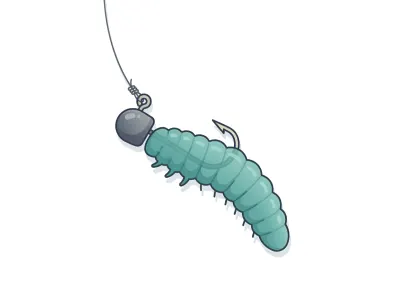
Tungsten Jig + Micro Plastic
1–1.5" micro plastic
Bluegill · Jigs & bladed
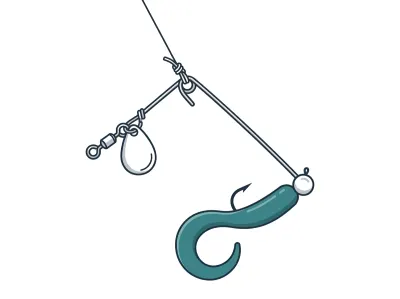
Beetle Spin
1.5–2" curly-tail grub trailer on a small in-line spinner jighead
Crappie · Soft plastics
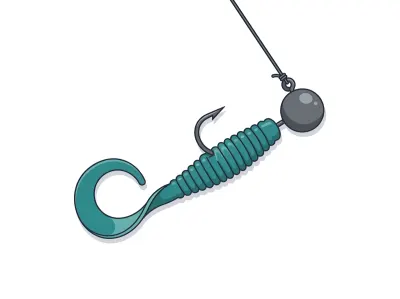
Curly-Tail Grub on Jig
3" curly-tail grub threaded on a round jighead
Crappie · Jigs & bladed
Beetle Spin
1.5–2" curly-tail grub trailer on a small in-line spinner jighead
Largemouth bass · Soft plastics
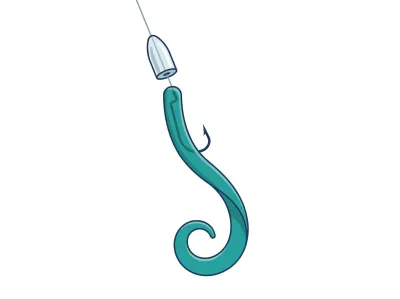
Texas-Rigged Worm
7" ribbon-tail or straight-tail plastic worm
Largemouth bass · Soft plastics
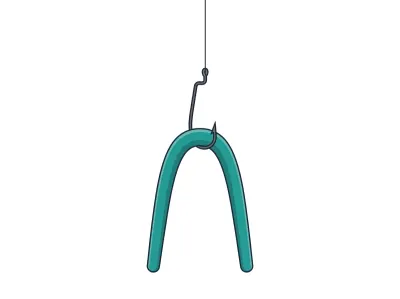
Wacky-Rigged Stickworm
5" stickworm
Full setups, including hooks, weights and line, are on the live map. As an Amazon Associate I earn from qualifying purchases.
DNR stocking records
Stocking history
| Year | Species | Stocked |
|---|---|---|
| 2025 | Black Crappie | 4,000 adults |
MN DNR · in their words
From the 2024 survey
A targeted Bluegill and Black Crappie assessment was conducted on Carnelian Lake from May 6-10, 2024. This assessment was conducted to update data last collected in a 2016 survey and to get an idea of the size structure of the spawning Bluegills and Black Crappie.
Carnelian Lake has had special regulations restricting the harvest of sunfish since 1996. In 1996, the sunfish bag limit was reduced from 30 to 10/day. This regulation was in place until 2007 when the sunfish bag limit was further reduced to five sunfish per day. The goal of the regulation is to reduce harvest and improve the average size of sunfish and the regulation was made permanent in 2017.
Read the full DNR narrative
A total of 109 bluegills were sampled during this assessment, which is less than the 365 sampled in 2016. Bluegill ranged in length from 3.4 to 9.9 inches with an average length of 6.8 inches. Sixty-six percent of Bluegill were six inches or longer with 38% also being eight inches or longer. Recent targeted Bluegill surveys in the Sauk Rapids Area have found the % > 6 inches ranged from 34 to 81 and % > 8 inches ranged from 0 to 39. Bluegill growth rates in Lake Carnelian were slow compared to the statewide average but were similar to the average for the Sauk Rapids Area for the first six years of life. The growth rates were fast for the Sauk Rapids Area for ages 7+ and more comparable to the statewide average, taking 7 years to reach 8 inches.
A total of 439 Black Crappie were sampled and ranged in length from 4.6 to 13.2 inches with an average length of 9.9 inches. Ninety-one percent of Black Crappie were eight inches or longer with 55% also being 10 inches or longer. Recent targeted panfish surveys in the Sauk Rapids Area have found the percent of Black Crappie > 8 inches ranged from 65 to 91 and % > 10 inches ranged from 35 to 64. Black Crappie growth rates were comparable to the Sauk Rapids Area average, taking 5 years to reach 10 inches.
In addition to Bluegill, Hybrid Sunfish were also sampled during the assessment and their lengths ranged from 4.1 to 9.5 inches, averaging 7.3 inches long.
The average replacement time for an eight-inch sunfish in the Sauk Rapids area is over 9 years. Therefore, anglers are encouraged to limit their harvest of larger Bluegill, especially the brightly colored adult males during the springtime when they are in the process of spawning and are more easily exploited by anglers. The larger male Bluegills are important to maintaining a healthy size structure because they restrict reproduction of smaller males, allowing the smaller males to put more energy into growth and less into reproduction. Anglers can help to maintain good fishing for Bluegill on Carnelian Lake by selectively harvesting medium sized females and releasing larger males.
Narrative text from the Minnesota DNR lake survey.
Recent reports
Carnelian Lake fishing reports
Recent reports on Carnelian Lake from guides, tournaments and regular anglers. Anything posted in the last two weeks also bumps the matching spots on the live map, so you'll see a "matches a recent report" tag on them.
Public water access
Getting on the water
- Carnelian Lake (trailer launch)
DNR bathymetry
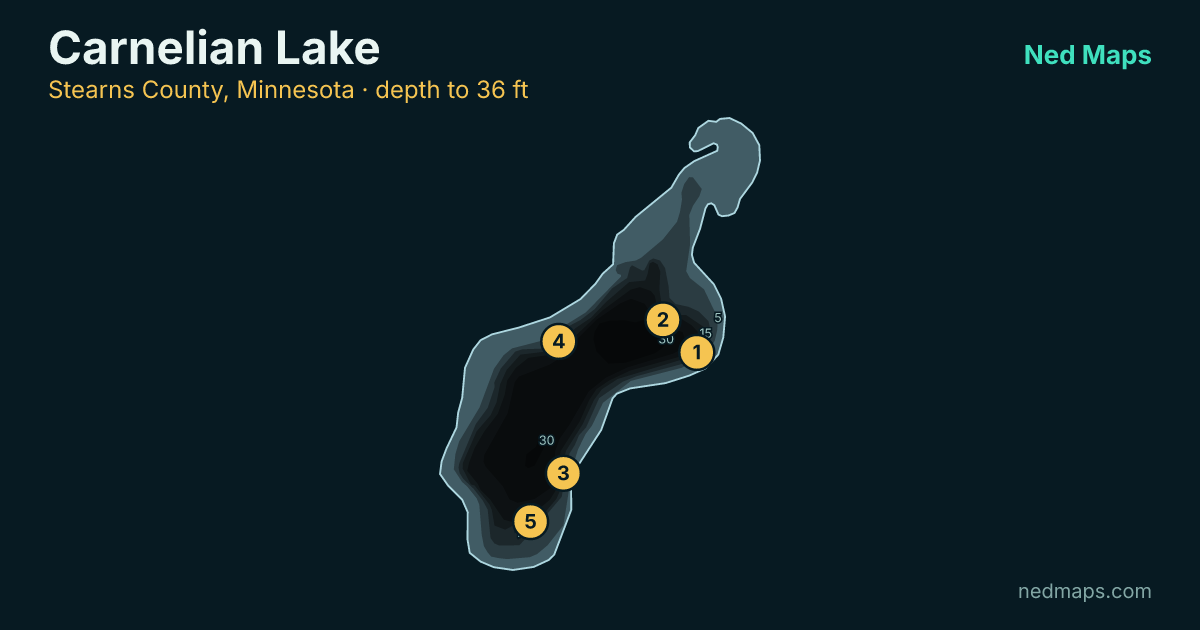
Carnelian Lake depth map
Within 30 miles
Nearby lakes
- School Section Lake · 211 ac · 2.6 mi
- Pearl Lake · 753 ac · 2.8 mi
- Beaver Lake · 112 ac · 3.3 mi
- Louisa Lake · 193 ac · 4.5 mi
- Marie Lake · 146 ac · 4.5 mi
- Caroline Lake · 137 ac · 5.1 mi
- Goodners Lake · 191 ac · 5.2 mi
- Grand Lake · 651 ac · 5.6 mi
Quick answers
Frequently asked questions
How deep is Carnelian Lake?
Carnelian Lake reaches 36 ft at its deepest point with a mean depth of 13.8 ft; about 35% of the lake is littoral (15 ft or shallower).
How big is Carnelian Lake?
Carnelian Lake covers 180 acres with about 3 miles of shoreline.
How clear is the water in Carnelian Lake?
DNR Secchi readings on Carnelian Lake average 10 ft of visibility, clear water for a Minnesota lake.
What fish are in Carnelian Lake?
Minnesota DNR surveys (most recently 2024) record walleye, largemouth bass, northern pike, bluegill, crappie, yellow perch.
Is Carnelian Lake stocked?
Yes. The DNR stocked black crappie in 2025.
Does Carnelian Lake have a public access?
Yes. Carnelian Lake has one public access site: Carnelian Lake (trailer launch).
How big do bluegill get in Carnelian Lake?
The biggest bluegill measured in recent DNR surveys taped 9"; the size-history table on this page tracks the biggest fish in each survey back to 1994.
When was Carnelian Lake last surveyed?
The Minnesota DNR last surveyed Carnelian Lake in 2024, the most recent of 10 surveys on record.
Page updated .

Featured guide spot
Your guide service here
One featured guide per lake, with your photo, your writeup and a link straight to your booking page. Free through December 31, 2026.
Then $20 a month from January. Cancel any time.
The live map adds today's conditions and ranked spots for Carnelian Lake, plus a trip plan you can share:
Open Carnelian Lake on the live map → Fished it lately? Write a report