Minnesota · Martin County
Budd Lake Fishing guide
Budd Lake sits in Martin County, Minnesota, and covers 228 acres, reaching 23 ft at its deepest point. Secchi readings average around 2.5 ft of visibility. The Minnesota DNR has surveyed the lake 12 times, most recently in 2025, with walleye, largemouth bass, northern pike and muskellunge in the nets.
DNR survey data
Fish species
WalleyeLast stocked 2025Fair numbers2.3per gill net16"Typical24"Biggest
Lengths measured · 29 fish
Recent · 2024Lengths measured · 29 fish
2024Lengths measured · 6 fish
2023Only 6 fish measured that year — too few to read as a shape.
Lengths measured · 9 fish
2020Only 9 fish measured that year — too few to read as a shape.
Lengths measured · 7 fish
2017Only 7 fish measured that year — too few to read as a shape.
No recent survey rating.
Present and managed by the DNR.
BluegillLast stocked 2025Just a few4.6per trap net5"Typical9"Biggest
Lengths measured · 41 fish
Recent · 2024Lengths measured · 41 fish
2024Lengths measured · 68 fish
2020Lengths measured · 59 fish
2017Lengths measured · 22 fish
2009CrappieFair numbers10.3per trap net6"Typical12"Biggest
Lengths measured · 162 fish
Recent · 2024Lengths measured · 162 fish
2024Lengths measured · 91 fish
2020Lengths measured · 118 fish
2017Lengths measured · 83 fish
2009Yellow perchLast stocked 2025Excellent numbers24.7per gill net7"Typical9"Biggest
Lengths measured · 84 fish
Recent · 2024Lengths measured · 84 fish
2024Lengths measured · 39 fish
2020Lengths measured · 3 fish
2017Only 3 fish measured that year — too few to read as a shape.
Lengths measured · 159 fish
2009Channel catfishGood numbers0.8per trap net17"Typical26"Biggest
Lengths measured · 12 fish
Recent · 2024Lengths measured · 12 fish
2024Lengths measured · 9 fish
2020Only 9 fish measured that year — too few to read as a shape.
Lengths measured · 57 fish
2017Lengths measured · 26 fish
2009Rates come from standard DNR survey gear (gill nets, trap nets, electrofishing), judged against statewide benchmarks for the same gear, so the same number of fish per net can read differently for two species. Where the standard gear can't count a species reliably, only presence and size are listed. Typical is the middle fish of those measured. Open a row for the full length spread, survey by survey.
How to fish Budd Lake through the year
Walleye
- Spring
- Walleye are shallow, on and just off the spawning flats and the first green weeds. In 2.5 ft of visibility, they sit shallower than you think.
- Early summer
- Walleye are setting up on the outside weed edge, points and shallow structure.
- Summer
- Walleye are working the weed edge, points and any wind-blown structure.
- Fall
- Walleye are packing onto the sharpest breaks and points as the water cools, in big schools with short windows.
Largemouth bass
- Spring
- Largemouth are moving up into the warming bays and flats, staging around wood, docks and new weeds to spawn. In 2.5 ft of visibility, they sit shallower than you think.
- Early summer
- Largemouth are on the shallow spawning flats and protected bays, where beds go on firm bottom next to isolated cover.
- Summer
- Largemouth are in and along the weeds: cabbage and milfoil edges, matted cover and shade.
- Fall
- Largemouth are chasing bait back onto the flats and into the remaining green weeds, feeding hard and shallow before the freeze.
Season patterns for each species. Open the live map for today's wind, light and water temp.
Size history
Biggest fish by survey year
| Survey year | Walleye | Largemouth bass | Muskellunge |
|---|---|---|---|
| 2025 | — | — | 42" |
| 2024 | 24" | 7" | — |
| 2023 | 8" | — | 34" |
| 2020 | 12" | — | — |
| 2017 | 28" | — | — |
| 2009 | 26" | 17" | — |
| 2001 | 22" | 10" | — |
| 1997 | 22" | 3" | — |
Longest fish measured by DNR survey crews in each year's nets. Survey gear samples the population, so the lake usually holds larger fish than any survey measured.
Suggested tackle
What to bring
Top presentations for this lake's structure and clarity:
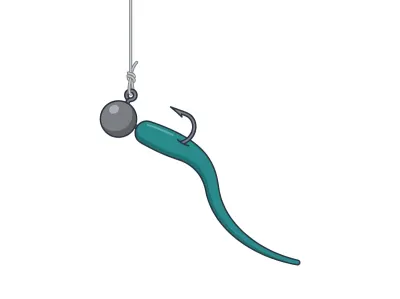
Walleye · Trolling
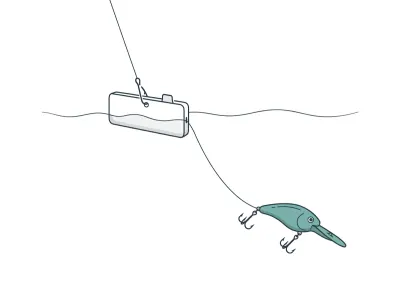
Planer Board Spread
4–6" crankbait or a 5–6 ft crawler harness run out to the side on an in-line planer board
Largemouth bass · Soft plastics
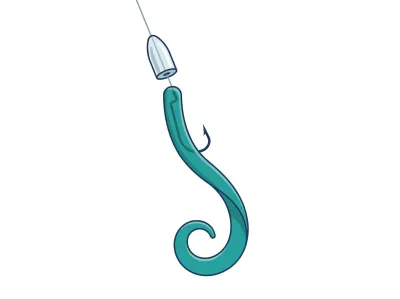
Texas-Rigged Worm
7" ribbon-tail or straight-tail plastic worm
Largemouth bass · Jigs & bladed
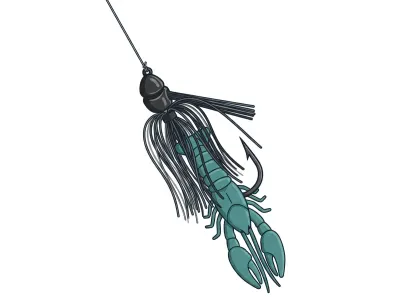
Skirted Casting Jig + Craw Trailer
3.5–4" craw-style trailer on a skirted casting/flipping jig
Muskellunge · Muskie & pike
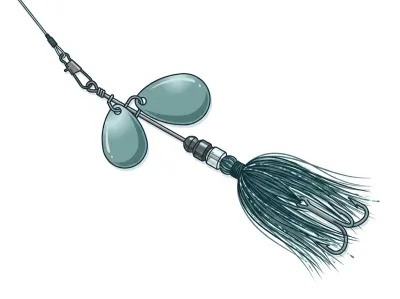
Double-10 Bucktail
9–10" double-10 bucktail
Muskellunge · Muskie & pike
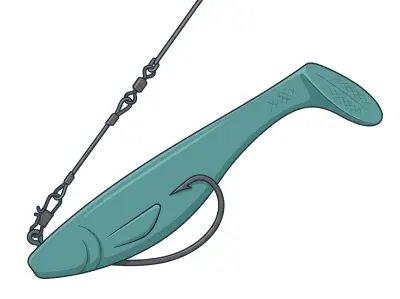
Soft Rubber (Bull Dawg / Medusa)
10" soft rubber body bait
Full setups, including hooks, weights and line, are on the live map. As an Amazon Associate I earn from qualifying purchases.
DNR stocking records
Stocking history
| Year | Species | Stocked |
|---|---|---|
| 2025 | Bluegill Sunfish | 2,500 adults |
| 2025 | Walleye | 55,500 fry |
| 2025 | Yellow Perch | 2,502 adults |
| 2024 | Muskellunge | 59 fingerlings |
| 2024 | Walleye | 55,500 fry · 214 yearlings |
| 2023 | Walleye | 55,500 fry |
| 2022 | Muskellunge | 59 fingerlings |
| 2022 | Walleye | 55,500 fry |
| 2021 | Muskellunge | 59 fingerlings |
| 2021 | Walleye | 55,000 fry |
| 2019 | Walleye | 55,500 fry · 1,251 fingerlings |
| 2018 | Muskellunge | 59 fingerlings |
Stocking records before 2018 omitted.
MN DNR · in their words
From the 2025 survey
Located within the City of Fairmont in Martin County, the "Fairmont Chain of Lakes" is an impoundment of Center Creek which is a tributary to the Blue Earth River and includes, from upstream to downstream, Amber Lake (182 acres), Hall Lake (548 acres), Budd Lake (227 acres), Sisseton Lake (138 acres), and George Lake (83 acres). The lakes are managed primarily for Walleye and Muskellunge and secondarily for Yellow Perch, Bluegill, and Crappie. Muskellunge are a recently new introduction to the Fairmont Chain of Lakes with an initial stocking in 2016. Muskellunge provide an apex predator population and biological control for undesired species along with an additional angling opportunity. Spring sampling utilizing electrofishing and cooperation with the commercial fisherman (seining) was used to collect Muskellunge for data collection to determine size and health of Muskie in the chain-of-lakes.
Muskie were first introduced to the Fairmont Chain of Lakes unsuccessfully in 1968 following a fish toxicant (rotenone) reclamation project in 1967. Those Muskie were stocked as fry (10,000 individuals estimated by weight) and typically do not survive well without proper nursery habitat. Since 1968, no Muskie were reported from that stocking. Additionally, the fish toxicant reclamation project had minimal success and undesirable species (Common Carp, Bigmouth Buffalo, Freshwater Drum, and Black Bullhead) continued to be abundant. Additionally, Yellow Bass were illegally introduced (most likely bucket stocked) in the Fairmont Chain of Lakes, with several first found in 2013, and have since established a self-sustaining population. To help control the undesirable fish populations and provide an additional angling opportunity, Muskellunge were re-introduced in 2016. Three hundred and fourteen Muskellunge fingerlings (over 10 inches but less than 15 inches) were stocked in 2016. The same number of Muskellunge were stocked again in 2018, 2021 (supposed to be 2020 but COVID-19 pandemic shut down egg-take operations), 2022, and 2024.
Read the full DNR narrative
Sampling, with large frame trap nets and electrofishing was first done during the spring of 2024. In 2024, zero Muskie were caught in large frame trap nets. Twelve Muskie were sampled in 12.7 hours of electrofishing for a catch rate of 0.95 Muskie per hour. One of the twelve Muskie was recaptured twice, so a total of 10 unique Muskie were sampled (fish are uniquely marked with PIT tags). Muskie sampled in 2024 averaged 38.4 inches with only 1 female Muskie (41 inches) and the rest male (average = 38.2 inches). In addition, 3 Muskie were caught by a commercial fisherman in Amber Lake and turned over to MN DNR to measure and release. Those 3 Muskie were 28.3 inches, 35.9 inches, and 36.3 inches. Sampling will continue throughout the entire Fairmont Chain of Lakes in 2025 and 2026. The Muskie population is still young and larger individuals should become part of the population over the next 5 to 10 years.
In 2025, seven Muskie were sampled using daytime electrofishing for a duration of 6.8 hours, resulting in a catch rate of 1.03 per hour of electrofishing, very similar to the 2024 catch rate of 0.94 per hour. An additional five Muskie were captured by commercial seine hauls in Hall, Budd, and George lakes. Eleven unique Muskie were captured in 2025 (Sisseton=3, Budd=6, Hall= 2 and George = 1). One Muskie was observed while electrofishing on Budd Lake, but could not be dipped, and was included in the catch rate. Lengths of Muskie sampled in 2025 ranged from 12.0 inches to 46.0 inches and averaged 31.0 inches. Based on Pit Tag identification numbers, captured Muskie had been stocked in 2016, 2018, and 2024. No fish stocked in 2021 and 2022 were sampled in the 2025 survey.
Narrative text from the Minnesota DNR lake survey.
Recent reports
Budd Lake fishing reports
Recent reports on Budd Lake from guides, tournaments and regular anglers. Anything posted in the last two weeks also bumps the matching spots on the live map, so you'll see a "matches a recent report" tag on them.
Public water access
Getting on the water
- Budd Lake (trailer launch)
- Budd Lake Fishing Pier (fishing pier)
DNR bathymetry
Budd Lake depth map
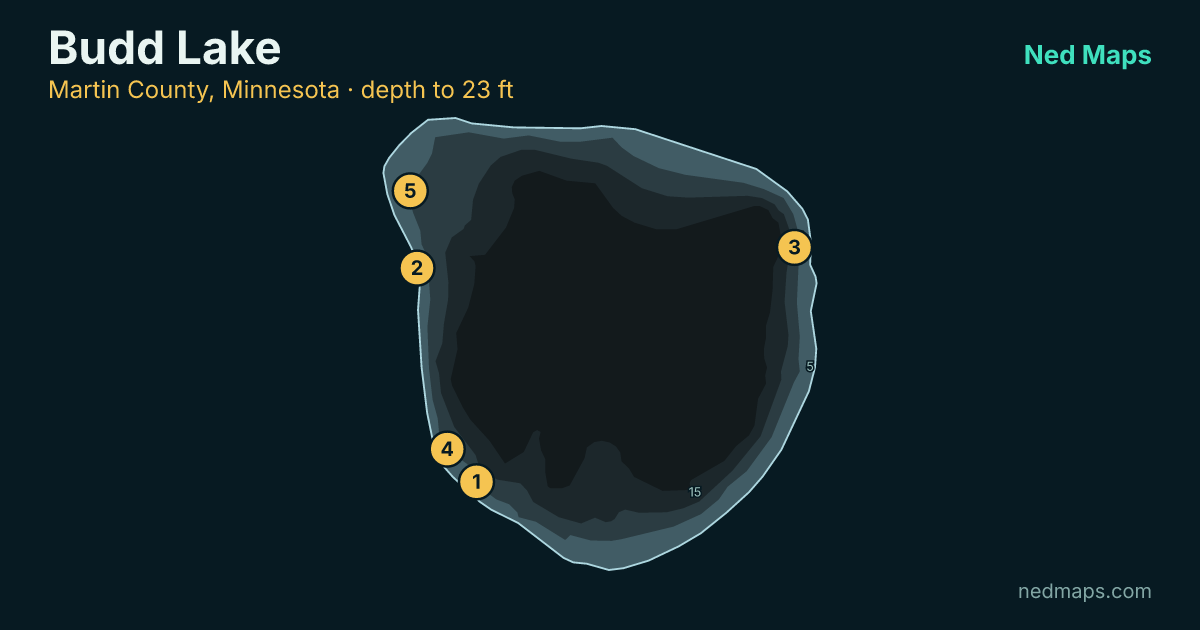
Within 30 miles
Nearby lakes
- Sisseton Lake · 138 ac · 0.8 mi
- Hall Lake · 548 ac · 1.2 mi
- George Lake · 83 ac · 1.5 mi
- Amber Lake · 182 ac · 2.3 mi
- Imogene Lake · 186 ac · 5 mi
- Willmert (main bay) Lake · 335 ac · 5.5 mi
- Bright Lake · 639 ac · 7.8 mi
- South Silver Lake · 252 ac · 8.4 mi
Quick answers
Frequently asked questions
How deep is Budd Lake?
Budd Lake reaches 23 ft at its deepest point; about 49% of the lake is littoral (15 ft or shallower).
How big is Budd Lake?
Budd Lake covers 228 acres with about 2.2 miles of shoreline.
How clear is the water in Budd Lake?
DNR Secchi readings on Budd Lake average 2.5 ft of visibility, on the stained end for a Minnesota lake.
What fish are in Budd Lake?
Minnesota DNR surveys (most recently 2025) record walleye, largemouth bass, northern pike, muskellunge, bluegill, crappie, yellow perch, channel catfish.
Is Budd Lake stocked?
Yes. The DNR stocked bluegill sunfish, walleye and yellow perch in 2025; the stocking table on this page lists every year back to 2018.
Does Budd Lake have a public access?
Yes. Budd Lake has 2 public access sites, including Budd Lake (trailer launch).
How big do walleye get in Budd Lake?
The biggest walleye measured in recent DNR surveys taped 24"; the size-history table on this page tracks the biggest fish in each survey back to 1997.
When was Budd Lake last surveyed?
The Minnesota DNR last surveyed Budd Lake in 2025, the most recent of 12 surveys on record.
Page updated .

Featured guide spot
Your guide service here
One featured guide per lake, with your photo, your writeup and a link straight to your booking page. Free through December 31, 2026.
Then $20 a month from January. Cancel any time.
The live map adds today's conditions and ranked spots for Budd Lake, plus a trip plan you can share:
Open Budd Lake on the live map → Fished it lately? Write a report