Minnesota · Freeborn County
Albert Lea Lake Fishing guide
Albert Lea Lake is a 2,669-acre lake in Freeborn County, Minnesota, reaching 5.5 ft at its deepest point. Secchi readings average around 2.2 ft of visibility. The Minnesota DNR has surveyed the lake 8 times, most recently in 2021, with walleye, largemouth bass, northern pike and bluegill in the nets.
DNR survey data
Fish species
WalleyeLast stocked 2025One of the best around16.7per gill net15"Typical24"Biggest
Lengths measured · 53 fish
Recent · 2021Lengths measured · 53 fish
2021Lengths measured · 12 fish
2018Lengths measured · 85 fish
2015Lengths measured · 155 fish
2010No recent survey rating.
BluegillJust a few7.4per trap net3"Typical6"Biggest
Lengths measured · 60 fish
Recent · 2021Lengths measured · 60 fish
2021Lengths measured · 48 fish
2018Lengths measured · 67 fish
2015Lengths measured · 199 fish
2010CrappieGood numbers24.7per trap net4"Typical8"Biggest
Lengths measured · 234 fish
Recent · 2021Lengths measured · 234 fish
2021Lengths measured · 458 fish
2018Lengths measured · 362 fish
2015Lengths measured · 444 fish
2010Yellow perchExcellent numbers18.3per gill net6"Typical10"Biggest
Lengths measured · 92 fish
Recent · 2021Lengths measured · 92 fish
2021Lengths measured · 122 fish
2018Lengths measured · 1573 fish
2015Lengths measured · 3014 fish
2010Rates come from standard DNR survey gear (gill nets, trap nets, electrofishing), judged against statewide benchmarks for the same gear, so the same number of fish per net can read differently for two species. Where the standard gear can't count a species reliably, only presence and size are listed. Typical is the middle fish of those measured. Open a row for the full length spread, survey by survey.
How to fish Albert Lea Lake through the year
Walleye
- Spring
- Walleye are shallow, on and just off the spawning flats and the first green weeds. In 2.2 ft of visibility, they sit shallower than you think.
- Early summer
- Walleye are setting up on the outside weed edge, points and shallow structure.
- Summer
- Walleye are working the weed edge, points and any wind-blown structure. With 100% of this lake 15 ft or shallower, the weed edge is the main event.
- Fall
- Walleye are packing onto the sharpest breaks and points as the water cools, in big schools with short windows. A 5.5-ft bowl cools fast, so the fall window comes early here.
Northern pike
- Spring
- Pike are in the shallow bays and along new weed growth. In 2.2 ft of visibility, they sit shallower than you think.
- Early summer
- Pike are on the outside weed edge and points.
- Summer
- Pike are on the deep weed edge and points near the coolest water they can find. With 100% of this lake 15 ft or shallower, the weed edge is the main event.
- Fall
- Pike are on the last green weeds and the breaks beside them, feeding heavily as the water drops. A 5.5-ft bowl cools fast, so the fall window comes early here.
Season patterns for each species. Open the live map for today's wind, light and water temp.
Size history
Biggest fish by survey year
| Survey year | Walleye | Northern pike | Yellow perch |
|---|---|---|---|
| 2021 | 24" | 30" | 10" |
| 2018 | 22" | 37" | 10" |
| 2015 | 17" | 34" | 9" |
| 2010 | 24" | 32" | 11" |
| 2006 | 18" | 20" | 11" |
| 2000 | 24" | 39" | 9" |
Longest fish measured by DNR survey crews in each year's nets. Survey gear samples the population, so the lake usually holds larger fish than any survey measured.
Suggested tackle
What to bring
Top presentations for this lake's structure and clarity:
Walleye · Live bait

Live-Bait (Lindy) Rig + Leech/Crawler
jumbo leech or half a nightcrawler
Walleye · Soft plastics
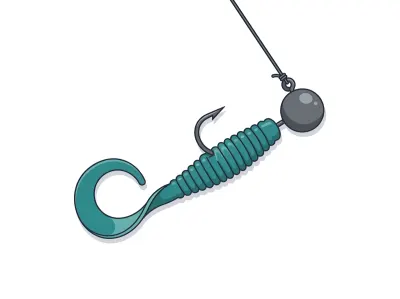
Curly-Tail Grub on Jig
3" curly-tail grub threaded on a round jighead
Northern pike · Jigs & bladed
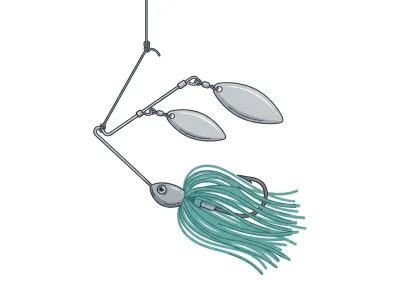
Spinnerbait
3/8–1/2 oz safety-pin spinnerbait with tandem willow-leaf blades
Northern pike · Jigs & bladed
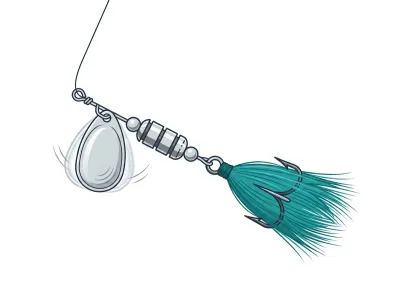
Inline Spinner (Mepps/Blue Fox)
#2–#4 in-line spinner
Yellow perch · Live bait
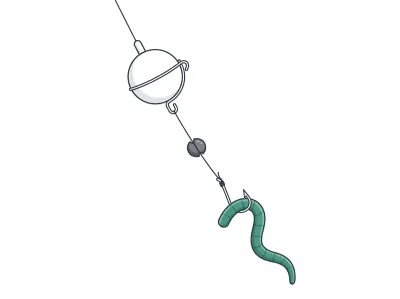
Clip-On Bobber + Worm
half to whole garden nightcrawler
Yellow perch · Soft plastics
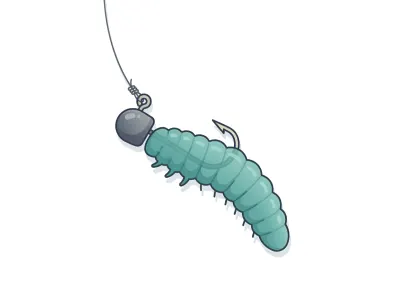
Tungsten Jig + Micro Plastic
1–1.5" micro plastic
Full setups, including hooks, weights and line, are on the live map. As an Amazon Associate I earn from qualifying purchases.
DNR stocking records
Stocking history
| Year | Species | Stocked |
|---|---|---|
| 2025 | Walleye | 2,654,000 fry |
| 2023 | Walleye | 2,665,703 fry |
| 2021 | Walleye | 2,654,086 fry |
| 2019 | Walleye | 2,654,000 fry |
| 2017 | Walleye | 2,657,052 fry |
MN DNR · in their words
From the 2021 survey
Albert Lea Lake is a 2,654-acre lake located in Freeborn County near the city of Albert Lea. A city-maintained public access is located on the northwest corner of the lake. Two DNR-maintained public accesses are located on the south side of the lake at Saint Nicholas Landing along County Road 19 and within Myre Big Island State Park. A county-maintained public access is located near the inlet channel along Frank Avenue. Albert Lea Lake is a nutrient-rich, shallow lake with a maximum depth of 5.5 feet and an average depth of only 3.5 feet. Albert Lea Lake is managed primarily for Walleye and secondarily for Bluegill, Black Crappie, Northern Pike, and Yellow Perch. Walleye fry are stocked every other year at a rate of 1,000 fry per littoral acre (about 2.6 million fry). The shallow, fertile waters of Albert Lea Lake are subject to periodic winterkill events. The most recent partial winterkill took place during the winter of 2013-14. After such events, walleye fry are stocked at a rate of 1,000/littoral acre the following spring. The connection to Fountain Lake provides a source for other species to repopulate the lake. Situations like this are managed as "boom and bust" fisheries, characterized by high survival and fast growth due to a temporary reduction of competition for resources. The "boom" years are typically 2-3 years post-winterkill, while the "bust" years are 0-1 year post-winterkill. Recent stocking events in Albert Lea include Walleye fry stocking in 2021, 2019, 2017, and 2015. About 3,675 Yellow Perch adults were also stocked in 2014 after the partial winterkill.
Albert Lea Lake was surveyed the week of June 14, 2021, as part of a standard survey program conducted by the Minnesota Department of Natural Resources. This survey was completed to assess the fish community by deploying 3 gill nets and 8 trap nets throughout the lake, as well as recording water quality parameters. A standard survey is used for sampling a wide range of fish species during the summer months using standard methods (standard time of year, set sampling stations, taking water clarity readings and oxygen/temperature profiles, etc.) and gears (lake survey gillnets, trap nets, and spring electrofishing for Largemouth Bass).
Read the full DNR narrative
A total of 50 Walleyes were sampled with gill nets for a catch rate of 16.7/net, which indicated high numbers were present. This represented a significant increase from the 2018 survey catch rate of 3.3/net. Since 2005, catch rates ranged from 3.3/net in 2018 to 60.5/net in 2006 with an average of 26.2/net. Walleye in 2021 ranged from 10.9 to 24.7 inches with an average of 16.0 inches. Four year classes were represented in the survey, 2019, 2018, 2017, and 2014. The high numbers of 2014 year class fish sampled in 2015 were almost nearly absent from the 2021 survey despite their being no evidence of winterkill since 2014. One possible explanation involved the newly constructed outlet and electric fish barrier. During high water or stressful periods in the lake, fish could exit the lake into the Shellrock River, unable to return to the lake.
A total of 59 Bluegills were sampled with trap nets for a catch rate of 7.4/net. Bluegills ranged from 3.2 to 6.7 inches with an average of 4.4 inches. The habitat in Albert Lea Lake remained largely unsuitable for Bluegill and their limited persistence in the lake was likely supported by emigration from Fountain Lake.
Black Crappie remain abundant in Albert Lea Lake with a total of 195 fish sampled with trap nets for a catch rate of 24.4/net. Black Crappie catch rates have exceeded 20.0/net with an average of 50.6/net in all 8 surveys dating back to 1984. Black Crappie ranged from 3.7 to 8.5 inches with an average of 5.3 inches. Black Crappies also sampled well in the gill nets with a catch rate of 13.0/net. Despite frequent winterkills, Black Crappies sourced from upstream Fountain Lake remained abundant in Albert Lea.
Only 2 Northern Pike were sampled with gill nets for a catch rate of 0.7/net, indicating low numbers were present. In five gill net surveys since 2005, only the 2018 survey exceeded 2.0/net. Northern Pike in Albert Lea Lake remained rare in 2021 but averaged nearly 27 inches. Southern Zone Northern Pike regulations are in effect for Albert Lea Lake. Anglers are allowed two Northern Pike which must be at least 24 inches long.
A total of 55 Yellow Perch were sampled with gill nets for a catch rate of 18.3/net. This represented the second lowest catch rate on record and failed to exceed 120/net for the second time since 2005. Fish were mostly small with an average length of 6.8 inches. Like Walleye, the population of Yellow Perch in Albert Lea Lake had drastically changed since the 2015 survey with no clear reason why.
Black Bullhead was the most common fish in the 2021 survey with a total of 393 sampled with gill nets for a catch rate of 131.0/net. Black Bullhead were sampled at historic high in 2018. Black Bullhead thrive in Albert Lea Lake due to shallow, fertile water and the lake's tendency to undergo stressful conditions in both winter and summer. Like Black Bullhead, Common Carp numbers dropped, down from an all-time high in 2018 (15.7/net) to only 3.3/net in 2021. This came as major local efforts to manage Common Carp numbers in the Shellrock River watershed had been implemented in recent years. Common Carp overabundance remains one of the biggest challenges to managing shallow, fertile lakes like Albert Lea Lake.
Other species sampled in 2021 include Channel Catfish, Golden Shiner, Goldfish, Green Sunfish, Hybrid Sunfish, Orangespotted Sunfish, Tadpole Madtom, White Crappie, White Sucker, and Yellow Bullhead.
Shoreline property owners also play an important role in the overall health of an aquatic ecosystem, including the fish population. Natural shorelines, including vegetation, woody debris, and bottom substrates, provide valuable habitat for fish and wildlife, help maintain water quality, and reduce bank erosion. Cattails and bulrushes are particularly beneficial for fish spawning, rearing, and feeding. By leaving natural shorelines unaltered or restoring them to natural conditions, shoreline property owners are doing their part to maintain or improve a healthy ecosystem in the lake and protect the resource for future generations.
-Tyler Fellows, fisheries specialist
Narrative text from the Minnesota DNR lake survey.
Recent reports
Albert Lea Lake fishing reports
Recent reports on Albert Lea Lake from guides, tournaments and regular anglers. Anything posted in the last two weeks also bumps the matching spots on the live map, so you'll see a "matches a recent report" tag on them.
Public water access
Getting on the water
- Albert Lea Lake, Frank Hall Park (trailer launch)
- Albert Lea Lake, Myre Big Island SPK (trailer launch)
- Albert Lea Lake, St. Nicholas Landing (trailer launch)
- Albert Lea Lake Fishing Pier (fishing pier)
- Albert Lea Lake Fishing Pier, Myre-Big Island State Park (fishing pier)
DNR bathymetry
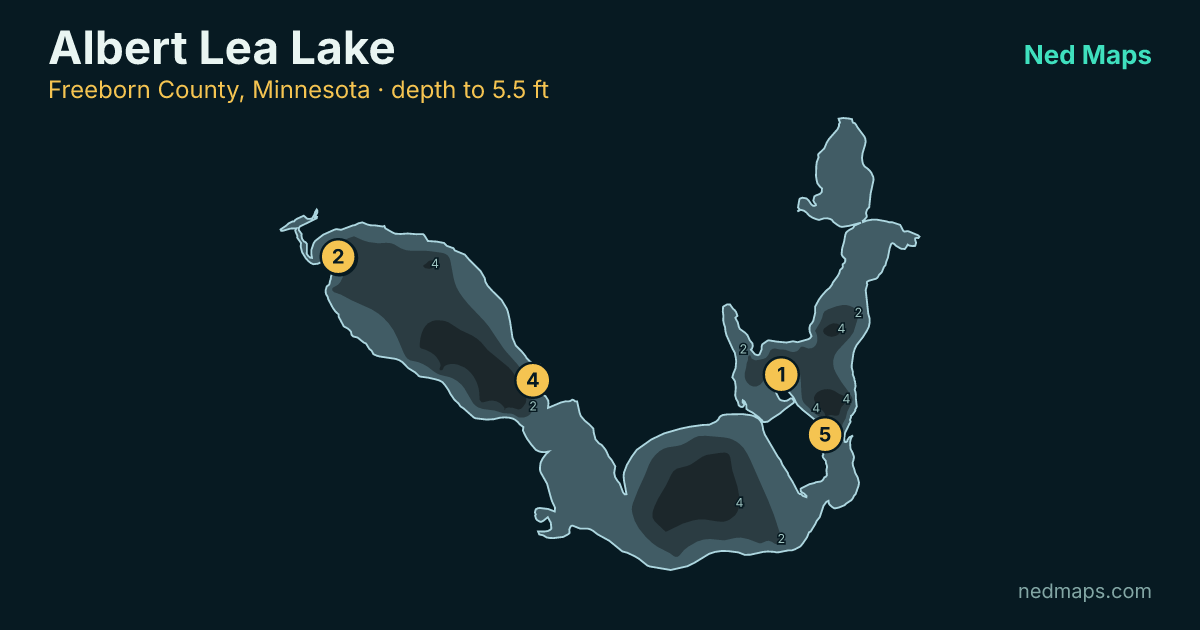
Albert Lea Lake depth map
Within 30 miles
Nearby lakes
- Fountain Lake · 522 ac · 4.1 mi
- Pickeral Lake · 588 ac · 5 mi
- White Lake · 168 ac · 5.5 mi
- Bear Lake · 1,033 ac · 11.4 mi
- State Line Lake · 372 ac · 12.1 mi
- Morin Lake · 21 ac · 13.8 mi
- Freeborn Lake · 2,034 ac · 14.9 mi
- Mill Pond · 18 ac · 17 mi
Quick answers
Frequently asked questions
How deep is Albert Lea Lake?
Albert Lea Lake reaches 5.5 ft at its deepest point with a mean depth of 3.5 ft; about 100% of the lake is littoral (15 ft or shallower).
How big is Albert Lea Lake?
Albert Lea Lake covers 2,669 acres with about 23.8 miles of shoreline.
How clear is the water in Albert Lea Lake?
DNR Secchi readings on Albert Lea Lake average 2.2 ft of visibility, on the stained end for a Minnesota lake.
What fish are in Albert Lea Lake?
Minnesota DNR surveys (most recently 2021) record walleye, largemouth bass, northern pike, bluegill, crappie, yellow perch, channel catfish.
Is Albert Lea Lake stocked?
Yes. The DNR stocked walleye in 2025; the stocking table on this page lists every year back to 2017.
Does Albert Lea Lake have a public access?
Yes. Albert Lea Lake has 5 public access sites, including Albert Lea Lake, Frank Hall Park (trailer launch).
How big do walleye get in Albert Lea Lake?
The biggest walleye measured in recent DNR surveys taped 24"; the size-history table on this page tracks the biggest fish in each survey back to 2000.
When was Albert Lea Lake last surveyed?
The Minnesota DNR last surveyed Albert Lea Lake in 2021, the most recent of 8 surveys on record.
Page updated .

Featured guide spot
Your guide service here
One featured guide per lake, with your photo, your writeup and a link straight to your booking page. Free through December 31, 2026.
Then $20 a month from January. Cancel any time.
The live map adds today's conditions and ranked spots for Albert Lea Lake, plus a trip plan you can share:
Open Albert Lea Lake on the live map → Fished it lately? Write a report