Minnesota · St. Louis County
White Iron Lake Fishing guide
White Iron Lake sits in St. Louis County, Minnesota, and covers 3,238 acres, reaching 47 ft at its deepest point. Secchi readings average around 5.7 ft of visibility. The Minnesota DNR has surveyed the lake 17 times, most recently in 2023, with walleye, largemouth bass, smallmouth bass and northern pike in the nets.
DNR survey data
Fish species
WalleyeGood numbers5.3per gill net13"Typical25"Biggest
Lengths measured · 69 fish
Recent · 2023Lengths measured · 69 fish
2023Lengths measured · 78 fish
2020Lengths measured · 117 fish
2017Lengths measured · 63 fish
2014No recent survey rating.
Northern pikeJust a few2.8per gill net20"Typical33"Biggest
Lengths measured · 60 fish
Recent · 2023Lengths measured · 60 fish
2023Lengths measured · 27 fish
2020Lengths measured · 50 fish
2017Lengths measured · 40 fish
2014BluegillJust a few1.2per trap net5"Typical6"Biggest
Lengths measured · 18 fish
Recent · 2023Lengths measured · 18 fish
2023Lengths measured · 32 fish
2017Lengths measured · 17 fish
2014Lengths measured · 13 fish
2011CrappieJust a few0.7per trap net9"Typical13"Biggest
Lengths measured · 11 fish
Recent · 2023Lengths measured · 11 fish
2023Lengths measured · 1 fish
2020Only 1 fish measured that year — too few to read as a shape.
Lengths measured · 7 fish
2017Only 7 fish measured that year — too few to read as a shape.
Lengths measured · 29 fish
2014Yellow perchGood numbers4.5per gill net6"Typical11"Biggest
Lengths measured · 74 fish
Recent · 2023Lengths measured · 74 fish
2023Lengths measured · 48 fish
2020Lengths measured · 143 fish
2017Lengths measured · 98 fish
2014Last recorded in the 2014 survey and not seen since.
Rock bassGood numbers1.3per trap net8"Typical10"Biggest
Lengths measured · 25 fish
Recent · 2023Lengths measured · 25 fish
2023Lengths measured · 11 fish
2020Lengths measured · 15 fish
2017Lengths measured · 38 fish
2014Rates come from standard DNR survey gear (gill nets, trap nets, electrofishing), judged against statewide benchmarks for the same gear, so the same number of fish per net can read differently for two species. Where the standard gear can't count a species reliably, only presence and size are listed. Typical is the middle fish of those measured. Open a row for the full length spread, survey by survey.
How to fish White Iron Lake through the year
Walleye
- Spring
- Walleye are shallow, on and just off the spawning flats and the first green weeds.
- Early summer
- Walleye are setting up on the outside weed edge, points and shallow structure.
- Summer
- Walleye are working the weed edge, points and any wind-blown structure. On a lake that drops to 47 ft, check the deep edge of that structure too.
- Fall
- Walleye are packing onto the sharpest breaks and points as the water cools, in big schools with short windows.
Smallmouth bass
- Spring
- Smallmouth are on shallow rock, gravel and sand where they spawn.
- Early summer
- Smallmouth are post-spawn on rock points, gravel bars and the adjacent breaks.
- Summer
- Smallmouth are on rock humps, points and hard-bottom breaks. On a lake that drops to 47 ft, check the deep edge of that structure too.
- Fall
- Smallmouth are bunched tight on deep rock, so find one and you have found the school.
Season patterns for each species. Open the live map for today's wind, light and water temp.
Size history
Biggest fish by survey year
| Survey year | Walleye | Smallmouth bass | Northern pike |
|---|---|---|---|
| 2023 | 25" | 10" | 33" |
| 2020 | 25" | — | 38" |
| 2017 | 26" | 19" | 39" |
| 2014 | 21" | 14" | 43" |
| 2011 | 23" | 15" | 35" |
| 2010 | 29" | 17" | 43" |
| 2008 | 26" | 18" | 43" |
| 2004 | 27" | 16" | 33" |
Longest fish measured by DNR survey crews in each year's nets. Survey gear samples the population, so the lake usually holds larger fish than any survey measured.
Suggested tackle
What to bring
Top presentations for this lake's structure and clarity:
Walleye · Live bait
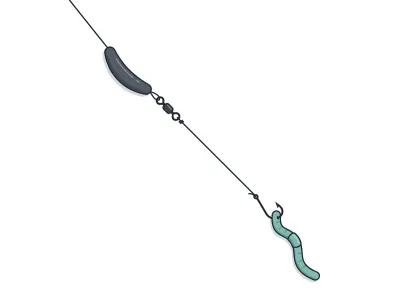
Live-Bait (Lindy) Rig + Leech/Crawler
jumbo leech or half a nightcrawler
Walleye · Trolling
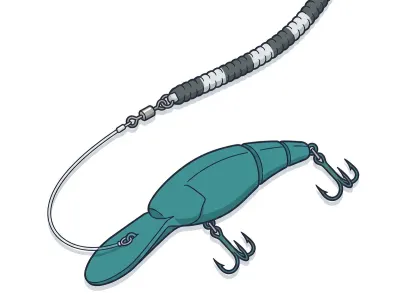
Leadcore Line + Crankbaits
4–5" mid-diving crankbait behind a long leadcore run
Smallmouth bass · Soft plastics
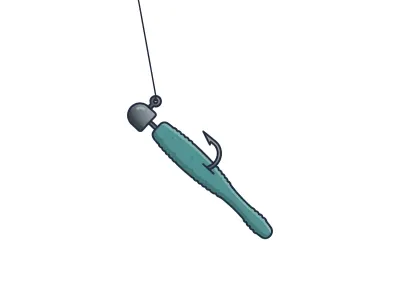
Ned Rig
2.75" finesse stickbait or craw-style Ned bait
Smallmouth bass · Soft plastics
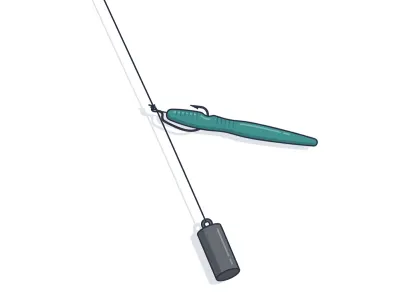
Drop Shot (Finesse Plastic)
4" finesse worm or 3" minnow-profile plastic
Northern pike · Soft plastics
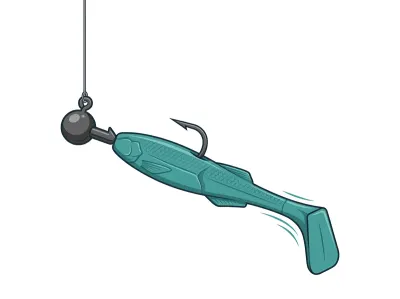
Paddletail Swimbait on Jighead
4–5" paddletail swimbait on a ball-head swimbait jighead
Northern pike · Muskie & pike
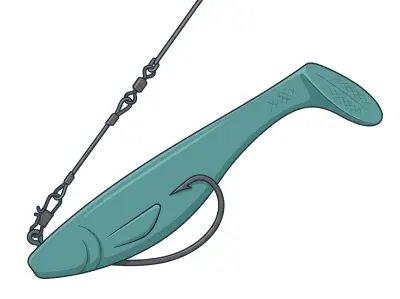
Soft Rubber (Bull Dawg / Medusa)
10" soft rubber body bait
Full setups, including hooks, weights and line, are on the live map. As an Amazon Associate I earn from qualifying purchases.
MN DNR · in their words
From the 2023 survey
White Iron Lake is fairly large, at 3,246 acres, and is three miles southeast of Ely. The lake has two public access with concrete boat ramps, both on the west side of the lake. White Iron Lake can also be accessed by boat from the Garden Reservoir via Farm Lake. Water levels on the lake are affected seasonally by a hydroelectric dam at the outlet of Garden Lake.
The 2018 lake management plan for White Iron Lake (White Iron) lists walleye as the primary management species and northern pike, smallmouth bass, and black crappie as secondary species. A standard survey was conducted in early fall 2023 to assess the populations of these species, especially walleye and northern pike which have special regulations, and to monitor lake quality and habitat. The survey crew sampled fish with gill nets and trap nets, and they measured water quality. White Iron was well mixed, with a water temperature of 64 F from the surface to 25 feet deep. Oxygen levels were adequate for all fish species throughout the water column. White Iron has brown, bog-stained water with visibility around 5 feet. Shoreline substrates are predominantly rocky, although some of the bays have muck bottoms and fair amounts of aquatic vegetation.
Read the full DNR narrative
Walleye harvest by anglers on White Iron is restricted with a special regulation that requires the release of all fish from 17 to 26 inches, with only one fish over 26 inches allowed in a 6-fish limit. This regulation, which also applies to the Garden Reservoir lakes, has been in place since 2006 and the goal has been to maintain overall catch rates while increasing the number of fish over 17 inches. The gill-net catch for walleye was lower than the historic median for the lake. Walleye averaged 14.7 inches in length and 47% of the fish sampled were over 14.0 inches. The catch rate of walleye over 17 inches was 1.6 fish/net, which was slightly higher than the historic median. A few walleye were also caught in trap nets and were larger, at 22.4 inches long on average. Walleye growth was fairly slow, as it took the average fish between 5 and 6 years to reach 15 inches in length. Walleye ages ranged from 0 to 19 years old.
Northern pike (pike) harvest by anglers on White Iron is restricted with a special regulation that requires the release of all fish from 24 to 36 inches, with only one fish over 36 inches allowed in a 3-fish limit. This regulation, which applies to all the connected lakes mentioned above, has been in place since 2003 with the goal of maintaining the overall catch rate and increasing the abundance of larger pike. In this survey, the gill-net catch for pike was slightly higher than the historic median for the lake. The fish averaged 21.2 inches in length, which was smaller than the historical average for the lake and a decline from the previous three surveys. Additional pike were caught in trap nets, and these fish tended to be smaller, averaging just 18.2 inches. However, pike greater than 30 inches were sampled in both gill nets and trap nets.
Bluegill were caught at rates that were above average for the lake. However, these fish were smaller than in previous surveys with an average length of just 5.4 inches. Bluegill ages ranged from 3 to 8 years.
Black crappie were caught at rates that were below the historic median for the lake. Black crappie averaged 9.7 inches in length. The largest black crappie sampled was 13.4 inches long, and ages ranged from 3 to 9.
Additional species sampled in 2023 included cisco, golden shiner, rock bass, smallmouth bass, white sucker, and yellow perch.
Narrative text from the Minnesota DNR lake survey.
Recent reports
White Iron Lake fishing reports
Recent reports on White Iron Lake from guides, tournaments and regular anglers. Anything posted in the last two weeks also bumps the matching spots on the live map, so you'll see a "matches a recent report" tag on them.
Open the live map → Fished it lately? Write a report
All White Iron Lake fishing reports → · St. Louis County reports
Public water access
Getting on the water
- White Iron Lake (trailer launch)
- White Iron Lake (trailer launch)
DNR bathymetry
White Iron Lake depth map
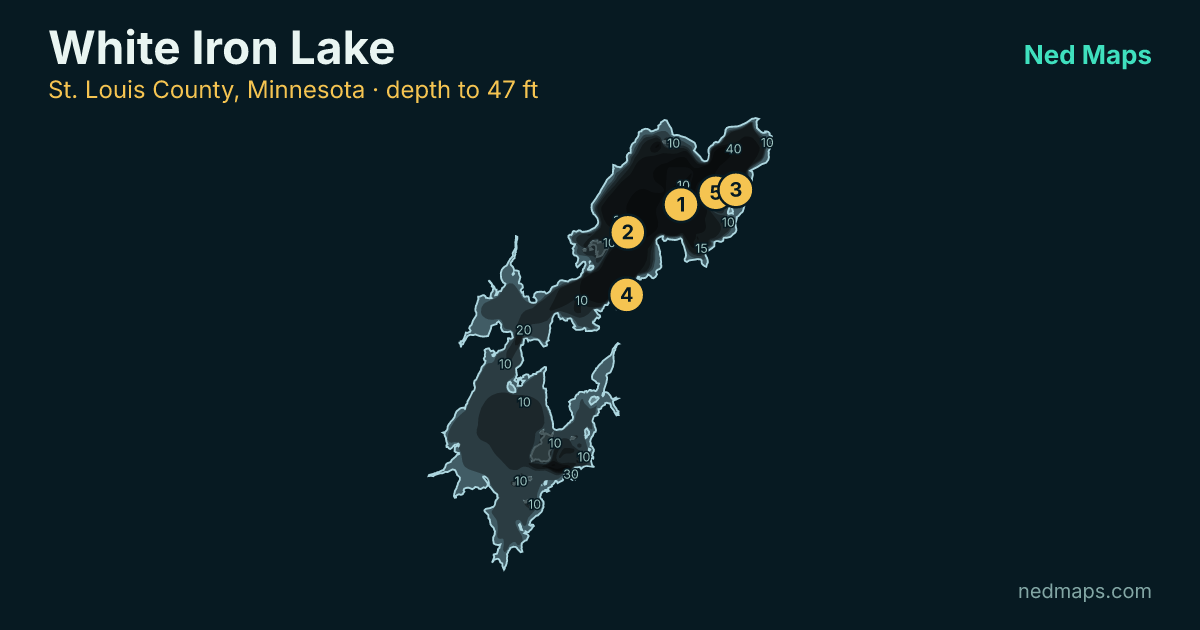
Within 30 miles
Nearby lakes
- Miner's Pit · 141 ac · 3.8 mi
- Farm Lake · 1,292 ac · 4.1 mi
- Garden Lake · 653 ac · 4.4 mi
- Shagawa Lake · 2,345 ac · 5.2 mi
- South Farm Lake · 564 ac · 5.2 mi
- One Pine Lake · 354 ac · 5.3 mi
- Mitchell Lake · 248 ac · 5.7 mi
- Cedar Lake · 465 ac · 6.1 mi
Quick answers
Frequently asked questions
How deep is White Iron Lake?
White Iron Lake reaches 47 ft at its deepest point; about 50% of the lake is littoral (15 ft or shallower).
How big is White Iron Lake?
White Iron Lake covers 3,238 acres with about 35.5 miles of shoreline.
How clear is the water in White Iron Lake?
DNR Secchi readings on White Iron Lake average 5.7 ft of visibility, middling clarity for a Minnesota lake.
What fish are in White Iron Lake?
Minnesota DNR surveys (most recently 2023) record walleye, largemouth bass, smallmouth bass, northern pike, bluegill, crappie, yellow perch, tiger muskellunge, rock bass.
Is White Iron Lake stocked?
No stocking is on record for White Iron Lake in the DNR's stocking database.
Does White Iron Lake have a public access?
Yes. White Iron Lake has 2 public access sites, including White Iron Lake (trailer launch).
How big do walleye get in White Iron Lake?
The biggest walleye measured in recent DNR surveys taped 25"; the size-history table on this page tracks the biggest fish in each survey back to 2004.
When was White Iron Lake last surveyed?
The Minnesota DNR last surveyed White Iron Lake in 2023, the most recent of 17 surveys on record.
Page updated .

Featured guide spot
Your guide service here
One featured guide per lake, with your photo, your writeup and a link straight to your booking page. Free through December 31, 2026.
Then $20 a month from January. Cancel any time.
The live map adds today's conditions and ranked spots for White Iron Lake, plus a trip plan you can share:
Open White Iron Lake on the live map → Fished it lately? Write a report