Minnesota · St. Louis County
Vermilion Lake Fishing guide
Vermilion Lake is a 39,272-acre lake in St. Louis County, Minnesota, reaching 76 ft at its deepest point. Secchi readings average around 7.6 ft of visibility. The Minnesota DNR has surveyed the lake 42 times, most recently in 2025, with walleye, largemouth bass, smallmouth bass and northern pike in the nets.
DNR survey data
Fish species
WalleyeLast stocked 2025One of the best around16.4per gill net6"Typical29"Biggest
Lengths measured · 4171 fish
Recent · 2021 + 2022 + 2023 + 2024 + 2025Lengths measured · 904 fish
2025Lengths measured · 936 fish
2024Lengths measured · 24 fish
2024Lengths measured · 691 fish
2023Smallmouth bassOne of the best around94.2per hr (electrofishing)9"Typical18"Biggest
Lengths measured · 618 fish
Recent · 2021 + 2022 + 2023 + 2024 + 2025Lengths measured · 272 fish
2025Lengths measured · 8 fish
2024Only 8 fish measured that year — too few to read as a shape.
Lengths measured · 1 fish
2024Only 1 fish measured that year — too few to read as a shape.
Lengths measured · 16 fish
2023Northern pikeJust a few0.7per gill net27"Typical38"Biggest
Lengths measured · 80 fish
Recent · 2021 + 2022 + 2023 + 2024 + 2025Lengths measured · 21 fish
2025Lengths measured · 14 fish
2024Lengths measured · 12 fish
2024Lengths measured · 12 fish
2023MuskellungeLast stocked 2025Present, stockedPresent and managed by the DNR.
Present and managed by the DNR.
Lengths measured · 11 fish
Recent · 2024 + 2025Lengths measured · 3 fish
2025Only 3 fish measured that year — too few to read as a shape.
Lengths measured · 2 fish
2024Only 2 fish measured that year — too few to read as a shape.
Lengths measured · 6 fish
2024Only 6 fish measured that year — too few to read as a shape.
Lengths measured · 1 fish
2023Only 1 fish measured that year — too few to read as a shape.
BluegillJust a few14.3per trap net6"Typical9"Biggest
Lengths measured · 578 fish
Recent · 2021 + 2022 + 2023 + 2024 + 2025Lengths measured · 26 fish
2025Lengths measured · 36 fish
2024Lengths measured · 430 fish
2024Lengths measured · 13 fish
2023CrappieJust a few5per trap net9"Typical14"Biggest
Lengths measured · 242 fish
Recent · 2021 + 2022 + 2023 + 2024 + 2025Lengths measured · 21 fish
2025Lengths measured · 14 fish
2024Lengths measured · 151 fish
2024Lengths measured · 12 fish
2023Yellow perchExcellent numbers27.6per gill net7"Typical12"Biggest
Lengths measured · 2799 fish
Recent · 2021 + 2022 + 2023 + 2024 + 2025Lengths measured · 313 fish
2025Lengths measured · 322 fish
2024Lengths measured · 33 fish
2024Lengths measured · 601 fish
2023Rock bassGood numbers0.8per trap net7"Typical10"Biggest
Lengths measured · 98 fish
Recent · 2021 + 2022 + 2023 + 2024 + 2025Lengths measured · 4 fish
2025Only 4 fish measured that year — too few to read as a shape.
Lengths measured · 15 fish
2024Lengths measured · 25 fish
2024Lengths measured · 13 fish
2023Rates come from standard DNR survey gear (gill nets, trap nets, electrofishing), judged against statewide benchmarks for the same gear, so the same number of fish per net can read differently for two species. Where the standard gear can't count a species reliably, only presence and size are listed. Typical is the middle fish of those measured. Open a row for the full length spread, survey by survey.
How to fish Vermilion Lake through the year
Walleye
- Spring
- Walleye are shallow, on and just off the spawning flats and the first green weeds.
- Early summer
- Walleye are setting up on the outside weed edge, points and shallow structure.
- Summer
- Walleye are working the weed edge, points and any wind-blown structure. On a lake that drops to 76 ft, check the deep edge of that structure too.
- Fall
- Walleye are packing onto the sharpest breaks and points as the water cools, in big schools with short windows.
Smallmouth bass
- Spring
- Smallmouth are on shallow rock, gravel and sand where they spawn.
- Early summer
- Smallmouth are post-spawn on rock points, gravel bars and the adjacent breaks.
- Summer
- Smallmouth are on rock humps, points and hard-bottom breaks. On a lake that drops to 76 ft, check the deep edge of that structure too.
- Fall
- Smallmouth are bunched tight on deep rock, so find one and you have found the school.
Season patterns for each species. Open the live map for today's wind, light and water temp.
Size history
Biggest fish by survey year
| Survey year | Walleye | Smallmouth bass | Largemouth bass |
|---|---|---|---|
| 2025 | 25" | 17" | 14" |
| 2024 | 29" | 18" | 17" |
| 2023 | 26" | 17" | 15" |
| 2022 | 26" | 18" | — |
| 2021 | 28" | 13" | 8" |
| 2020 | 29" | 17" | 13" |
| 2019 | 27" | 16" | 2" |
| 2018 | 25" | 17" | 10" |
Longest fish measured by DNR survey crews in each year's nets. Survey gear samples the population, so the lake usually holds larger fish than any survey measured.
Suggested tackle
What to bring
Top presentations for this lake's structure and clarity:
Walleye · Live bait
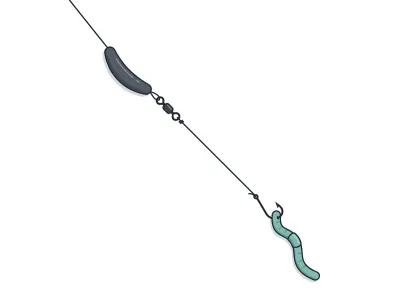
Live-Bait (Lindy) Rig + Leech/Crawler
jumbo leech or half a nightcrawler
Walleye · Trolling
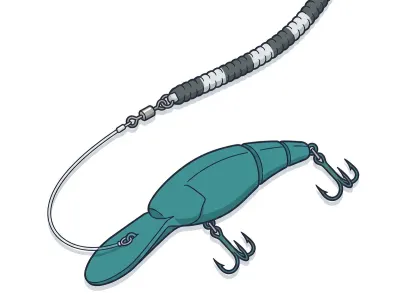
Leadcore Line + Crankbaits
4–5" mid-diving crankbait behind a long leadcore run
Smallmouth bass · Soft plastics
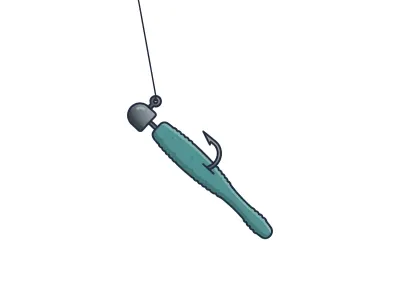
Ned Rig
2.75" finesse stickbait or craw-style Ned bait
Smallmouth bass · Soft plastics
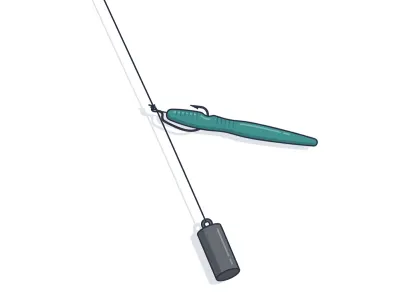
Drop Shot (Finesse Plastic)
4" finesse worm or 3" minnow-profile plastic
Largemouth bass · Soft plastics

Texas-Rigged Worm
7" ribbon-tail or straight-tail plastic worm
Largemouth bass · Soft plastics
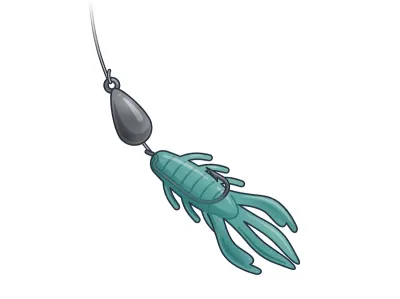
Free Rig
Creature bait or magnum finesse worm
Full setups, including hooks, weights and line, are on the live map. As an Amazon Associate I earn from qualifying purchases.
DNR stocking records
Stocking history
| Year | Species | Stocked |
|---|---|---|
| 2025 | Muskellunge | 3,761 fingerlings |
| 2025 | Walleye | 7,500,000 fry |
| 2024 | Muskellunge | 3,017 fingerlings |
| 2024 | Walleye | 9,100,000 fry |
| 2023 | Muskellunge | 3,014 fingerlings |
| 2023 | Walleye | 5,000,000 fry |
| 2022 | Muskellunge | 3,512 fingerlings |
| 2022 | Walleye | 5,000,000 fry |
| 2021 | Muskellunge | 3,048 fingerlings |
| 2021 | Walleye | 5,500,000 fry |
| 2019 | Muskellunge | 5,026 fingerlings |
| 2019 | Walleye | 5,000,000 fry |
Stocking records before 2019 omitted.
MN DNR · in their words
From the 2025 survey
Management Summary
Lake Vermilion is managed to support a high-quality, multi-species fishery driven largely by strong natural reproduction for most species. The lake is intensively monitored and managed by the Minnesota DNR through long-term annual surveys, periodic creel surveys, stocking programs for Walleye and Muskellunge, ecological monitoring, outreach, and management planning activities. Harvest for most species is regulated using statewide seasons and limits except for Walleye, which has a 4 fish limit with a 20-26-inch protected slot. Northern Pike are managed with the northeast zone regulation that allows a 2 fish limit with a 30-40-inch protected slot.
Read the full DNR narrative
Like many large lakes, Vermilion is dealing with aquatic invasive species. Zebra mussels are now considered established, based on the presence of larvae, even though adult mussels have not been documented. Rusty crayfish are also well established, particularly in East Vermilion, where they have altered habitat by reducing aquatic vegetation. Finally, spiny waterfleas may be encountered especially when trolling. For anglers, this means potential changes in fish location and an increased responsibility to prevent further spread. Cleaning boats and gear is not just a rule-it's part of protecting the fishery.
2026 Angling Outlook
Lake Vermilion stands out as a destination where anglers can target multiple species in one trip-and realistically succeed at several. Whether you're after a meal of Walleyes, a trophy Muskie, or steady bass action, the lake offers a wide range of experiences. Lake Vermilion is composed of two major basins, East Vermilion (east of Oak Narrows) and West Vermilion (west of Oak Narrows). Each basin is slightly different in terms of habitat and fish communities. Lake Vermilion's two basins can create distinct fishing experiences. West Vermilion generally offers higher fish numbers across several species, making it a strong choice for action and consistency. East Vermilion, on the other hand, often produces larger fish on average, appealing to anglers focused on size. The opposite is generally true when it comes to Walleyes, as East Vermilion generally has higher numbers, but West Vermilion produces a larger average size. Understanding this split can help anglers tailor their approach depending on whether they want numbers, size, or a mix of both.
Walleye: Walleye fishing remains the backbone of the Vermilion experience. Survey data from 2025 showed one of the highest catch rates in over four decades. The 2026 season should be especially rewarding for anglers looking to harvest fish. Strong numbers of Walleyes in the 13-20-inch range mean plenty of legal fish under the protected slot. Fish in the 12-15-inch range are particularly abundant, providing good harvest opportunities.
At the same time, larger Walleyes are common enough to provide big fish opportunities. Fish over 20 inches are widely available, giving anglers a shot at memorable catches even while targeting smaller fish for harvest. The current regulation requires release of fish from 20 to 26 inches, with a four-fish limit and only one over 26 inches allowed. For anglers, that means a balanced fishery featuring good harvest opportunities without sacrificing the chance at bigger fish.
Muskellunge: Muskies provide a world-class sport fishery on Lake Vermilion with the potential for trophy fish. Muskies are second only to Walleyes in terms of popularity for Lake Vermilion anglers. Recent surveys show an average size just under 45 inches, with over 40% of fish exceeding that mark. Fish over 50 inches are present in sufficient numbers to provide trophy opportunities. For anglers, this creates a classic Muskie experience: fewer strikes, but every one of them matters. Vermilion has earned its reputation as a world-class destination because those rare encounters can turn into truly exceptional fish.
Smallmouth Bass: Smallmouth Bass are found throughout Lake Vermilion, and the population provides an important fishery. They are typically the third most sought after species by Lake Vermilion anglers behind Walleyes and Muskies. Results from the 2025 spring electrofishing survey suggest numbers remain high which continues the upward trend over the last three decades. Anglers can expect steady action with fish in the 10-17-inch range, along with the occasional larger bass. The lake's two basins offer slightly different experiences. West Vermilion tends to produce more fish overall, while East Vermilion gives anglers a better shot at larger individuals. For anglers looking for numbers, action, and aggressive strikes, Smallmouth Bass are a dependable option throughout the season.
Largemouth Bass: Largemouth Bass are not a primary draw on Vermilion, but they do offer a quiet alternative for anglers willing to seek them out. They are found mainly in West Vermilion in specific habitats. Numbers are low, but the population appears stable or increasing. Most anglers treat them as a catch-and-release bonus rather than a target species.
Northern Pike: Northern Pike are found in low abundance in Lake Vermilion, but anglers seeking them can find higher numbers in West Vermilion. Northern Pike are less abundant than in the past, but the fish that remain are generally larger. Regulations protecting mid-sized fish have shifted the population toward bigger individuals. Anglers can expect a lower catch rate, but with the possibility of occasional trophies. In 2025, sampled pike length averaged almost 27 inches with the largest fish measuring about 36 inches suggesting anglers and spearers can find fish with a solid average size.
Panfish and Perch: Yellow Perch numbers are currently below average, but size is good. Anglers willing to search can still find fish over 10 inches, which are well worth keeping.
Black Crappies are generally a minor component of the Lake Vermilion fishery that can provide good fishing opportunities at certain times. Black Crappies are not abundant, but they run large. Fish average around 10 inches, with some exceeding 14 inches. West Vermilion holds more fish overall, though both basins can produce quality catches.
Bluegills can provide catch and harvest opportunities for anglers fishing Lake Vermilion. Typically, very few anglers come to Lake Vermilion seeking Bluegills, but they tend to be one of the most caught and harvested species in terms of total numbers. Fish over 9 inches are available throughout the lake, with higher numbers in West Vermilion.
Narrative text from the Minnesota DNR lake survey.
Recent reports
Vermilion Lake fishing reports
Recent reports on Vermilion Lake from guides, tournaments and regular anglers. Anything posted in the last two weeks also bumps the matching spots on the live map, so you'll see a "matches a recent report" tag on them.
Open the live map → Fished it lately? Write a report
All Vermilion Lake fishing reports → · St. Louis County reports
Public water access
Getting on the water
- Vermilion Lake, Black Duck Bay (trailer launch)
- Vermilion Lake, Cable Bay (trailer launch)
- Vermilion Lake, Everett Bay (trailer launch)
- Vermilion Lake, Frazer Bay (trailer launch)
- Vermilion Lake, Head o Lakes (trailer launch)
- Vermilion Lake, Hoodoo (trailer launch)
- Vermilion Lake, Hoodoo (N) (trailer launch)
- Vermilion Lake, McKinley Park (trailer launch)
- Vermilion Lake, Moccasin Point (trailer launch)
- Vermilion Lake, Norwegian Bay (trailer launch)
- Vermilion Lake, Oak Narrows (trailer launch)
- Vermilion Lake, Pederson Landing (Wakemup Bay) (trailer launch)
- Vermilion Lake, Polley Road (trailer launch)
- Vermilion Lake, Rice Bay (trailer launch)
- Vermilion Lake, Stuntz Bay (trailer launch)
- Vermilion Lake, Armstrong Bay Fishing Pier (fishing pier)
DNR bathymetry
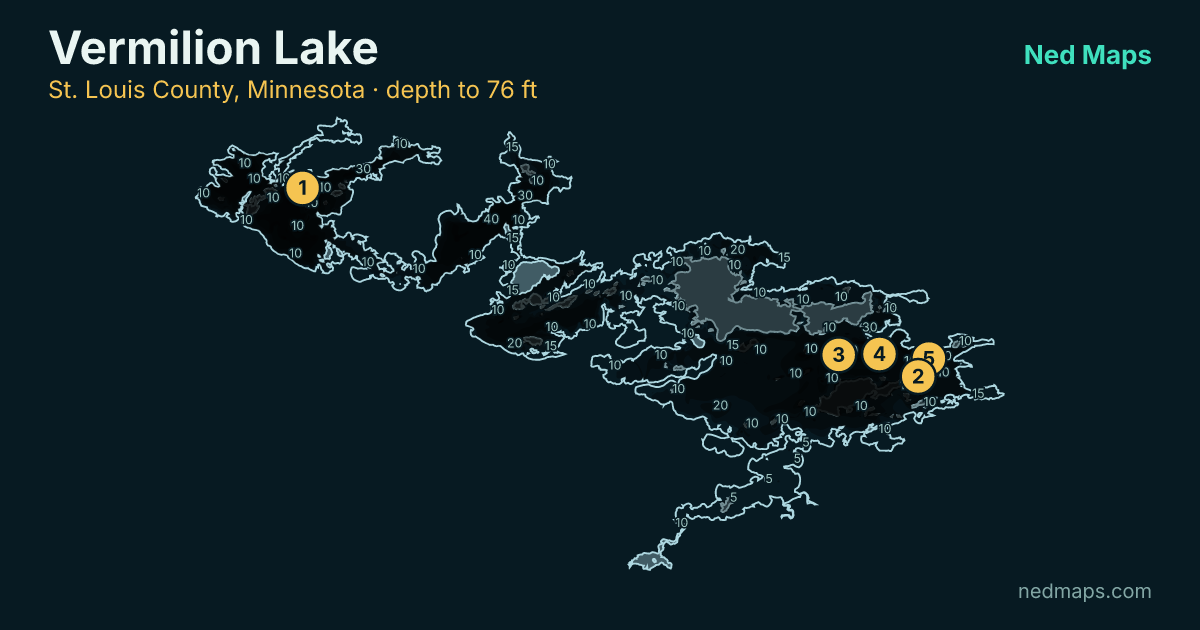
Vermilion Lake depth map
Within 30 miles
Nearby lakes
- Wolf Lake · 179 ac · 2.3 mi
- Lost Lake · 752 ac · 4.8 mi
- Trout Lake · 7,425 ac · 7 mi
- Pike River Flowage · 214 ac · 7.9 mi
- Pine Lake · 830 ac · 8.6 mi
- Oriniack Lake · 744 ac · 8.6 mi
- Little Trout Lake · 528 ac · 9.7 mi
- Bass Lake · 244 ac · 9.9 mi
Quick answers
Frequently asked questions
How deep is Vermilion Lake?
Vermilion Lake reaches 76 ft at its deepest point; about 38% of the lake is littoral (15 ft or shallower).
How big is Vermilion Lake?
Vermilion Lake covers 39,272 acres with about 341.5 miles of shoreline.
How clear is the water in Vermilion Lake?
DNR Secchi readings on Vermilion Lake average 7.6 ft of visibility, middling clarity for a Minnesota lake.
What fish are in Vermilion Lake?
Minnesota DNR surveys (most recently 2025) record walleye, largemouth bass, smallmouth bass, northern pike, muskellunge, bluegill, crappie, yellow perch, rock bass.
Is Vermilion Lake stocked?
Yes. The DNR stocked muskellunge and walleye in 2025; the stocking table on this page lists every year back to 2019.
Does Vermilion Lake have a public access?
Yes. Vermilion Lake has 16 public access sites, including Vermilion Lake, Black Duck Bay (trailer launch).
How big do walleye get in Vermilion Lake?
The biggest walleye measured in recent DNR surveys taped 29"; the size-history table on this page tracks the biggest fish in each survey back to 2018.
When was Vermilion Lake last surveyed?
The Minnesota DNR last surveyed Vermilion Lake in 2025, the most recent of 42 surveys on record.
Page updated .

Featured guide spot
Your guide service here
One featured guide per lake, with your photo, your writeup and a link straight to your booking page. Free through December 31, 2026.
Then $20 a month from January. Cancel any time.
The live map adds today's conditions and ranked spots for Vermilion Lake, plus a trip plan you can share:
Open Vermilion Lake on the live map → Fished it lately? Write a report