Minnesota · Itasca County
South Sturgeon Lake Fishing guide
South Sturgeon Lake is a 204-acre lake in Itasca County, Minnesota, reaching 43 ft at its deepest point. Secchi readings average around 2.5 ft of visibility. The Minnesota DNR has surveyed the lake 8 times, most recently in 2016, with walleye, largemouth bass, northern pike and bluegill in the nets. That survey is 10 years old now.
DNR survey data
Fish species
No recent survey rating.
BluegillJust a few5.5per trap net6"Typical9"Biggest
Lengths measured · 44 fish
Recent · 2016Lengths measured · 44 fish
2016Lengths measured · 30 fish
2002Lengths measured · 43 fish
1995CrappieJust a few2.9per trap net7"Typical11"Biggest
Lengths measured · 24 fish
Recent · 2016Lengths measured · 24 fish
2016Lengths measured · 22 fish
2002Lengths measured · 30 fish
1995Rates come from standard DNR survey gear (gill nets, trap nets, electrofishing), judged against statewide benchmarks for the same gear, so the same number of fish per net can read differently for two species. Where the standard gear can't count a species reliably, only presence and size are listed. Typical is the middle fish of those measured. Open a row for the full length spread, survey by survey.
How to fish South Sturgeon Lake through the year
Walleye
- Spring
- Walleye are shallow, on and just off the spawning flats and the first green weeds. In 2.5 ft of visibility, they sit shallower than you think.
- Early summer
- Walleye are setting up on the outside weed edge, points and shallow structure.
- Summer
- Walleye are working the weed edge, points and any wind-blown structure. On a lake that drops to 43 ft, check the deep edge of that structure too.
- Fall
- Walleye are packing onto the sharpest breaks and points as the water cools, in big schools with short windows.
Northern pike
- Spring
- Pike are in the shallow bays and along new weed growth. In 2.5 ft of visibility, they sit shallower than you think.
- Early summer
- Pike are on the outside weed edge and points.
- Summer
- Pike are on the deep weed edge and points near the coolest water they can find. On a lake that drops to 43 ft, check the deep edge of that structure too.
- Fall
- Pike are on the last green weeds and the breaks beside them, feeding heavily as the water drops.
Season patterns for each species. Open the live map for today's wind, light and water temp.
Size history
Biggest fish by survey year
| Survey year | Walleye | Northern pike | Bluegill |
|---|---|---|---|
| 2016 | 26" | 26" | 9" |
| 2002 | 17" | 37" | 9" |
| 1995 | 24" | 39" | 8" |
Longest fish measured by DNR survey crews in each year's nets. Survey gear samples the population, so the lake usually holds larger fish than any survey measured.
Suggested tackle
What to bring
Top presentations for this lake's structure and clarity:
Walleye · Live bait

Live-Bait (Lindy) Rig + Leech/Crawler
jumbo leech or half a nightcrawler
Walleye · Trolling
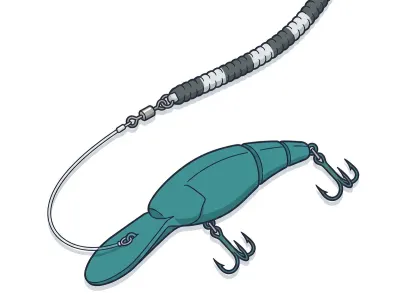
Leadcore Line + Crankbaits
4–5" mid-diving crankbait behind a long leadcore run
Northern pike · Soft plastics

Paddletail Swimbait on Jighead
4–5" paddletail swimbait on a ball-head swimbait jighead
Northern pike · Muskie & pike
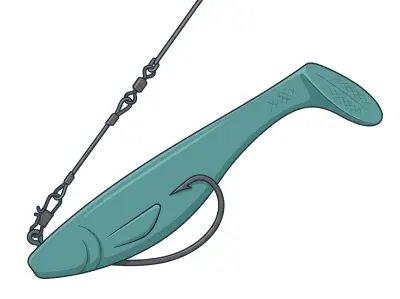
Soft Rubber (Bull Dawg / Medusa)
10" soft rubber body bait
Bluegill · Live bait
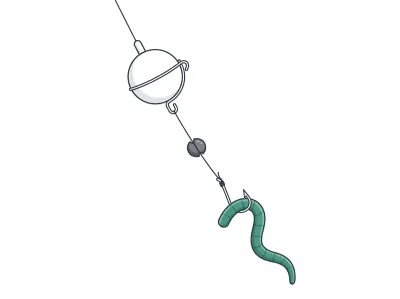
Clip-On Bobber + Worm
half to whole garden nightcrawler
Bluegill · Soft plastics
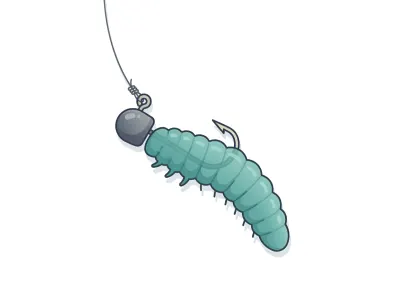
Tungsten Jig + Micro Plastic
1–1.5" micro plastic
Full setups, including hooks, weights and line, are on the live map. As an Amazon Associate I earn from qualifying purchases.
MN DNR · in their words
From the 2016 survey
South Sturgeon Lake is a small, infertile lake located about 15 miles northwest of Chisholm, Minnesota. There is a public access on the southwest side of the lake. Small, accessible, infertile lakes like South Sturgeon often do not have the ability to produce high quality fisheries and are vulnerable to angling overharvest. An attribute of infertile lakes is that fish tend to grow slowly even though their numbers are low. The 2003 lake management plan (LMP) indicates Black Crappie and Northern Pike as the primary species of management with Bluegill as a secondary species. The LMP goals were established based on prior netting data. A standard survey was conducted in July of 2016 to assess the status of the fish community.
Black Crappie numbers have fluctuated like all populations do but have been typical for the lake type. The 2016 trap-net catch of 2.9 fish/net approached the LMP goal of 3.0/net. The trap-net sampled fish ranged from 3.6 to 11.0 inches and averaged 6.8 inches. The sampling of five age-classes suggest fairly consistent reproduction had occurred. Growth was somewhat slower than other lakes with similar habitat. Fish averaged 8.1 inches after five years. Black Crappie may provide decent fishing opportunities following periods of good natural reproduction.
Read the full DNR narrative
Northern Pike gill-net catch rates have been low in all surveys. No Northern Pike were sampled by gill nets in 2016 so the LMP goal was not attained. However, six Northern Pike were sampled by trap nets and these fish ranged from 14.4 to 26.5 inches and averaged 20.1 inches. Anglers may want to consider releasing pike because the population appears to be quite low.
Bluegill catches have been low compared to other lakes with similar habitat. The 2016 catch of 5.5 fish/trap net was typical for the lake. The sampled fish ranged from 3.4 to 9.5 inches and averaged 6.3 inches. Consistent natural reproduction was noted based on the nine age-classes sampled. Growth was slow to average compared to other lakes with similar habitat and on average it required five years of growth to attain 5.2 inches. The oldest fish were estimated to be 11 years old. The Bluegill population in South Sturgeon may provide some angling opportunities at times, but could only sustain light or modest angling pressure and harvest due to low lake productivity.
Walleye catches have always been low in South Sturgeon, which is typical for the lake type. The highest catch occurred in 1955 but the catches have never been close to that level again despite frequent stockings. Only two Walleye were sampled by gill nets in each of the last two surveys. Low lake productivity in conjunction with an inadequate prey base likely limits Walleye.
Yellow Perch catches have been low in all surveys since 1955 and the 2016 catch equaled the lowest on record. The three sampled Yellow Perch ranged from 5.9 to 7.7 inches and averaged 6.5 inches. Yellow Perch are not likely providing much fishing opportunities or prey for predators due to their poor size structure and low numbers.
Narrative text from the Minnesota DNR lake survey.
Recent reports
South Sturgeon Lake fishing reports
Recent reports on South Sturgeon Lake from guides, tournaments and regular anglers. Anything posted in the last two weeks also bumps the matching spots on the live map, so you'll see a "matches a recent report" tag on them.
Public water access
Getting on the water
- South Sturgeon Lake (trailer launch)
DNR bathymetry
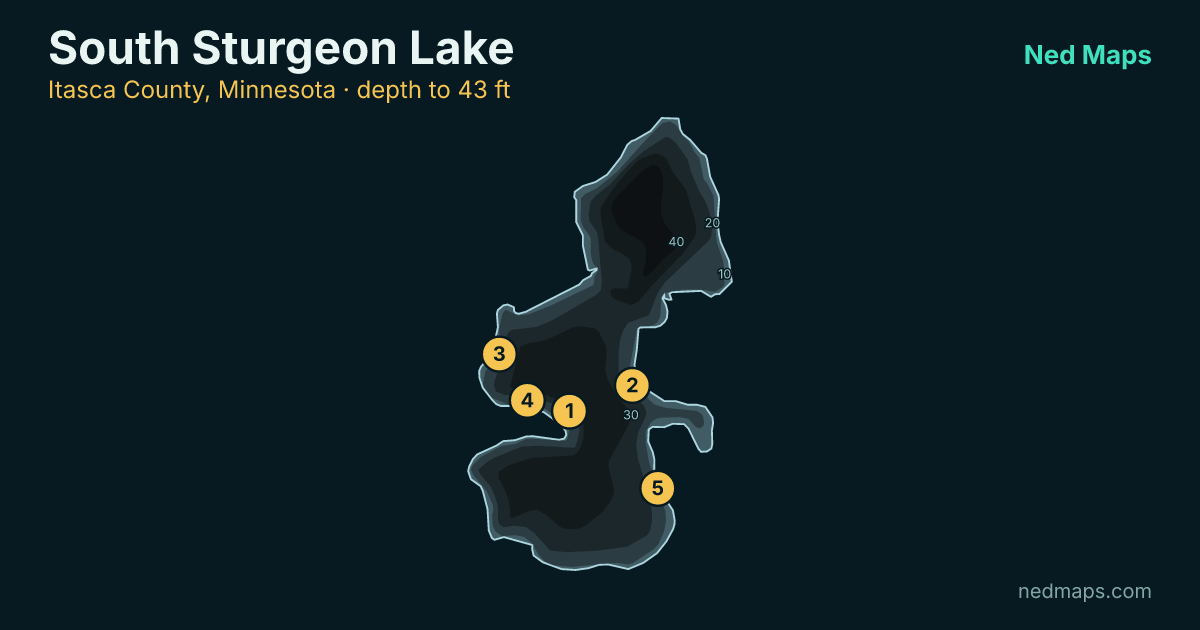
South Sturgeon Lake depth map
Within 30 miles
Nearby lakes
- Little Sturgeon Lake · 272 ac · 1.8 mi
- West Sturgeon Lake · 117 ac · 1.9 mi
- Sturgeon Lake · 1,585 ac · 3.2 mi
- Side Lake · 368 ac · 3.2 mi
- Stingy Lake · 361 ac · 3.6 mi
- Pickerel Lake · 32 ac · 3.9 mi
- Perch Lake · 344 ac · 4.1 mi
- Bower Lake · 93 ac · 4.7 mi
Quick answers
Frequently asked questions
How deep is South Sturgeon Lake?
South Sturgeon Lake reaches 43 ft at its deepest point; about 22% of the lake is littoral (15 ft or shallower).
How big is South Sturgeon Lake?
South Sturgeon Lake covers 204 acres with about 3.7 miles of shoreline.
How clear is the water in South Sturgeon Lake?
DNR Secchi readings on South Sturgeon Lake average 2.5 ft of visibility, on the stained end for a Minnesota lake.
What fish are in South Sturgeon Lake?
Minnesota DNR surveys (most recently 2016) record walleye, largemouth bass, northern pike, bluegill, crappie, yellow perch, rock bass.
Is South Sturgeon Lake stocked?
No stocking is on record for South Sturgeon Lake in the DNR's stocking database.
Does South Sturgeon Lake have a public access?
Yes. South Sturgeon Lake has one public access site: South Sturgeon Lake (trailer launch).
How big do walleye get in South Sturgeon Lake?
The biggest walleye measured in recent DNR surveys taped 26"; the size-history table on this page tracks the biggest fish in each survey back to 1995.
When was South Sturgeon Lake last surveyed?
The Minnesota DNR last surveyed South Sturgeon Lake in 2016, the most recent of 8 surveys on record. A survey that old is a starting point, not a current reading.
Page updated .

Featured guide spot
Your guide service here
One featured guide per lake, with your photo, your writeup and a link straight to your booking page. Free through December 31, 2026.
Then $20 a month from January. Cancel any time.
The live map adds today's conditions and ranked spots for South Sturgeon Lake, plus a trip plan you can share:
Open South Sturgeon Lake on the live map → Fished it lately? Write a report