Minnesota · Murray County
Sarah Lake Fishing guide
Sarah Lake is a 1,209-acre lake in Murray County, Minnesota, reaching 10 ft at its deepest point. Secchi readings average around 3.1 ft of visibility. The Minnesota DNR has surveyed the lake 22 times, most recently in 2025, with walleye, northern pike, bluegill and crappie in the nets.
DNR survey data
Fish species
WalleyeLast stocked 2017One of the best around42.3per gill net13"Typical28"Biggest
Lengths measured · 333 fish
Recent · 2021 + 2024Lengths measured · 947 fish
2025Lengths measured · 185 fish
2024Lengths measured · 229 fish
2024Lengths measured · 2688 fish
2023No recent survey rating.
CrappieFair numbers19.6per trap net3"Typical13"Biggest
Lengths measured · 494 fish
Recent · 2021 + 2024Lengths measured · 66 fish
2024Lengths measured · 428 fish
2021Lengths measured · 6 fish
2018Only 6 fish measured that year — too few to read as a shape.
Lengths measured · 12 fish
2014Yellow perchElite fishery84.2per gill net7"Typical12"Biggest
Lengths measured · 1478 fish
Recent · 2021 + 2024Lengths measured · 38 fish
2024Lengths measured · 1440 fish
2021Lengths measured · 159 fish
2018Lengths measured · 48 fish
2014No recent survey rating.
Rates come from standard DNR survey gear (gill nets, trap nets, electrofishing), judged against statewide benchmarks for the same gear, so the same number of fish per net can read differently for two species. Where the standard gear can't count a species reliably, only presence and size are listed. Typical is the middle fish of those measured. Open a row for the full length spread, survey by survey.
How to fish Sarah Lake through the year
Walleye
- Spring
- Walleye are shallow, on and just off the spawning flats and the first green weeds. In 3.1 ft of visibility, they sit shallower than you think.
- Early summer
- Walleye are setting up on the outside weed edge, points and shallow structure.
- Summer
- Walleye are working the weed edge, points and any wind-blown structure. With 100% of this lake 15 ft or shallower, the weed edge is the main event.
- Fall
- Walleye are packing onto the sharpest breaks and points as the water cools, in big schools with short windows. A 10-ft bowl cools fast, so the fall window comes early here.
Yellow perch
- Spring
- Perch are draping eggs over flooded cover and weed stems on the shallow flats. In 3.1 ft of visibility, they sit shallower than you think.
- Early summer
- Perch are spread over sand-grass flats and the first weed edges in loose packs.
- Summer
- Perch are over deeper soft-bottom flats and the basin, on the bottom and in schools. With 100% of this lake 15 ft or shallower, the weed edge is the main event.
- Fall
- Perch are roaming the mid-depth flats in loose schools, chasing young-of-year bait while it is still shallow. A 10-ft bowl cools fast, so the fall window comes early here.
Season patterns for each species. Open the live map for today's wind, light and water temp.
Size history
Biggest fish by survey year
| Survey year | Walleye | Yellow perch | Crappie |
|---|---|---|---|
| 2025 | 9" | — | — |
| 2024 | 28" | 11" | 13" |
| 2023 | 11" | — | — |
| 2022 | 8" | — | — |
| 2021 | 27" | 12" | 10" |
| 2020 | 9" | — | — |
| 2019 | 9" | — | — |
| 2018 | 28" | 11" | 14" |
Longest fish measured by DNR survey crews in each year's nets. Survey gear samples the population, so the lake usually holds larger fish than any survey measured.
Suggested tackle
What to bring
Top presentations for this lake's structure and clarity:
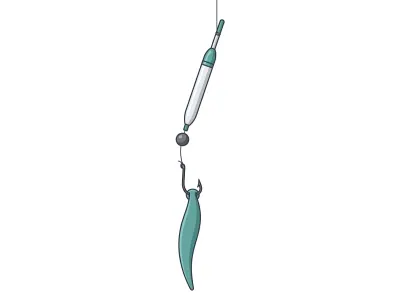
Walleye · Soft plastics
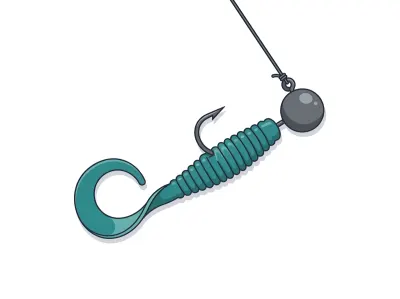
Curly-Tail Grub on Jig
3" curly-tail grub threaded on a round jighead
Yellow perch · Soft plastics
Curly-Tail Grub on Jig
3" curly-tail grub threaded on a round jighead
Yellow perch · Soft plastics
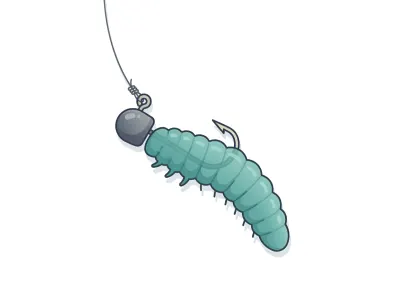
Tungsten Jig + Micro Plastic
1–1.5" micro plastic
Crappie · Jigs & bladed
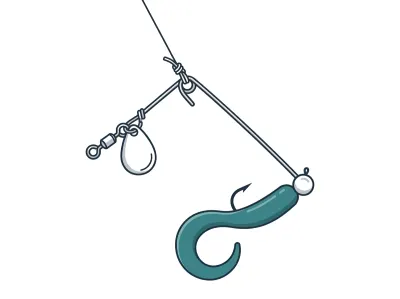
Beetle Spin
1.5–2" curly-tail grub trailer on a small in-line spinner jighead
Crappie · Soft plastics
Tungsten Jig + Micro Plastic
1–1.5" micro plastic
Full setups, including hooks, weights and line, are on the live map. As an Amazon Associate I earn from qualifying purchases.
DNR stocking records
Stocking history
| Year | Species | Stocked |
|---|---|---|
| 2017 | Walleye | 200,000 fry |
| 2016 | Walleye | 253,676 fry |
MN DNR · in their words
From the 2025 survey
Lake Sarah is a 1,093-acre, class 41 lake, located approximately 4 miles south of the City of Garvin in Murray County. Lake Sarah has a maximum depth of 11.0 feet and a watershed-to-lake ratio of 10-to-1. Lake Sarah is managed primarily for Walleye and secondarily for Yellow Perch. Lake Sarah's Walleye population is unique in the Windom fisheries management area. It is sustained through natural reproduction alone, as it has had limited stocking since 1991. Put-back fry were stocked during the initial stages of an egg-take from 2015-2017. Minnesota DNR stocked approximately 100,000 fry (100 fry/acre) in 2015 and 200,000 fry (200 fry/acre) in 2016 and 2017. Put-back stocking was discontinued due to limited return of genetically marked Walleye fry compared to natural reproduction. During the Walleye egg take on Lake Sarah and by taking genetic tissue from every broodstock Walleye used for egg take, we could tell if the Walleye fry stocked are a result of stocking or natural reproduction. So, from 2015-2017, we were able to determine the percentage of contribution the put-back fry was toward the capture of all Age-0 Walleye in the fall (Figure 1).
The take home message is that the number of Age-0 Walleye was extremely high and the contribution of put-back fry was low (by comparison) and not needed. Put-back fry has not been stocked since 2017. We determined that the Walleye population will maintain itself naturally. Given we can electrofish Lake Sarah for Age-0 Walleye each Fall, we will be able to monitor the situation and make changes to the put-back fry if the population begins to falter. No stocking of Walleye fry from any egg-take stations statewide in 2020 due to the COVID-19 pandemic and spring shutdown of close contact work. However, in 2021, the egg-take operations were restarted with enhanced safety protocols for close contact work. Starting 2022, there was a return to more normal operations that were done from 2015 to 2019.
Read the full DNR narrative
A genetics study found that Lake Sarah's Walleye are unique to the Cannon River in east-central Minnesota, which was used as an egg take source decades ago by the Waterville Office. The study suggested that this Lower Mississippi Strain (LMS) of Walleye has persisted in some southern waters despite extensive stocking of a northern "Mississippi strain" Walleye and the fact that the LMS Walleye egg take and subsequent stocking ended decades ago. In other words, the only way these unique genetics persist in some of these southern waters is through natural reproduction through the decades. The study also suggested that the LMS strain of Walleye in Lake Sarah can naturally reproduce, thereby creating a self-sustaining population. It is the goal to create other southern Minnesota lakes with similar self-sustaining populations and thereby potentially creating additional LMS egg take lakes and establish genetic conservation.
Annual fall night electrofishing is done on Lake Sarah to monitor natural reproduction. Two-hours of night electrofishing was conducted on 08 October 2025 to assess natural reproduction. Below is a table with historical catch data. The catch of age-0 (YOY) Walleye in 2025 was 473.5 per hour, which is greater than the interquartile range developed for Lake Sarah (75.3 to 289.8 age-0 per hour). This catch follows a consecutive trend of high catch rates since 2020 and a record catch in 2023 (Figure 1). Total length of Walleye sampled ranged from 6.7 to 9.9 inches and averaged 8.2 inches (Table 1). Walleye reproduction will be monitored annually to assess natural reproduction and determine if there are negative consequences with the LMS Walleye egg take operations. To date, there have been no adverse impacts realized on the Lake Sarah Walleye population as a result of the annual egg-take operation. However, in the event that we do see any adverse impacts, egg-take operations may need to be altered or be paused.
Table 1. Historic catch rates for young-of-the-year (YOY) Walleye during fall night electrofishing on Lake Sarah.
Date Total N Mean Length Catch Rate (n/hour)
10/8/2025 947 8.2 473.5
10/14/2024 229 7.2 114.01
10/9/2023 2,689 9.3 1,344.5
10/10/2022 850 6.4 425.0
10/14/2021 880 8.4 440.0
10/7/2020 937 8.2 468.5
10/7/2019 180 8.5 163.6
10/16/2018 81 9.2 81.0
10/10/2017 216 7.7 288.0
9/27/2016 253 8.2 337.3
10/6/2015 32 9.0 28.6
10/15/2014 350 7.8 244.2
10/7/2013 293 8.1 290.4
10/11/2012 193 8.4 186.7
10/20/2011 312 8.2 301.5
9/21/2010 162 8.2 149.5
9/28/2006 56 9.5 74.7
10/10/2005 145 9.1 96.7
9/28/2004 77 7.7 77.0
10/8/2003 12 9.1 16.0
9/18/2001 174 7.2 139.2
9/24/2000 90 7.1 60.0
9/16/1999 101 6.9 93.2
9/24/1998 105 8.1 105.0
10/14/1997 61 7.1 40.7
9/29/1996 183 6.4 183.0
10/9/1995 50 7.6 33.3
10/13/1994 296 7.9 197.3
10/14/1993 86 7.4 57.3
Narrative text from the Minnesota DNR lake survey.
Recent reports
Sarah Lake fishing reports
Recent reports on Sarah Lake from guides, tournaments and regular anglers. Anything posted in the last two weeks also bumps the matching spots on the live map, so you'll see a "matches a recent report" tag on them.
Public water access
Getting on the water
- Lake Sarah (trailer launch)
- Sarah Lake (E) (trailer launch)
- Sarah Lake (W) (trailer launch)
- Sarah Fishing Pier (fishing pier)
DNR bathymetry
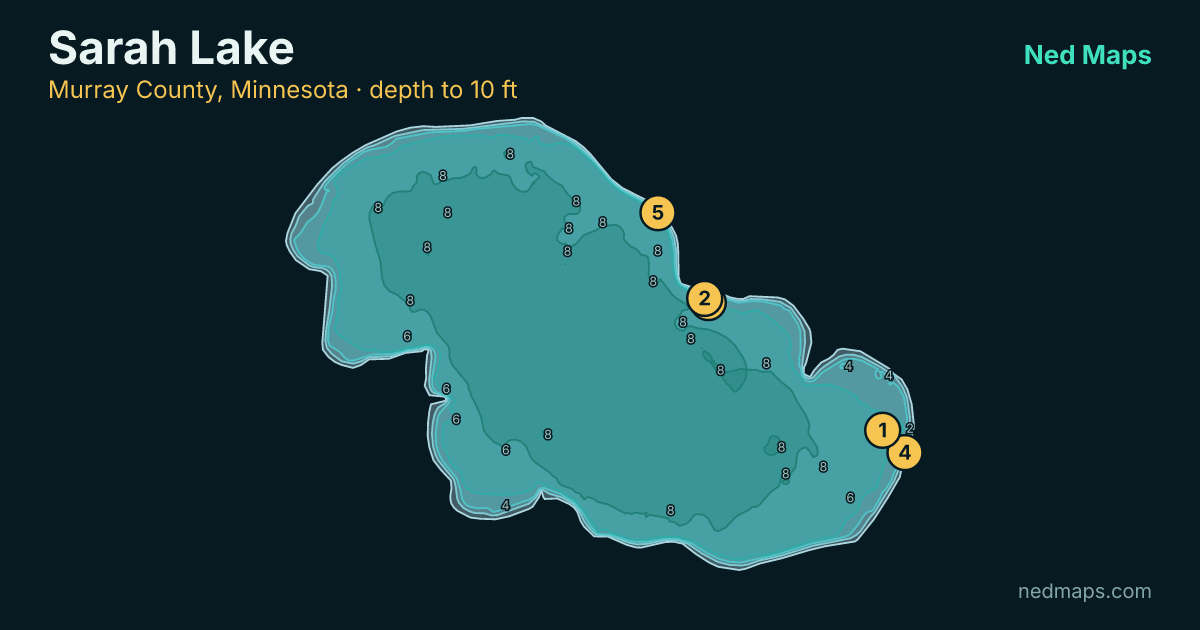
Sarah Lake depth map
Within 30 miles
Nearby lakes
- Shetek Lake · 3,462 ac · 3.2 mi
- Bloody Lake · 274 ac · 5 mi
- Iron Lake · 282 ac · 5.1 mi
- Lake of the Hill · 147 ac · 5.4 mi
- Fox Lake · 172 ac · 6.2 mi
- Yankton Lake · 403 ac · 8.1 mi
- Currant Lake · 406 ac · 9.1 mi
- Buffalo Lake · 127 ac · 10.6 mi
Quick answers
Frequently asked questions
How deep is Sarah Lake?
Sarah Lake reaches 10 ft at its deepest point; about 100% of the lake is littoral (15 ft or shallower).
How big is Sarah Lake?
Sarah Lake covers 1,209 acres with about 8.1 miles of shoreline.
How clear is the water in Sarah Lake?
DNR Secchi readings on Sarah Lake average 3.1 ft of visibility, on the stained end for a Minnesota lake.
What fish are in Sarah Lake?
Minnesota DNR surveys (most recently 2025) record walleye, northern pike, bluegill, crappie, yellow perch, channel catfish.
Is Sarah Lake stocked?
Yes. The DNR stocked walleye in 2017; the stocking table on this page lists every year back to 2016.
Does Sarah Lake have a public access?
Yes. Sarah Lake has 4 public access sites, including Lake Sarah (trailer launch).
How big do walleye get in Sarah Lake?
The biggest walleye measured in recent DNR surveys taped 28"; the size-history table on this page tracks the biggest fish in each survey back to 2018.
When was Sarah Lake last surveyed?
The Minnesota DNR last surveyed Sarah Lake in 2025, the most recent of 22 surveys on record.
Page updated .

Featured guide spot
Your guide service here
One featured guide per lake, with your photo, your writeup and a link straight to your booking page. Free through December 31, 2026.
Then $20 a month from January. Cancel any time.
The live map adds today's conditions and ranked spots for Sarah Lake, plus a trip plan you can share:
Open Sarah Lake on the live map → Fished it lately? Write a report