Minnesota · Lake County
Sand Lake Fishing guide
Sand Lake covers 487 acres in Lake County, Minnesota, reaching 11 ft at its deepest point. Average water clarity runs about 4.1 ft. The Minnesota DNR has surveyed the lake 13 times, most recently in 2022, with walleye, northern pike, bluegill and yellow perch in the nets.
DNR survey data
Fish species
WalleyeLast stocked 2016One of the best around14.4per gill net12"Typical25"Biggest
Lengths measured · 148 fish
Recent · 2021 + 2022Lengths measured · 137 fish
2022Lengths measured · 11 fish
2021Lengths measured · 5 fish
2014Only 5 fish measured that year — too few to read as a shape.
Lengths measured · 105 fish
2014Northern pikeJust a few3.4per gill net17"Typical33"Biggest
Lengths measured · 65 fish
Recent · 2021 + 2022Lengths measured · 39 fish
2022Lengths measured · 26 fish
2021Lengths measured · 18 fish
2014Lengths measured · 6 fish
2014Only 6 fish measured that year — too few to read as a shape.
BluegillJust a few7per trap net2"Typical10"Biggest
Lengths measured · 534 fish
Recent · 2021 + 2022Lengths measured · 375 fish
2022Lengths measured · 159 fish
2021Lengths measured · 79 fish
2014Lengths measured · 3 fish
2014Only 3 fish measured that year — too few to read as a shape.
Yellow perchGood numbers6.2per gill net6"Typical11"Biggest
Lengths measured · 304 fish
Recent · 2021 + 2022Lengths measured · 99 fish
2022Lengths measured · 205 fish
2021Lengths measured · 28 fish
2014Lengths measured · 35 fish
2014Rates come from standard DNR survey gear (gill nets, trap nets, electrofishing), judged against statewide benchmarks for the same gear, so the same number of fish per net can read differently for two species. Where the standard gear can't count a species reliably, only presence and size are listed. Typical is the middle fish of those measured. Open a row for the full length spread, survey by survey.
How to fish Sand Lake through the year
Walleye
- Spring
- Walleye are shallow, on and just off the spawning flats and the first green weeds.
- Early summer
- Walleye are setting up on the outside weed edge, points and shallow structure.
- Summer
- Walleye are working the weed edge, points and any wind-blown structure. With 100% of this lake 15 ft or shallower, the weed edge is the main event.
- Fall
- Walleye are packing onto the sharpest breaks and points as the water cools, in big schools with short windows. A 11-ft bowl cools fast, so the fall window comes early here.
Northern pike
- Spring
- Pike are in the shallow bays and along new weed growth.
- Early summer
- Pike are on the outside weed edge and points.
- Summer
- Pike are on the deep weed edge and points near the coolest water they can find. With 100% of this lake 15 ft or shallower, the weed edge is the main event.
- Fall
- Pike are on the last green weeds and the breaks beside them, feeding heavily as the water drops. A 11-ft bowl cools fast, so the fall window comes early here.
Season patterns for each species. Open the live map for today's wind, light and water temp.
Size history
Biggest fish by survey year
| Survey year | Walleye | Northern pike | Yellow perch |
|---|---|---|---|
| 2022 | 25" | 33" | 10" |
| 2021 | 17" | 32" | 11" |
| 2014 | 24" | 39" | 12" |
| 2011 | 27" | 31" | 12" |
| 2008 | 22" | 35" | 11" |
| 2005 | 20" | 26" | 12" |
Longest fish measured by DNR survey crews in each year's nets. Survey gear samples the population, so the lake usually holds larger fish than any survey measured.
Suggested tackle
What to bring
Top presentations for this lake's structure and clarity:
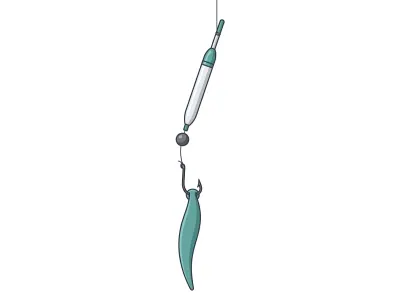
Walleye · Soft plastics
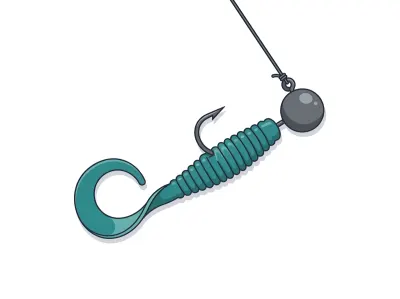
Curly-Tail Grub on Jig
3" curly-tail grub threaded on a round jighead
Northern pike · Soft plastics
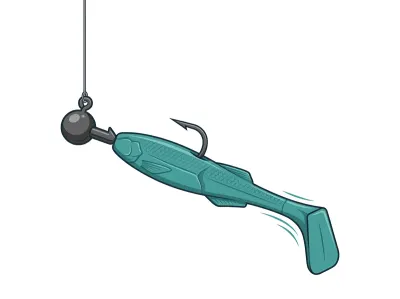
Paddletail Swimbait on Jighead
4–5" paddletail swimbait on a ball-head swimbait jighead
Northern pike · Jigs & bladed
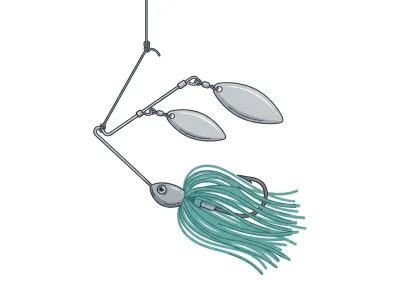
Spinnerbait
3/8–1/2 oz safety-pin spinnerbait with tandem willow-leaf blades
Yellow perch · Soft plastics
Curly-Tail Grub on Jig
3" curly-tail grub threaded on a round jighead
Yellow perch · Soft plastics
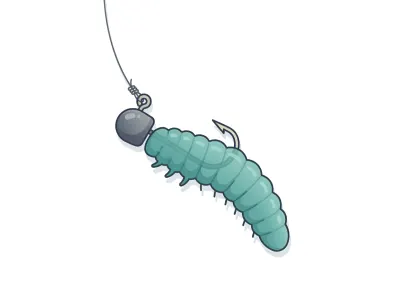
Tungsten Jig + Micro Plastic
1–1.5" micro plastic
Full setups, including hooks, weights and line, are on the live map. As an Amazon Associate I earn from qualifying purchases.
DNR stocking records
Stocking history
| Year | Species | Stocked |
|---|---|---|
| 2016 | Walleye | 500,000 fry |
MN DNR · in their words
From the 2022 survey
Sand Lake is located about fifteen miles west of Isabella on the west side of Lake Co Hwy 2 and is 486 acres in size with a maximum depth of 11 feet. The primary access is a carry in at the Sand Lake rustic campground maintained by the Forest Service. A second access is located at the end of Forest Service 941, a 0.4 mile spur that originates on Hwy 2. A small boat and trailer can be turned around by hand to launch, but space for parking is limited. This trail is narrow, rough, and a four-wheel drive vehicle with good ground clearance is recommended. Walleye have been the primary management species in Sand Lake since the first Lake Management Plan in 1987. The lake was stocked with Walleye fry for many years. In 2016 the decision was made to end stocking due to consistent strong year classes produced in non-stocked years. In 2000, adult Bluegill of various sizes were stocked in the lake and have since established a self-sustaining population with excellent size structure. The lake currently has a special regulation of a reduced bag limit on Bluegill of 5 daily and 20 in possession to help preserve this quality fishery.
The 2022 Walleye gill net catch of 14.44/lift was higher than average compared to similar lakes and was the highest catch on Sand Lake since 1961. The average weight was 0.65 pounds, which is below the normal range compared to similar lakes. The average length was 11.9 inches with the largest fish sampled measuring 25.6 inches long. Analysis determined over 85% of Walleye were from non-stocked years with several strong year classes produced since stocking was discontinued. Survey results suggest that Walleye 12-15 inches long currently provide good opportunities for anglers. With the highest catch in 60 years and most of the fish naturally reproduced it is apparent that the decision to end Walleye stocking was a sound one at this time.
Read the full DNR narrative
The Bluegill trap net catch of 3.33/lift with an average weight of 0.21 pounds was within the normal range compared to other similar lakes. Growth was also average for the area. While there are some very nice Bluegill present, most anglers report catching an occasional keeper while fishing for Walleyes and Perch.
The Northern Pike gill net catch of 3.44/lift with an average weight of 1.60 pounds was within the normal range of other similar lakes. Average length was 19 inches long. The largest fish sampled was 33 inches long with just 10% of the catch at least 24 inches. Survey results suggest than most of the Northern Pike are small, but there is a reasonable chance at catching a memorable sized fish.
The Yellow Perch gill net catch of 6.22/lift with an average weight of 0.24 pounds is average compared to other similar lakes. Most of the catch was between 6.5-9.5 inches long with 21% longer than 9 inches and the largest fish measuring 10.9 inches long. These results suggest that the lake currently supports a perch population with decent opportunities for angler harvest.
Narrative text from the Minnesota DNR lake survey.
Recent reports
Sand Lake fishing reports
Recent reports on Sand Lake from guides, tournaments and regular anglers. Anything posted in the last two weeks also bumps the matching spots on the live map, so you'll see a "matches a recent report" tag on them.
Public water access
Getting on the water
- Sand Lake (carry-in)
DNR bathymetry
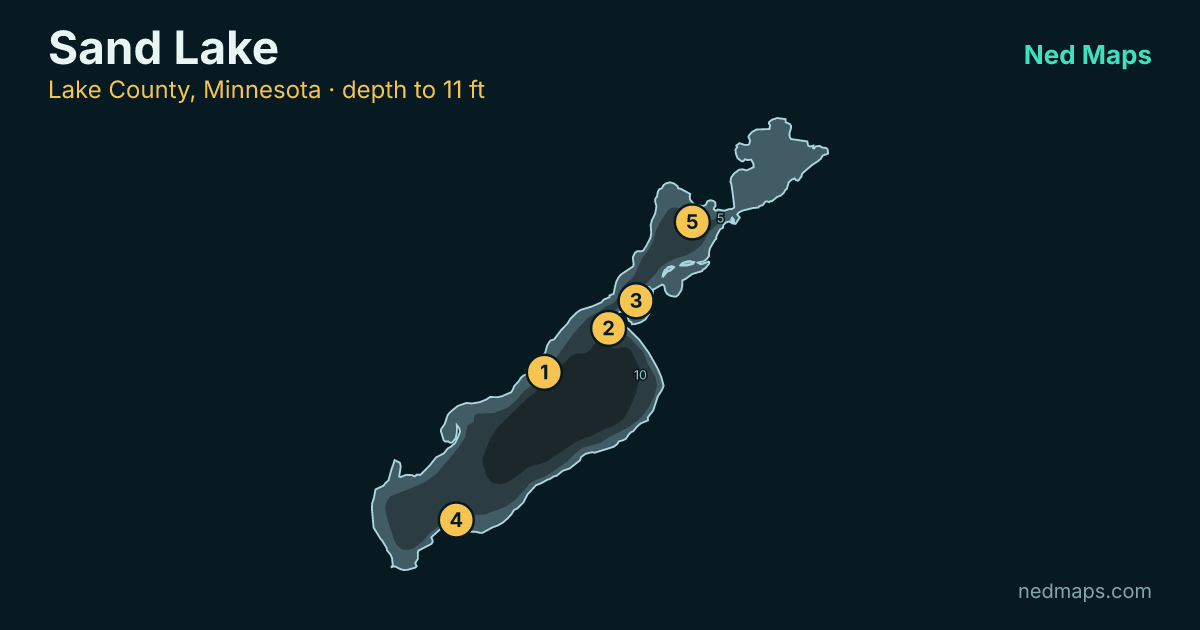
Sand Lake depth map
Within 30 miles
Nearby lakes
- Stony Lake · 249 ac · 3.5 mi
- Greenwood Lake · 1,329 ac · 4.6 mi
- South McDougal Lake · 287 ac · 5.4 mi
- Fourth McDougal Lake · 13 ac · 6.1 mi
- Middle McDougal Lake · 104 ac · 6.1 mi
- West Chub Lake · 115 ac · 6.3 mi
- Campers Lake · 48 ac · 6.3 mi
- North McDougal Lake · 273 ac · 6.6 mi
Quick answers
Frequently asked questions
How deep is Sand Lake?
Sand Lake reaches 11 ft at its deepest point; about 100% of the lake is littoral (15 ft or shallower).
How big is Sand Lake?
Sand Lake covers 487 acres with about 8.1 miles of shoreline.
How clear is the water in Sand Lake?
DNR Secchi readings on Sand Lake average 4.1 ft of visibility, middling clarity for a Minnesota lake.
What fish are in Sand Lake?
Minnesota DNR surveys (most recently 2022) record walleye, northern pike, bluegill, yellow perch, rock bass.
Is Sand Lake stocked?
Yes. The DNR stocked walleye in 2016.
Does Sand Lake have a public access?
Yes. Sand Lake has one public access site: Sand Lake (carry-in).
How big do walleye get in Sand Lake?
The biggest walleye measured in recent DNR surveys taped 25"; the size-history table on this page tracks the biggest fish in each survey back to 2005.
When was Sand Lake last surveyed?
The Minnesota DNR last surveyed Sand Lake in 2022, the most recent of 13 surveys on record.
Page updated .

Featured guide spot
Your guide service here
One featured guide per lake, with your photo, your writeup and a link straight to your booking page. Free through December 31, 2026.
Then $20 a month from January. Cancel any time.
The live map adds today's conditions and ranked spots for Sand Lake, plus a trip plan you can share:
Open Sand Lake on the live map → Fished it lately? Write a report