Minnesota · McLeod County
Otter Lake Fishing guide
Otter Lake sits in McLeod County, Minnesota, and covers 642 acres, reaching 9 ft at its deepest point. Average water clarity runs about 1.4 ft. The Minnesota DNR has surveyed the lake 10 times, most recently in 2025, with walleye, largemouth bass, northern pike and bluegill in the nets.
DNR survey data
Fish species
WalleyePresent34.1per hr (electrofishing)12"Typical25"Biggest
Lengths measured · 500 fish
Recent · 2021 + 2022 + 2023 + 2024 + 2025Lengths measured · 66 fish
2025Lengths measured · 51 fish
2024Lengths measured · 60 fish
2023Lengths measured · 154 fish
2022Largemouth bassPresent (last recorded 2012)0.7per gill net4"Typical15"Biggest
Lengths measured · 35 fish
Recent · 2012Lengths measured · 35 fish
2012Lengths measured · 2 fish
2005Only 2 fish measured that year — too few to read as a shape.
Northern pikeJust a few5.9per gill net21"Typical32"Biggest
Lengths measured · 84 fish
Recent · 2012Lengths measured · 84 fish
2012Lengths measured · 23 fish
2005BluegillJust a few0.7per trap net1"Typical7"Biggest
Lengths measured · 135 fish
Recent · 2012Lengths measured · 135 fish
2012Lengths measured · 39 fish
2005Yellow perchFair numbers1.3per gill net8"Typical9"Biggest
Lengths measured · 14 fish
Recent · 2012Lengths measured · 14 fish
2012Lengths measured · 67 fish
2005Channel catfishExcellent numbers7.4per gill net9"Typical27"Biggest
Lengths measured · 82 fish
Recent · 2012Lengths measured · 82 fish
2012Lengths measured · 4 fish
2005Only 4 fish measured that year — too few to read as a shape.
Rates come from standard DNR survey gear (gill nets, trap nets, electrofishing), judged against statewide benchmarks for the same gear, so the same number of fish per net can read differently for two species. Where the standard gear can't count a species reliably, only presence and size are listed. Typical is the middle fish of those measured. Open a row for the full length spread, survey by survey.
How to fish Otter Lake through the year
Walleye
- Spring
- Walleye are shallow, on and just off the spawning flats and the first green weeds. In 1.4 ft of visibility, they sit shallower than you think.
- Early summer
- Walleye are setting up on the outside weed edge, points and shallow structure.
- Summer
- Walleye are working the weed edge, points and any wind-blown structure. With 100% of this lake 15 ft or shallower, the weed edge is the main event.
- Fall
- Walleye are packing onto the sharpest breaks and points as the water cools, in big schools with short windows. A 9-ft bowl cools fast, so the fall window comes early here.
Crappie
- Spring
- Crappie are up in the back bays and against wood in a few feet of water, spawning shallower than most people fish for them. In 1.4 ft of visibility, they sit shallower than you think.
- Early summer
- Crappie are pulling off the bays to the first deep weed edge and brush, still reachable shallow at dusk.
- Summer
- Crappie are over the basin of a stratified lake, well off any structure, which is why summer netting barely catches them inshore. With 100% of this lake 15 ft or shallower, the weed edge is the main event.
- Fall
- Crappie are schooled along the deep weedline and the basin edge, pushing shallow to feed at dusk while the water still turns over slowly. A 9-ft bowl cools fast, so the fall window comes early here.
Season patterns for each species. Open the live map for today's wind, light and water temp.
Size history
Biggest fish by survey year
| Survey year | Walleye | Crappie | Largemouth bass |
|---|---|---|---|
| 2025 | 21" | — | — |
| 2024 | 18" | — | — |
| 2023 | 18" | — | — |
| 2022 | 22" | — | — |
| 2021 | 25" | 4" | — |
| 2012 | 22" | 13" | 15" |
| 2005 | 19" | 10" | 14" |
Longest fish measured by DNR survey crews in each year's nets. Survey gear samples the population, so the lake usually holds larger fish than any survey measured.
Suggested tackle
What to bring
Top presentations for this lake's structure and clarity:
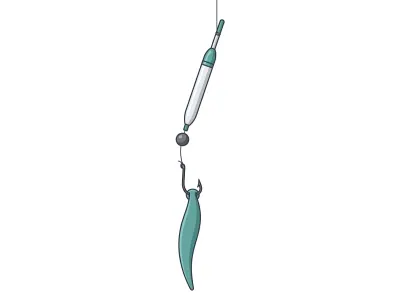
Walleye · Soft plastics
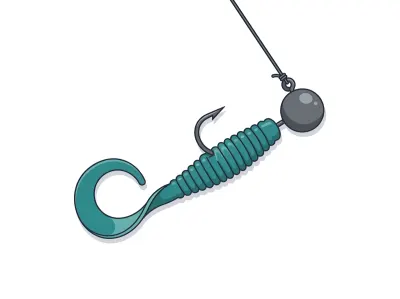
Curly-Tail Grub on Jig
3" curly-tail grub threaded on a round jighead
Crappie · Jigs & bladed
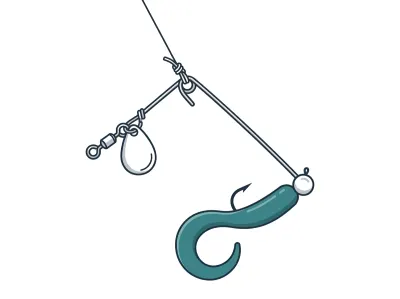
Beetle Spin
1.5–2" curly-tail grub trailer on a small in-line spinner jighead
Crappie · Soft plastics
Curly-Tail Grub on Jig
3" curly-tail grub threaded on a round jighead
Largemouth bass · Soft plastics
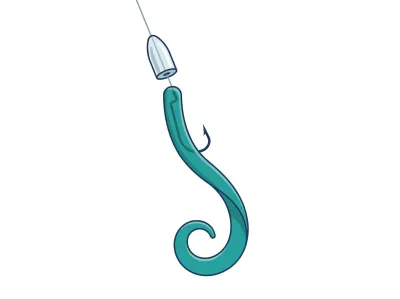
Texas-Rigged Worm
7" ribbon-tail or straight-tail plastic worm
Largemouth bass · Jigs & bladed
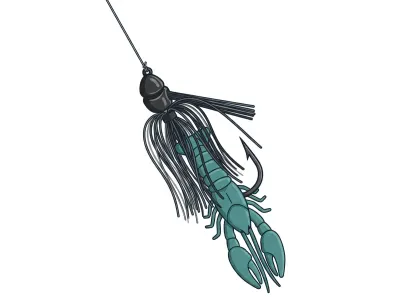
Skirted Casting Jig + Craw Trailer
3.5–4" craw-style trailer on a skirted casting/flipping jig
Full setups, including hooks, weights and line, are on the live map. As an Amazon Associate I earn from qualifying purchases.
MN DNR · in their words
From the 2025 survey
Otter (including Campbell Lake to the north) is a moderate sized reservoir (642 acres) located in the City of Hutchinson in McLeod County. Otter has approximately fourteen miles of shoreline and a maximum depth of nine feet, but much of this shallow reservoir is closer to five feet in depth. There are two City Parks (Masonic West River and Roberts) that both have cement boat ramps with ample parking. A fishing pier can be found in the eastern arm of the reservoir and numerous shore fishing opportunities are available to anglers. The reservoir's fish populations occasionally suffer from winterkill. Abundances of those species that are intolerant of low oxygen levels such as Bluegill, Channel Catfish, Common Carp and Largemouth Bass can vary greatly from year to year. Other species are usually affected to a lesser degree but can be significantly impacted during extremely harsh winters. Species' abundances will depend on the severity of the latest winterkill event, time that has passed since the last kill and water levels of the river, which can influence fish movement, spawning success and recolonization. Low water levels during droughts can also intensify winterkill events. Partial winterkills occurred in 2022 and 2023. Fish from the South Fork of the Crow River can immigrate into Otter Reservoir from both upstream and downstream following winterkill events to repopulate the system, so the stocking of Walleye is not needed. Winter anglers are reminded to be extra careful while ice fishing on Otter Reservoir as flowing water from the South Fork of the Crow River can lead to thin ice conditions in various parts of the shallow basin. Summer boat anglers should also be aware of the numerous shallow rock hazards that are present.
Fall nighttime electrofishing was used to monitor Otter Reservoir's Walleye population in 2025. The electrofishing catch indicated that fair numbers of Walleye were present this fall. Walleye were 5.2 to 21.6 inches long in 2025. Most of the Walleye sampled (56 percent) were young-of-the-year (2025 year class), and they averaged 6.9 inches in length, but decent numbers of 15 to 18 inch long fish should provide some decent angling action. Of interest, many Northern Pike were also observed during the assessment and should provide good fishing opportunities in 2026. Anglers also reported good catches of both Black Crappie and White Crappie in the fall of 2025 on Otter Reservoir.
Read the full DNR narrative
People can have significant impacts on lakes and the fish populations they support. Over harvest, lakeshore development, removal of shoreline vegetation, and introductions of invasive species can all adversely affect fish populations. Aquatic invasive species (AIS) are typically moved from infested to non-infested waters by anglers, boaters and lakeshore owners, and can adversely impact lakes and fish populations. To avoid spreading AIS, lake users are required to remove all aquatic plants and animals from their watercraft and drain all lake water from their boat and bait buckets before leaving the lake. If you suspect an infestation of an invasive species in this lake, save a specimen and report it to a local Minnesota Department of Natural Resources (MNDNR) office. Additional information on all these topics can be found on the MNDNR website (www.dnr.state.mn.us) or by contacting the Hutchinson Area Fisheries office.
Narrative text from the Minnesota DNR lake survey.
Recent reports
Otter Lake fishing reports
Recent reports on Otter Lake from guides, tournaments and regular anglers. Anything posted in the last two weeks also bumps the matching spots on the live map, so you'll see a "matches a recent report" tag on them.
Public water access
Getting on the water
- Otter Lake (E) (trailer launch)
- South Fork of Crow River, Roberts Park (trailer launch)
- Otter Lake (W) (carry-in)
DNR bathymetry
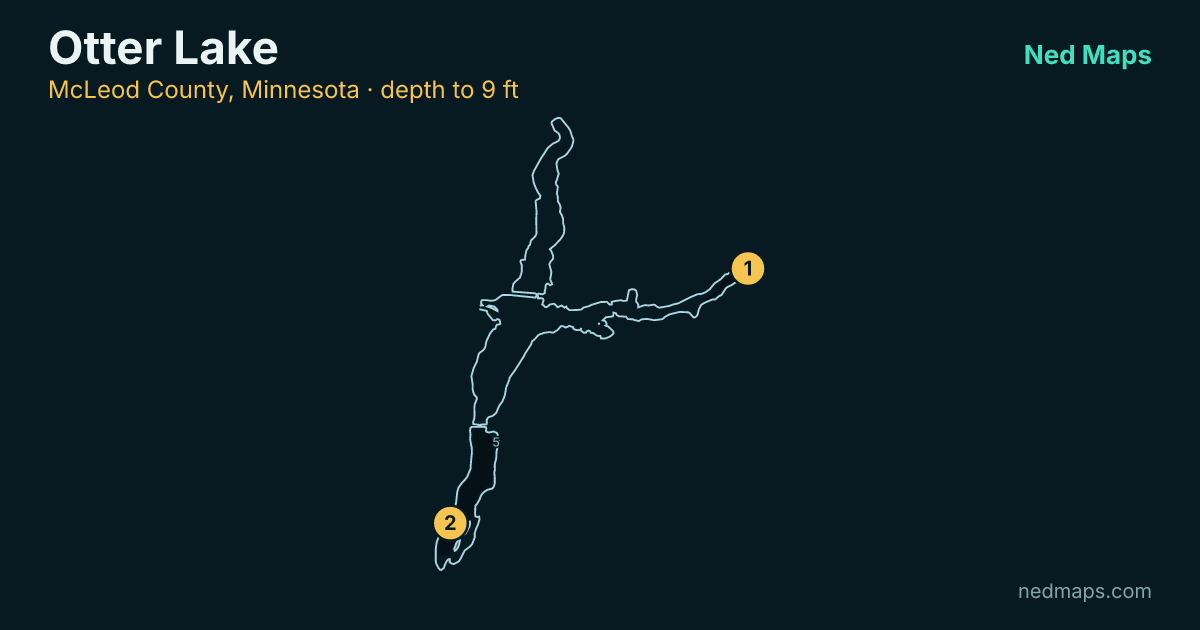
Otter Lake depth map
Within 30 miles
Nearby lakes
- French Lake · 42 ac · 4 mi
- Clear Lake · 82 ac · 4.5 mi
- Stahl's Lake · 141 ac · 4.6 mi
- Hook Lake · 330 ac · 5.2 mi
- Todd Lake · 214 ac · 6.3 mi
- Belle Lake · 864 ac · 6.4 mi
- Cedar Lake · 1,860 ac · 6.5 mi
- Marion Lake · 520 ac · 6.7 mi
Quick answers
Frequently asked questions
How deep is Otter Lake?
Otter Lake reaches 9 ft at its deepest point with a mean depth of 5 ft; about 100% of the lake is littoral (15 ft or shallower).
How big is Otter Lake?
Otter Lake covers 642 acres with about 14.2 miles of shoreline.
How clear is the water in Otter Lake?
DNR Secchi readings on Otter Lake average 1.4 ft of visibility, on the stained end for a Minnesota lake.
What fish are in Otter Lake?
Minnesota DNR surveys (most recently 2025) record walleye, largemouth bass, northern pike, bluegill, crappie, yellow perch, channel catfish.
Is Otter Lake stocked?
No stocking is on record for Otter Lake in the DNR's stocking database.
Does Otter Lake have a public access?
Yes. Otter Lake has 3 public access sites, including Otter Lake (E) (trailer launch).
How big do walleye get in Otter Lake?
The biggest walleye measured in recent DNR surveys taped 25"; the size-history table on this page tracks the biggest fish in each survey back to 2005.
When was Otter Lake last surveyed?
The Minnesota DNR last surveyed Otter Lake in 2025, the most recent of 10 surveys on record.
Page updated .

Featured guide spot
Your guide service here
One featured guide per lake, with your photo, your writeup and a link straight to your booking page. Free through December 31, 2026.
Then $20 a month from January. Cancel any time.
The live map adds today's conditions and ranked spots for Otter Lake, plus a trip plan you can share:
Open Otter Lake on the live map → Fished it lately? Write a report