Minnesota · St. Louis County
Little Grand Lake Fishing guide
Little Grand Lake is a 176-acre lake in St. Louis County, Minnesota, reaching 58 ft at its deepest point. Average water clarity runs about 13 ft. The Minnesota DNR has surveyed the lake 1 time, most recently in 2008, with walleye, largemouth bass, smallmouth bass and northern pike in the nets. That survey is 18 years old now.
DNR survey data
Fish species
Largemouth bassPresent3.4per seine haul5"Typical16"Biggest
Lengths measured · 25 fish
Northern pikeFair numbers9.8per gill net20"Typical29"Biggest
Lengths measured · 63 fish
BluegillJust a few3.1per trap net6"Typical8"Biggest
Lengths measured · 42 fish
CrappieJust a few4per trap net8"Typical11"Biggest
Lengths measured · 42 fish
Yellow perchFair numbers2.2per gill net6"Typical6"Biggest
Lengths measured · 15 fish
Rock bassGood numbers0.7per trap net7"Typical10"Biggest
Lengths measured · 14 fish
Rates come from standard DNR survey gear (gill nets, trap nets, electrofishing), judged against statewide benchmarks for the same gear, so the same number of fish per net can read differently for two species. Where the standard gear can't count a species reliably, only presence and size are listed. Typical is the middle fish of those measured. Open a row for the full length spread, survey by survey.
How to fish Little Grand Lake through the year
Northern pike
- Spring
- Pike are in the shallow bays and along new weed growth. At 13 ft of clarity, fish them deeper and lighter than usual.
- Early summer
- Pike are on the outside weed edge and points.
- Summer
- Pike are on the deep weed edge and points near the coolest water they can find. On a lake that drops to 58 ft, check the deep edge of that structure too.
- Fall
- Pike are on the last green weeds and the breaks beside them, feeding heavily as the water drops.
Walleye
- Spring
- Walleye are shallow, on and just off the spawning flats and the first green weeds. At 13 ft of clarity, fish them deeper and lighter than usual.
- Early summer
- Walleye are setting up on the outside weed edge, points and shallow structure.
- Summer
- Walleye are working the weed edge, points and any wind-blown structure. On a lake that drops to 58 ft, check the deep edge of that structure too.
- Fall
- Walleye are packing onto the sharpest breaks and points as the water cools, in big schools with short windows.
Season patterns for each species. Open the live map for today's wind, light and water temp.
Suggested tackle
What to bring
Top presentations for this lake's structure and clarity:
Northern pike · Soft plastics

Paddletail Swimbait on Jighead
4–5" paddletail swimbait on a ball-head swimbait jighead
Northern pike · Muskie & pike
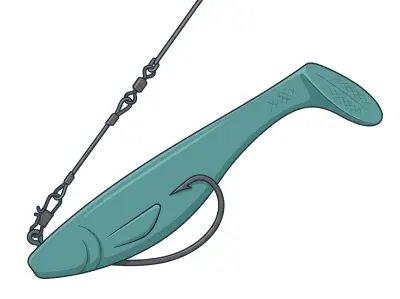
Soft Rubber (Bull Dawg / Medusa)
10" soft rubber body bait
Walleye · Live bait
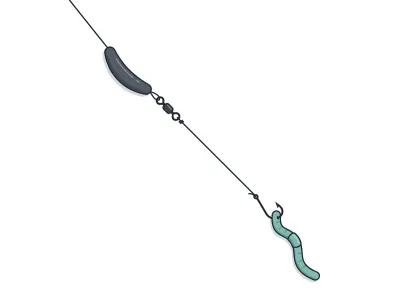
Live-Bait (Lindy) Rig + Leech/Crawler
jumbo leech or half a nightcrawler
Walleye · Trolling
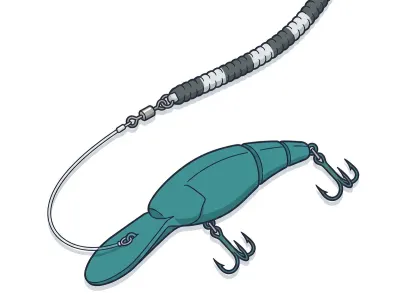
Leadcore Line + Crankbaits
4–5" mid-diving crankbait behind a long leadcore run
Largemouth bass · Soft plastics
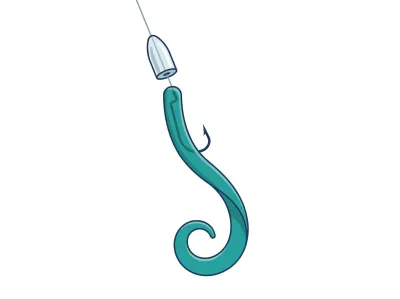
Texas-Rigged Worm
7" ribbon-tail or straight-tail plastic worm
Largemouth bass · Soft plastics
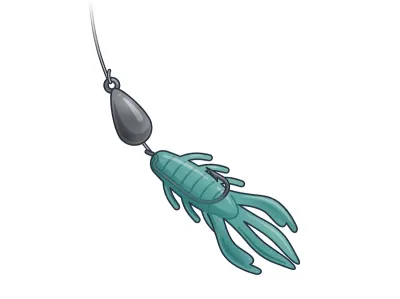
Free Rig
Creature bait or magnum finesse worm
Full setups, including hooks, weights and line, are on the live map. As an Amazon Associate I earn from qualifying purchases.
DNR stocking records
Stocking history
| Year | Species | Stocked |
|---|---|---|
| 2024 | Walleye | 9,750 fingerlings |
MN DNR · in their words
From the 2008 survey
Little Grand is a 174-acre lake near the town of Saginaw, MN. There is no public access to Little Grand. Maximum depth is 58 feet with 48% of the lake shallower than 15 feet. Little Grand has an inlet from Baby Grand and an outlet to Big Grand. The connection to Big Grand is not navigable and fish movement is limited to periods of high water. There is a navigable channel for small watercraft between Little Grand and Baby Grand and fish movement is less restricted. Little Grand was surveyed during the summer of 2008 to update information about fish populations.
Walleye abundance of 0.7 per gillnet lift was below average compared to other Minnesota lakes of similar type. Walleye mean length was 19.8 inches but not enough individuals were sampled (4) to evaluate stock density or growth. The 2002 and 2005 year-classes were present.
Read the full DNR narrative
Northern pike abundance of 9.8 per gillnet lift was above average compared to other Minnesota lakes of similar type. Mean length was 20.3 inches and growth was average when compared to other Duluth Area lakes. All year-classes from 2002 to 2007 were represented. Fall shoreline seining captured 1 young-of-the-year (YOY) northern pike.
The black crappie trapnet catch of 4.0 per lift was average compared to other Minnesota lakes of similar type. Black crappie mean length was 8.6 inches and growth was average when compared to other Duluth Area lakes. All year-classes from 2002 to 2006 were represented in the sample with strong 2002 and 2005 year-classes, comprising 81% of captured fish.
Both largemouth and smallmouth bass were captured during the survey. Although YOY largemouth bass were sampled during the 1964 survey, largemouth bass were not sampled again until the 2008 survey. A total of five largemouth bass were caught in gillnets and three in trapnets. Mean length was 10.9 inches from the gillnets, with fish up to 16.9 inches sampled. Fall shoreline seining captured 7 YOY largemouth bass. A total of nine smallmouth bass were caught in gillnets, up from eight caught in 1992, the first time smallmouth bass were sampled in Little Grand Lake. Mean length was 16.6 inches with fish up to 18.6 inches sampled.
Yellow perch abundance of 2.2 per gillnet lift was average compared to other Minnesota lakes of similar type. Mean length of perch was 6.3 inches and growth was average when compared to other Duluth Area lakes. All year-classes from 2004 to 2006 were represented.
Other fish species sampled included black bullhead, brown bullhead, yellow bullhead, pumpkinseed sunfish, rock bass, Johnny darter and white sucker.
Information was collected on aquatic vegetation, substrate and water quality. Diversity of aquatic plants was good with 35 species or species groups identified along 20 transects. Clasping-leaf pondweed was the most frequently found plant (90% of transects) followed by Canada waterweed and variable-leaf pondweed (80% of transects each). Numerous plants species or species groups were found at only one transect (5%) including the bladderwort group, hardstem bulrush, horsetail group, rush group, sessile-fruited arrowhead, sweet flag, white-stem pondweed, wool grass and yellow waterlily. The most common substrate types were sand, gravel and rubble which were identified along 100%, 70% and 40% of the transects, respectively. Results of laboratory water analysis indicate Little Grand is a slightly alkaline, moderately hard water lake with good fertility.
Narrative text from the Minnesota DNR lake survey.
Recent reports
Little Grand Lake fishing reports
Recent reports on Little Grand Lake from guides, tournaments and regular anglers. Anything posted in the last two weeks also bumps the matching spots on the live map, so you'll see a "matches a recent report" tag on them.
DNR bathymetry
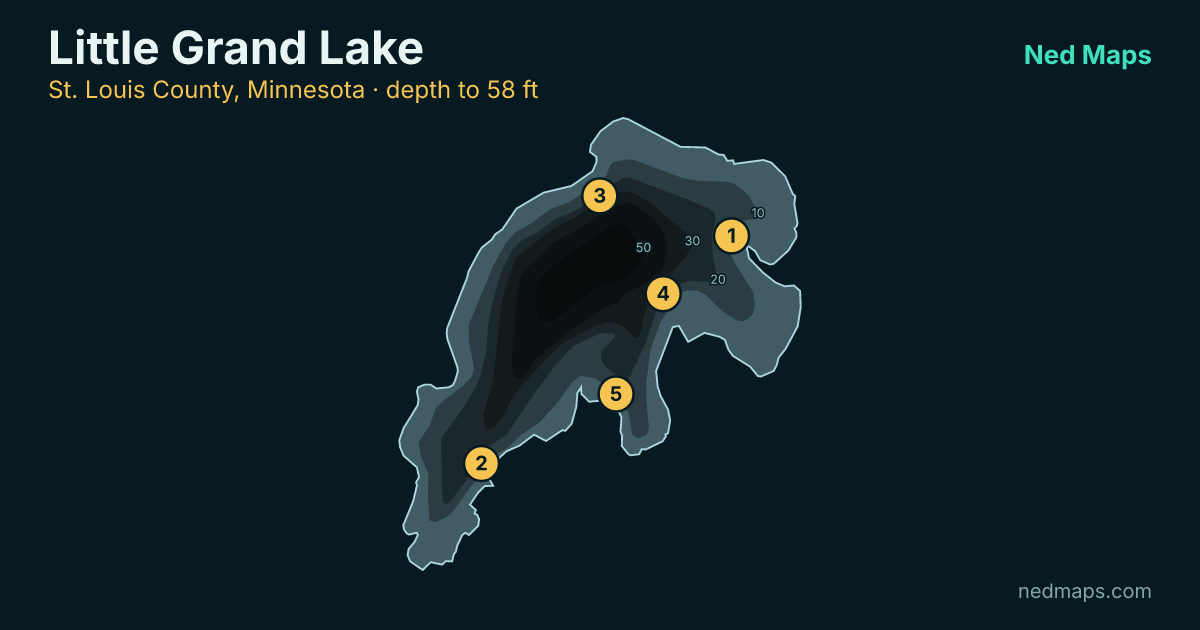
Little Grand Lake depth map
Within 30 miles
Nearby lakes
- Little Grand Lake · 65 ac · 0.5 mi
- Grand Lake · 1,665 ac · 1.7 mi
- Mud Lake · 51 ac · 3.2 mi
- Pike Lake · 488 ac · 5.6 mi
- Caribou Lake · 539 ac · 5.8 mi
- Fish Lake Flowage · 3,259 ac · 9 mi
- West Twin Lake · 121 ac · 9.1 mi
- Scanlon Reservoir · 71 ac · 9.8 mi
Quick answers
Frequently asked questions
How deep is Little Grand Lake?
Little Grand Lake reaches 58 ft at its deepest point with a mean depth of 15 ft; about 48% of the lake is littoral (15 ft or shallower).
How big is Little Grand Lake?
Little Grand Lake covers 176 acres with about 3.2 miles of shoreline.
How clear is the water in Little Grand Lake?
DNR Secchi readings on Little Grand Lake average 13 ft of visibility, clear water for a Minnesota lake.
What fish are in Little Grand Lake?
Minnesota DNR surveys (most recently 2008) record walleye, largemouth bass, smallmouth bass, northern pike, bluegill, crappie, yellow perch, rock bass.
Is Little Grand Lake stocked?
Yes. The DNR stocked walleye in 2024.
How big do northern pike get in Little Grand Lake?
The biggest northern pike measured in recent DNR surveys taped 29".
When was Little Grand Lake last surveyed?
The Minnesota DNR last surveyed Little Grand Lake in 2008. A survey that old is a starting point, not a current reading.
Page updated .

Featured guide spot
Your guide service here
One featured guide per lake, with your photo, your writeup and a link straight to your booking page. Free through December 31, 2026.
Then $20 a month from January. Cancel any time.
The live map adds today's conditions and ranked spots for Little Grand Lake, plus a trip plan you can share:
Open Little Grand Lake on the live map → Fished it lately? Write a report