Minnesota · St. Louis County
Leander Lake Fishing guide
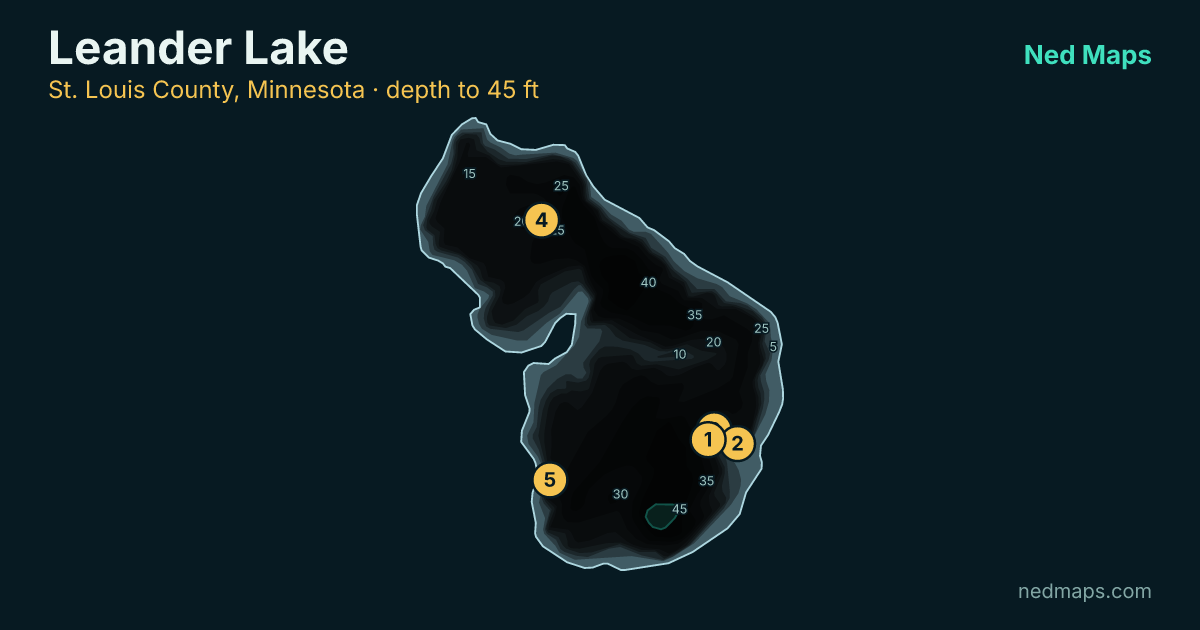
Leander Lake is a 252-acre lake in St. Louis County, Minnesota, reaching 45 ft at its deepest point. The Minnesota DNR has surveyed the lake 3 times, most recently in 1991, with walleye, largemouth bass, northern pike and bluegill in the nets. That survey is 35 years old now.
DNR survey data
Fish species
The DNR last surveyed Leander Lake in 1991. Ratings need a survey from the last 20 years, so this page lists the species from that older record without numbers.
- Walleye
- Largemouth bass
- Northern pike
- Bluegill
- Crappie
- Yellow perch
How to fish Leander Lake through the year
Walleye
- Spring
- Walleye are shallow, on and just off the spawning flats and the first green weeds.
- Early summer
- Walleye are setting up on the outside weed edge, points and shallow structure.
- Summer
- Walleye are working the weed edge, points and any wind-blown structure. On a lake that drops to 45 ft, check the deep edge of that structure too.
- Fall
- Walleye are packing onto the sharpest breaks and points as the water cools, in big schools with short windows.
Largemouth bass
- Spring
- Largemouth are moving up into the warming bays and flats, staging around wood, docks and new weeds to spawn.
- Early summer
- Largemouth are on the shallow spawning flats and protected bays, where beds go on firm bottom next to isolated cover.
- Summer
- Largemouth are in and along the weeds: cabbage and milfoil edges, matted cover and shade. On a lake that drops to 45 ft, check the deep edge of that structure too.
- Fall
- Largemouth are chasing bait back onto the flats and into the remaining green weeds, feeding hard and shallow before the freeze.
Season patterns for each species. Open the live map for today's wind, light and water temp.
Suggested tackle
What to bring
Top presentations for this lake's structure and clarity:
Walleye · Live bait

Live-Bait (Lindy) Rig + Leech/Crawler
jumbo leech or half a nightcrawler
Walleye · Trolling
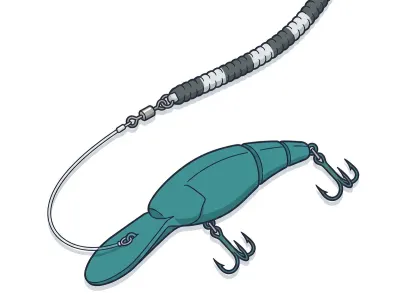
Leadcore Line + Crankbaits
4–5" mid-diving crankbait behind a long leadcore run
Largemouth bass · Hardbaits
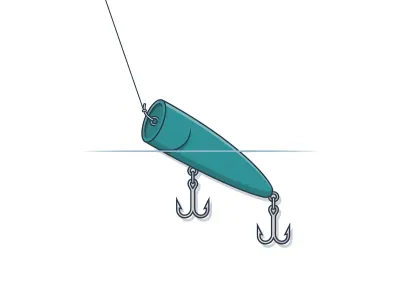
Topwater Popper
2.5–3" concave-face popper
Largemouth bass · Hardbaits
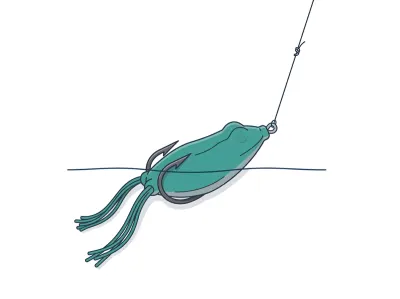
Hollow-Body Frog
3–3.5" hollow-body frog
Northern pike · Soft plastics

Paddletail Swimbait on Jighead
4–5" paddletail swimbait on a ball-head swimbait jighead
Northern pike · Muskie & pike
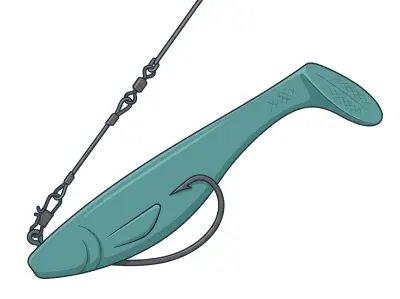
Soft Rubber (Bull Dawg / Medusa)
10" soft rubber body bait
Full setups, including hooks, weights and line, are on the live map. As an Amazon Associate I earn from qualifying purchases.
DNR stocking records
Stocking history
| Year | Species | Stocked |
|---|---|---|
| 2024 | Walleye | 140,000 fry |
| 2022 | Walleye | 70,000 fry |
| 2021 | Walleye | 70,000 fry |
| 2018 | Walleye | 100,000 fry |
| 2016 | Walleye | 65,000 fry |
MN DNR · in their words
From the 1991 survey
current test netting results indicated that the main predator species within the fish community included nop, lmb, and wae, while the other species consisted of tlc, pmk, blg, blc, and yep. Sucker and brbs were sampled in previous test netting assessments but were absent from present net catches. Yep, which were quite abundant in the 1980 assessment (cpue=10.2 fish/gill net) went almost undetected in the present net catches (1 fish in a trap net). There appears to be a shift in fish species within this lake. Gill net and trap net catches (cpue's) were evaluated with medians and quartiles calculated for ecological lake class #5 (schupp). Note: lakes in this class are soft water (alkalinities less than 40 ppm) basins with about 300 surface acres of which 25% are within the littoral zone, maximum depths are around 68 feet, and water is relatively clear as indicated by a mean secchi disk value of 14 feet. The nop population appears to have increased slightly from any previous test netting results and may be above normal for lakes in the same lake class. The current nop gill net cpue (5.4 fish/net) was the highest value determined for any test netting survey since 1950. The current catch rate is also slightly above the third quartile index (4.2 fish/net) for lake class #5. Although nop abundance may have increased from previous surveys, further analysis of mean lengths of net catches from the 1980, 1985, and 1991 assessments indicate the size structure has not changed meaningfully. Variability of the mean lengths (inches) with a 95% confidence interval for each assessment was determined as follows: 1980 (n=25 fish): 23.5 25.8); 1985 (n=27 fish): 21.2 1.0 (20.2-22.2): 1991 (n=27 fish) : 21.1 (19.9-22.3). The present tlc abundance appears to have increased as there was a 6 to 7 fold increase in the present gill net cpue from previous studies (see historical netting summary). This increase coincides with the closure of fall tlc netting beginning in 1984. Tlc habitat appears to be restricted due to summer temperature stratification, small size of lake, and limited zooplankton productivity; therefore, the potential was high for over harvest of spawning tlc with gill nets. Note: past field crew spot checks of fall tlc netting were inconclusive to evaluate harvest. The present wae population appears to be low and consists of mostly large, old fish. The cpue of 1.2 fish/gill net was below the first quartile value (2.0). The wae sample contained six fish which were all greater than 21 inches in length, and age 7 or older. This age structure corresponds to the wae stocking chronology where plantings of wae fry were discontinued in 1984. As no fish were sampled from the past seven year classes, natural reproduction appears to be non- existent in this lake. Therefore any managed wae population would need to be artificially maintained with periodic plantings of fry or fingerlings. The blg population is within normal limits for lake class #5 but the trap net catch has increased 60% from the 1985 assessment. The length frequency distributions suggest a slight shift to larger sized fish in the current assessment. The modal length group changed from 4.0-4.5 inches in 1985 to 6.0-6.4 inches in this assessment. The change in size structure may mirror a shift in age structure of the blg population. This was the first assessment where blgs were aged and back calculated lengths were determined. This information indicated a blg population of old slow growing fish with a back calculated length of 5.3 inches at last annulus formation. The lmb gill net and trap net cpue's were low and may not accurately represent the population level. The survey crew observed numerous bass when conducting the field work and many lakeshore residents reported catching lmb much more frequently in recent years (see lake conditions and fishing). Lmb were most abundant fish in seine hauls as 24 fish were sampled in 0.12 acres. Most of the suspected age 1+ fish were included in the aging sample. Distribution of age classes probably doesn't accurately represent the bass population but length values for back calculations at last annulus indicated that growth is below the state average for age groups 1,2, and 3. The cpue values for blc were low (1.2 fish/gillnet and 0.7 fish/trap net) but are normal for a lake of this class. Local anglers reported catching seining efforts revealed minimal information. It was determined that lmb may have been the only species to produce a substantial year class in 1991. One minnow species was captured (bluntnose shiner) in low numbers.
Narrative text from the Minnesota DNR lake survey.
Recent reports
Leander Lake fishing reports
Recent reports on Leander Lake from guides, tournaments and regular anglers. Anything posted in the last two weeks also bumps the matching spots on the live map, so you'll see a "matches a recent report" tag on them.
Public water access
Getting on the water
- Public access: CARRY-IN THROUGH DNR LAND ON NW PENINSULA and THRU USFS SWIMMING BEACH and PICNIC AREA ON S SHORE.
DNR bathymetry
Leander Lake depth map
Within 30 miles
Nearby lakes
- Fourteen Lake · 386 ac · 1.6 mi
- Dark Lake · 231 ac · 3.1 mi
- Camp A Lake · 18 ac · 3.6 mi
- Little Sand Lake · 96 ac · 4.5 mi
- Deepwater Lake · 22 ac · 5.1 mi
- Auto Lake · 97 ac · 5.6 mi
- Sand Lake · 779 ac · 6.1 mi
- James Lake · 18 ac · 7 mi
Quick answers
Frequently asked questions
How deep is Leander Lake?
Leander Lake reaches 45 ft at its deepest point; about 23% of the lake is littoral (15 ft or shallower).
How big is Leander Lake?
Leander Lake covers 252 acres with about 3 miles of shoreline.
What fish are in Leander Lake?
Minnesota DNR surveys (most recently 1991) record walleye, largemouth bass, northern pike, bluegill, crappie, yellow perch.
Is Leander Lake stocked?
Yes. The DNR stocked walleye in 2024; the stocking table on this page lists every year back to 2016.
Does Leander Lake have a public access?
Yes. Leander Lake has one public access site: Public access (CARRY-IN THROUGH DNR LAND ON NW PENINSULA and THRU USFS SWIMMING BEACH and PICNIC AREA ON S SHORE.).
When was Leander Lake last surveyed?
The Minnesota DNR last surveyed Leander Lake in 1991, the most recent of 3 surveys on record. That is more than 20 years ago, so this page lists species without ratings.
Page updated .

Featured guide spot
Your guide service here
One featured guide per lake, with your photo, your writeup and a link straight to your booking page. Free through December 31, 2026.
Then $20 a month from January. Cancel any time.
The live map adds today's conditions and ranked spots for Leander Lake, plus a trip plan you can share:
Open Leander Lake on the live map → Fished it lately? Write a report