Minnesota · Lake County
Isabella Lake Fishing guide
Isabella Lake covers 1,257 acres in Lake County, Minnesota, reaching 19 ft at its deepest point. Secchi readings average around 7.3 ft of visibility. The Minnesota DNR has surveyed the lake 9 times, most recently in 2016, with walleye, largemouth bass, northern pike and bluegill in the nets. That survey is 10 years old now.
DNR survey data
Fish species
WalleyeExcellent numbers7.3per gill net11"Typical21"Biggest
Lengths measured · 87 fish
Recent · 2016Lengths measured · 87 fish
2016Lengths measured · 143 fish
2006Lengths measured · 107 fish
1996No recent survey rating.
Northern pikeJust a few1.6per gill net27"Typical39"Biggest
Lengths measured · 19 fish
Recent · 2016Lengths measured · 19 fish
2016Lengths measured · 40 fish
2006Lengths measured · 17 fish
1996BluegillNo recent survey ratingNo recent survey rating.
No recent survey rating.
Lengths measured · 32 fish
CrappiePresent1.2per gill net2"Typical11"Biggest
Lengths measured · 33 fish
Recent · 2016Lengths measured · 33 fish
2016Lengths measured · 4 fish
2006Only 4 fish measured that year — too few to read as a shape.
Yellow perchFair numbers3.9per gill net6"Typical11"Biggest
Lengths measured · 75 fish
Recent · 2016Lengths measured · 75 fish
2016Lengths measured · 73 fish
2006Lengths measured · 37 fish
1996Rock bassGood numbers1.6per gill net7"Typical9"Biggest
Lengths measured · 19 fish
Recent · 2016Lengths measured · 19 fish
2016Lengths measured · 15 fish
2006Lengths measured · 2 fish
1996Only 2 fish measured that year — too few to read as a shape.
Rates come from standard DNR survey gear (gill nets, trap nets, electrofishing), judged against statewide benchmarks for the same gear, so the same number of fish per net can read differently for two species. Where the standard gear can't count a species reliably, only presence and size are listed. Typical is the middle fish of those measured. Open a row for the full length spread, survey by survey.
How to fish Isabella Lake through the year
Walleye
- Spring
- Walleye are shallow, on and just off the spawning flats and the first green weeds.
- Early summer
- Walleye are setting up on the outside weed edge, points and shallow structure.
- Summer
- Walleye are working the weed edge, points and any wind-blown structure. With 77% of this lake 15 ft or shallower, the weed edge is the main event.
- Fall
- Walleye are packing onto the sharpest breaks and points as the water cools, in big schools with short windows. A 19-ft bowl cools fast, so the fall window comes early here.
Northern pike
- Spring
- Pike are in the shallow bays and along new weed growth.
- Early summer
- Pike are on the outside weed edge and points.
- Summer
- Pike are on the deep weed edge and points near the coolest water they can find. With 77% of this lake 15 ft or shallower, the weed edge is the main event.
- Fall
- Pike are on the last green weeds and the breaks beside them, feeding heavily as the water drops. A 19-ft bowl cools fast, so the fall window comes early here.
Season patterns for each species. Open the live map for today's wind, light and water temp.
Size history
Biggest fish by survey year
| Survey year | Walleye | Northern pike | Largemouth bass |
|---|---|---|---|
| 2016 | 21" | 39" | 6" |
| 2006 | 26" | 36" | 6" |
| 1996 | 22" | 27" | — |
Longest fish measured by DNR survey crews in each year's nets. Survey gear samples the population, so the lake usually holds larger fish than any survey measured.
Suggested tackle
What to bring
Top presentations for this lake's structure and clarity:
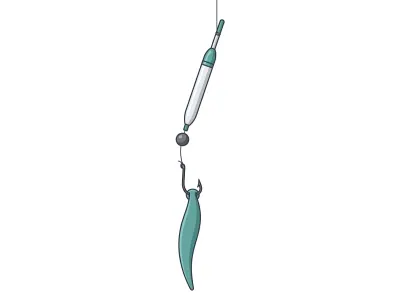
Walleye · Trolling
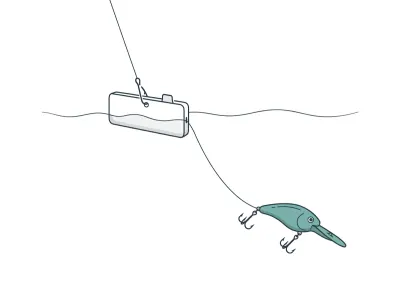
Planer Board Spread
4–6" crankbait or a 5–6 ft crawler harness run out to the side on an in-line planer board
Northern pike · Soft plastics
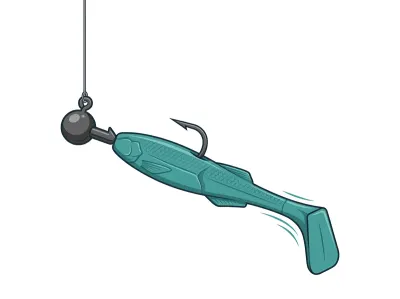
Paddletail Swimbait on Jighead
4–5" paddletail swimbait on a ball-head swimbait jighead
Northern pike · Jigs & bladed
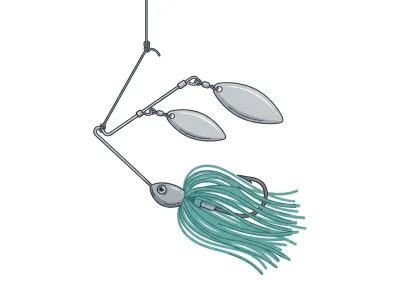
Spinnerbait
3/8–1/2 oz safety-pin spinnerbait with tandem willow-leaf blades
Largemouth bass · Soft plastics

Texas-Rigged Worm
7" ribbon-tail or straight-tail plastic worm
Largemouth bass · Soft plastics
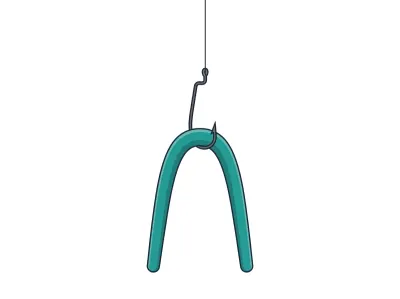
Wacky-Rigged Stickworm
5" stickworm
Full setups, including hooks, weights and line, are on the live map. As an Amazon Associate I earn from qualifying purchases.
MN DNR · in their words
From the 2016 survey
Isabella Lake has an area of 1,257 acres and has a maximum depth of 19 feet. It is located entirely with the Boundary Waters Canoe Area Wilderness (BWCAW) approximately 13 miles north of Isabella, MN off of USFS Road 377 (Tomahawk Road). The lake has three different access points. The main access to Isabella Lake is a 56 rod portage from the parking lot at BWCAW Entry Point 35, the second access is a 16 rod portage from Boga Lake on the eastern shore, and the third access is a 28 rod portage from the Isabella River on the western shore. There are currently nine campsites open to public use on the lake with an additional campsite being classified as a resting site. Isabella Lake gets a moderate to high use during the summer by visitors to the BWCAW.
Water clarity is poor with visibility measured to 5.5 feet in brown bog-stained water. The shoreline and watershed around the lake are recovering from the Pagami Creek Fire, which moved through the area in 2011. A majority of the shoreline contains young plant growth as the forest regenerates. The southeastern shore was the not affected by the fire and remains in a completely forested state. The entire shoreline and watershed is under public ownership. The aquatic and riparian plant community is diverse with 31 species present in the lake. Boulder, ledge rock, and sand are the most common substrates. Walleye, Northern Pike, Black Crappie, and Yellow Perch are the most common game fish in the lake.
Read the full DNR narrative
The 2016 standard survey was conducted to monitor abundance and size structure of the fish populations in Isabella Lake. The survey also sought to determine the status of Black Crappie and Largemouth Bass populations in the lake, which were first found in 2006.
The Walleye catch was above average relative to similar lakes in the Northeastern Minnesota with a total of 87 fish sampled in gill nets. The average length of Walleye was 11.6 inches with an average weight of 0.7 pounds. Even with the high number of Walleye sampled, only 5% of the catch was over 15 inches long. The largest Walleye sampled was 21.2 inches long and weighed 2.8 pounds. Eight year classes were represented in the 2016 survey indicating consistent recruitment to the population. Walleye growth was slow for the Finland Area.
The 2016 Northern Pike catch was below average for lakes in the Finland Area with 19 fish sampled. The average weight of the Northern Pike sampled was 5.2 pounds and average length was 27.1 inches. Of the 19 Northern Pike sampled, five were over 35 inches long. The largest Northern Pike caught was 39.4 inches long and weighed 14.6 pounds. Nine year classes were present in the sample and growth of Northern Pike appears to be fast for the Finland Area.
Black Crappie were sampled at average numbers for lakes with similar characteristics in the Finland Area with a total of 14 fish caught. Black Crappie ranged from 4.4 to 11.9 inches, with approximately 40 % of the catch over 10 inches. The average weight was just under 0.5 pounds. Black Crappie lakes in the Finland Area tend to have small populations with fast growing fish that may have an occasional strong year class. The spawning habitat in Isabella Lake appears to be good for Black Crappie, but the cool climate of northeastern Minnesota may be a limiting factor in successful reproduction for years with a late spring or cool summer.
The Yellow Perch gill net catch was near average for similar lakes in the Northeastern Minnesota. The average weight of Yellow Perch was 0.26 pounds with an average length of 8.3 inches. The largest Yellow Perch caught was 11.8 inches long and weighed 0.8 pounds. Yellow Perch over 9 inches long made up 34% of the total catch. Growth was average for the Finland Area with seven year class present.
The 2016 survey sampled seven Largemouth Bass with the largest being 6.9 inches long. This was the second survey that sampled Largemouth Bass in Isabella Lake. Largemouth Bass are difficult to sample with standard survey gill nets and the full scope of the bass population is not known.
A total of 72 Lake Whitefish were caught with gill nets, which was about average for comparable lakes in Northeastern Minnesota. The average length of Lake Whitefish was 11.1 inches with an average weight of 0.6 pounds. The largest whitefish caught was 17.3 inches and 2.0 pounds. Nine year classes were represented in the survey and growth of Lake Whitefish appeared to be average for the area.
White Sucker were sampled at average numbers when compared to similar lakes. The average length of White Sucker was 15.1 inches and just over 1.6 pounds in weight. The 2016 survey caught 19 Rock Bass with an average length of 7.2 inches and 0.3 pounds.
Other fish sampled included Pumpkinseed Sunfish, Blacknose Shiner, Spottail Shiner, Tadpole Madtom, Bluegill, and young of the year sunfish. This was the first time Bluegill had been sampled in Isabella Lake.
Isabella Lake is a good Walleye lake that can produce numerous "eater size" Walleyes. The lake can also produce some trophy size Northern Pike. The Black Crappie population is still being established, but currently there are nice fish to be caught if anglers are able to locate them. The Lake Whitefish population is healthy and the lake is open to whitefish sport gill netting in the fall; a whitefish netting license is required. The netting season usually has a small number of individuals who participate. Angling pressure on the lake is presumed to be moderate to high and all anglers and visitors to Isabella Lake must abide by the BWCAW regulations at all times; the lake is entirely non-motorized.
Narrative text from the Minnesota DNR lake survey.
Recent reports
Isabella Lake fishing reports
Recent reports on Isabella Lake from guides, tournaments and regular anglers. Anything posted in the last two weeks also bumps the matching spots on the live map, so you'll see a "matches a recent report" tag on them.
Public water access
Getting on the water
- Isabella Lake (carry-in)
DNR bathymetry
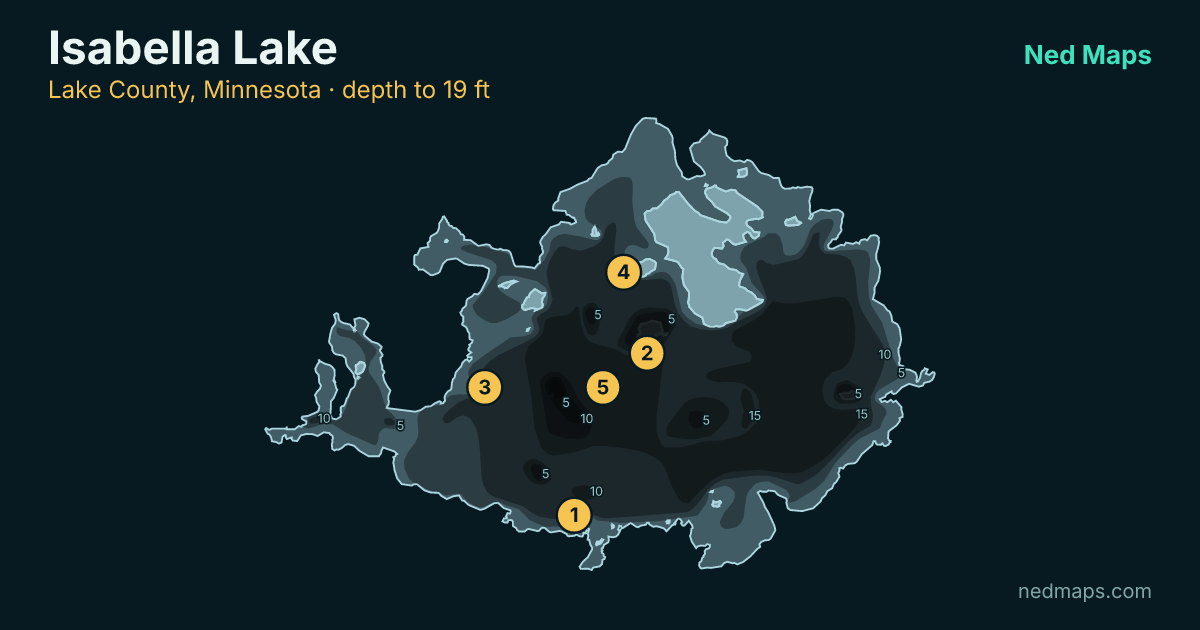
Isabella Lake depth map
Within 30 miles
Nearby lakes
- Boga Lake · 30 ac · 1.4 mi
- Island River Lake · 81 ac · 3.9 mi
- Comfort Lake · 42 ac · 4 mi
- Bog Lake · 259 ac · 4.9 mi
- Section 29 Lake · 100 ac · 5.2 mi
- Bunny Lake · 39 ac · 5.8 mi
- Sylvania Lake · 77 ac · 6.3 mi
- Quadga Lake · 251 ac · 6.5 mi
Quick answers
Frequently asked questions
How deep is Isabella Lake?
Isabella Lake reaches 19 ft at its deepest point with a mean depth of 8 ft; about 77% of the lake is littoral (15 ft or shallower).
How big is Isabella Lake?
Isabella Lake covers 1,257 acres with about 17.1 miles of shoreline.
How clear is the water in Isabella Lake?
DNR Secchi readings on Isabella Lake average 7.3 ft of visibility, middling clarity for a Minnesota lake.
What fish are in Isabella Lake?
Minnesota DNR surveys (most recently 2016) record walleye, largemouth bass, northern pike, bluegill, crappie, yellow perch, rock bass.
Is Isabella Lake stocked?
No stocking is on record for Isabella Lake in the DNR's stocking database.
Does Isabella Lake have a public access?
Yes. Isabella Lake has one public access site: Isabella Lake (carry-in).
How big do walleye get in Isabella Lake?
The biggest walleye measured in recent DNR surveys taped 21"; the size-history table on this page tracks the biggest fish in each survey back to 1996.
When was Isabella Lake last surveyed?
The Minnesota DNR last surveyed Isabella Lake in 2016, the most recent of 9 surveys on record. A survey that old is a starting point, not a current reading.
Page updated .

Featured guide spot
Your guide service here
One featured guide per lake, with your photo, your writeup and a link straight to your booking page. Free through December 31, 2026.
Then $20 a month from January. Cancel any time.
The live map adds today's conditions and ranked spots for Isabella Lake, plus a trip plan you can share:
Open Isabella Lake on the live map → Fished it lately? Write a report