Minnesota · St. Louis County
Esquagama Lake Fishing guide
Esquagama Lake sits in St. Louis County, Minnesota, and covers 453 acres, reaching 90 ft at its deepest point. Secchi readings average around 6 ft of visibility. The Minnesota DNR has surveyed the lake 4 times, most recently in 2018, with walleye, northern pike, bluegill and crappie in the nets. That survey is 8 years old now.
DNR survey data
Fish species
WalleyeGood numbers5.8per gill net10"Typical29"Biggest
Lengths measured · 55 fish
Recent · 2018Lengths measured · 55 fish
2018Lengths measured · 41 fish
1999Northern pikeJust a few2.1per gill net20"Typical38"Biggest
Lengths measured · 24 fish
Recent · 2018Lengths measured · 24 fish
2018Lengths measured · 40 fish
1999BluegillJust a few6per trap net4"Typical8"Biggest
Lengths measured · 54 fish
Recent · 2018Lengths measured · 54 fish
2018Lengths measured · 239 fish
1999CrappieJust a few2.3per trap net8"Typical12"Biggest
Lengths measured · 21 fish
Recent · 2018Lengths measured · 21 fish
2018Lengths measured · 9 fish
1999Only 9 fish measured that year — too few to read as a shape.
Rock bassExcellent numbers1.8per trap net8"Typical10"Biggest
Lengths measured · 16 fish
Recent · 2018Lengths measured · 16 fish
2018Lengths measured · 38 fish
1999Rates come from standard DNR survey gear (gill nets, trap nets, electrofishing), judged against statewide benchmarks for the same gear, so the same number of fish per net can read differently for two species. Where the standard gear can't count a species reliably, only presence and size are listed. Typical is the middle fish of those measured. Open a row for the full length spread, survey by survey.
How to fish Esquagama Lake through the year
Walleye
- Spring
- Walleye are shallow, on and just off the spawning flats and the first green weeds.
- Early summer
- Walleye are setting up on the outside weed edge, points and shallow structure.
- Summer
- Walleye are working the weed edge, points and any wind-blown structure. On a lake that drops to 90 ft, check the deep edge of that structure too.
- Fall
- Walleye are packing onto the sharpest breaks and points as the water cools, in big schools with short windows.
Northern pike
- Spring
- Pike are in the shallow bays and along new weed growth.
- Early summer
- Pike are on the outside weed edge and points.
- Summer
- Pike are on the deep weed edge and points near the coolest water they can find. On a lake that drops to 90 ft, check the deep edge of that structure too.
- Fall
- Pike are on the last green weeds and the breaks beside them, feeding heavily as the water drops.
Season patterns for each species. Open the live map for today's wind, light and water temp.
Size history
Biggest fish by survey year
| Survey year | Walleye | Northern pike | Bluegill |
|---|---|---|---|
| 2018 | 29" | 38" | 8" |
| 1999 | 29" | 31" | 9" |
Longest fish measured by DNR survey crews in each year's nets. Survey gear samples the population, so the lake usually holds larger fish than any survey measured.
Suggested tackle
What to bring
Top presentations for this lake's structure and clarity:
Walleye · Live bait

Live-Bait (Lindy) Rig + Leech/Crawler
jumbo leech or half a nightcrawler
Walleye · Trolling
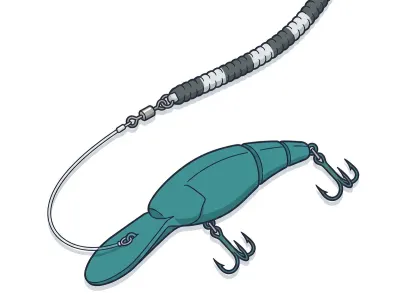
Leadcore Line + Crankbaits
4–5" mid-diving crankbait behind a long leadcore run
Northern pike · Soft plastics
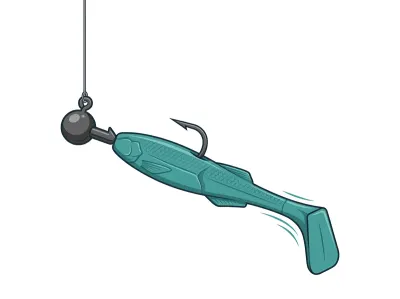
Paddletail Swimbait on Jighead
4–5" paddletail swimbait on a ball-head swimbait jighead
Northern pike · Muskie & pike
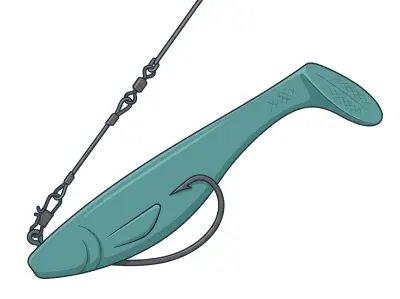
Soft Rubber (Bull Dawg / Medusa)
10" soft rubber body bait
Bluegill · Live bait
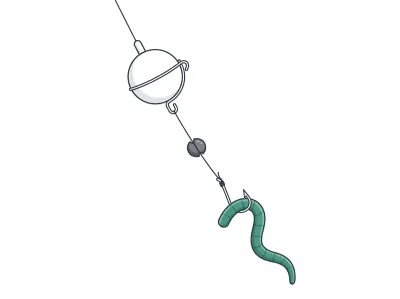
Clip-On Bobber + Worm
half to whole garden nightcrawler
Bluegill · Soft plastics
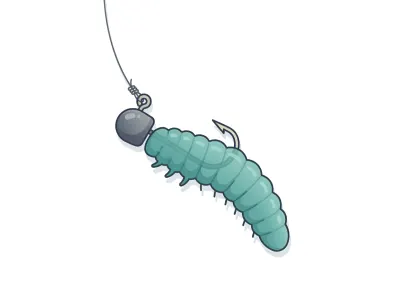
Tungsten Jig + Micro Plastic
1–1.5" micro plastic
Full setups, including hooks, weights and line, are on the live map. As an Amazon Associate I earn from qualifying purchases.
MN DNR · in their words
From the 2018 survey
Esquagama Lake is a 453 acre lake located five miles southeast of Gilbert. It is accessed by a ramp on the south side of the lake on land that is privately owned by the Eshquaguma Country Club. This Ecological Lake Class 5 lake has a maximum depth of 90 feet and dark brown water. On July 17, 2018 Esquagama Lake was weakly thermally stratified with a surface temperature of 75 F and a bottom temperature of 42 F. Oxygen levels were adequate for gamefish throughout the water column.
Esquagama is relatively developed with year round and seasonal homes. Lake bottom substrates along the shoreline are mostly sand and rubble. The only place a substantial amount of aquatic vegetation grows is in the long muck bottom bay that extends to the southwest. The Embarrass River enters the lake on the north end and empties out the southwest corner. There are no barriers to fish movement in the inlet from Cedar Island Lake. The outlet to the St. Louis River has a dam with a fixed head of several feet. At times of high water fish are able to move in and out of Esquagama Lake.
Read the full DNR narrative
The overall gillnet catch rate for all fish combined was 22.7 fish/net which was below average compared to past surveys on the lake. Fish species sampled were cisco, walleye, northern pike, white sucker, black bullhead, and yellow perch. Trap nets caught fish at an overall rate of 12.4 fish/net which was also lower than average for the lake. Additional species sampled in trap nets were bluegill, black crappie, rock bass, shorthead redhorse, pumpkinseed, and brown bullhead.
Fifty-two walleye were sampled in gill nets for a catch rate of 5.8 fish/net, which was above average compared to other similar lakes in the state and the highest catch on record for Esquagama Lake. Sizes ranged from 8 to 29 inches with an average of 12 inches which was bigger than normal for the lake. As is the often the case for lakes with strong river influence, walleye growth can be somewhat slow. It takes the average walleye 7 years to reach 15 inches in Esquagama.
The northern pike gillnet catch was 2.1 fish/net which was higher than normal for Esquagama but lower than average compared to other similar lakes. Lengths ranged from 16 to 39 inches with an average of 23 inches. The average weight was nearly 3 pounds which was good compared to other similar lakes in the state.
The bluegill trapnet catch was 6 fish/net which was similar to most past surveys on the lake, with one exception being a high catch rate in 1999. Lengths were also similar with an average of 5 inches and the biggest fish measuring nearly 9 inches.
The black crappie trapnet catch was 2.3 fish/net which was above average compared to other similar lakes and tied for the highest catch rate on Esquagama. Lengths ranged from 4 to 12 inches with an average of just over 8 inches. Ages ranged from 1 to 8 with the strongest representation from the 2015 year class. Growth rates were average compared to other area crappie lakes.
The cisco catch rate was 13.3 fish/gill net which was below average compared to past surveys on Esquagama. The average length of 8 inches was smaller than past surveys. The biggest fish which measured over 15 inches, was similar to big fish caught in past surveys.
Other species sampled but in lower numbers were black and brown bullhead, white sucker, yellow perch, pumpkinseed, rock bass, and shorthead redhorse.
Some of the northern pike and rock bass had moderate neascus (black spot) infestations.
Rusty crayfish, a non-native invasive species, were sampled for the first time in Esquagama Lake during the 1999 survey. In that survey, over 11/gill net and 46/trap net were sampled. The 2018 survey showed a lower abundance with a gill net catch rate of just over 3/net and a trap net catch rate of less than 1/net.
Narrative text from the Minnesota DNR lake survey.
Recent reports
Esquagama Lake fishing reports
Recent reports on Esquagama Lake from guides, tournaments and regular anglers. Anything posted in the last two weeks also bumps the matching spots on the live map, so you'll see a "matches a recent report" tag on them.
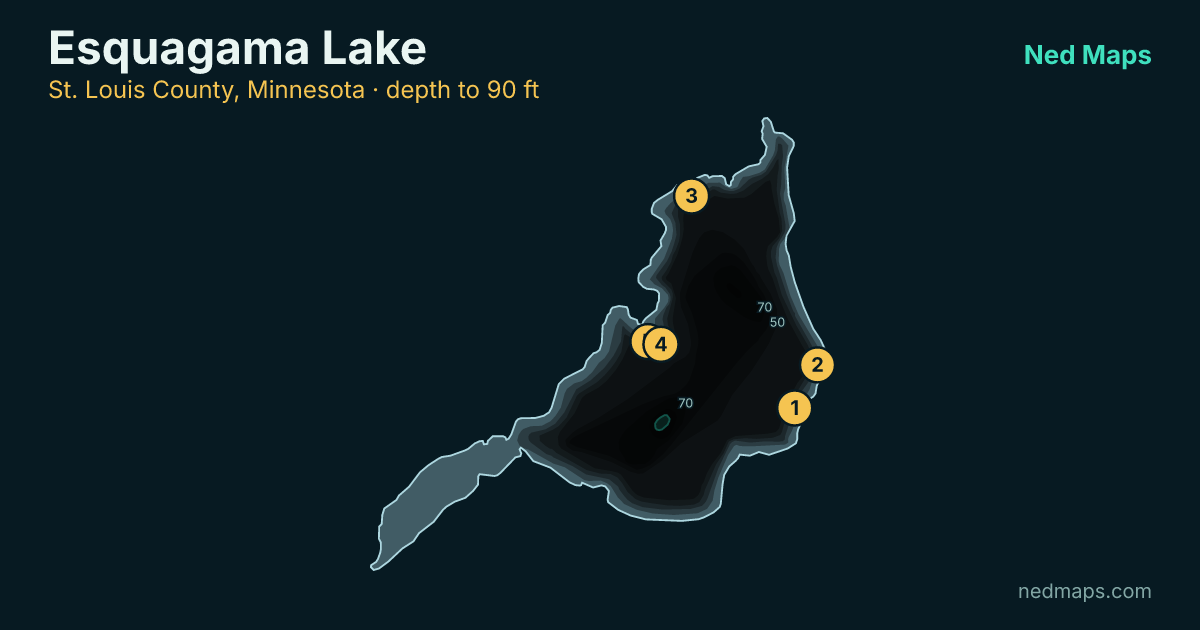
DNR bathymetry
Esquagama Lake depth map
Within 30 miles
Nearby lakes
- Bass Lake · 147 ac · 1.9 mi
- Silver Lake · 38 ac · 2 mi
- Cedar Island Lake · 205 ac · 2.2 mi
- Lost Lake · 124 ac · 2.4 mi
- Cedar Lake · 32 ac · 4.3 mi
- Frying Pan Lake · 69 ac · 4.7 mi
- Embarrass Lake · 463 ac · 4.9 mi
- Gilbert Pit · 243 ac · 4.9 mi
Quick answers
Frequently asked questions
How deep is Esquagama Lake?
Esquagama Lake reaches 90 ft at its deepest point; about 18% of the lake is littoral (15 ft or shallower).
How big is Esquagama Lake?
Esquagama Lake covers 453 acres with about 5.5 miles of shoreline.
How clear is the water in Esquagama Lake?
DNR Secchi readings on Esquagama Lake average 6 ft of visibility, middling clarity for a Minnesota lake.
What fish are in Esquagama Lake?
Minnesota DNR surveys (most recently 2018) record walleye, northern pike, bluegill, crappie, yellow perch, rock bass.
Is Esquagama Lake stocked?
No stocking is on record for Esquagama Lake in the DNR's stocking database.
How big do walleye get in Esquagama Lake?
The biggest walleye measured in recent DNR surveys taped 29"; the size-history table on this page tracks the biggest fish in each survey back to 1999.
When was Esquagama Lake last surveyed?
The Minnesota DNR last surveyed Esquagama Lake in 2018, the most recent of 4 surveys on record. A survey that old is a starting point, not a current reading.
Page updated .

Featured guide spot
Your guide service here
One featured guide per lake, with your photo, your writeup and a link straight to your booking page. Free through December 31, 2026.
Then $20 a month from January. Cancel any time.
The live map adds today's conditions and ranked spots for Esquagama Lake, plus a trip plan you can share:
Open Esquagama Lake on the live map → Fished it lately? Write a report