Minnesota · Chisago County
East Rush Lake Fishing guide
East Rush Lake is a 1,494-acre lake in Chisago County, Minnesota, reaching 24 ft at its deepest point. Average water clarity runs about 2.2 ft. The Minnesota DNR has surveyed the lake 15 times, most recently in 2024, with walleye, largemouth bass, smallmouth bass and northern pike in the nets.
DNR survey data
Fish species
WalleyeLast stocked 2025Fair numbers3.3per gill net20"Typical31"Biggest
Lengths measured · 1490 fish
Recent · 2023 + 2024Lengths measured · 1448 fish
2024Lengths measured · 42 fish
2023Lengths measured · 26 fish
2019Lengths measured · 34 fish
2015No recent survey rating.
Northern pikeFair numbers6.5per gill net28"Typical38"Biggest
Lengths measured · 761 fish
Recent · 2023 + 2024Lengths measured · 667 fish
2024Lengths measured · 94 fish
2023Lengths measured · 57 fish
2019Lengths measured · 62 fish
2015MuskellungeLast stocked 2025Present, stockedPresent and managed by the DNR.
Present and managed by the DNR.
Lengths measured · 48 fish
Recent · 2023 + 2024Lengths measured · 47 fish
2024Lengths measured · 1 fish
2023Only 1 fish measured that year — too few to read as a shape.
Lengths measured · 2 fish
2015Only 2 fish measured that year — too few to read as a shape.
Lengths measured · 17 fish
2012BluegillJust a few11.3per trap net6"Typical9"Biggest
Lengths measured · 150 fish
Recent · 2023Lengths measured · 150 fish
2023Lengths measured · 112 fish
2019Lengths measured · 387 fish
2015Lengths measured · 266 fish
2011CrappieJust a few9.6per trap net5"Typical11"Biggest
Lengths measured · 924 fish
Recent · 2023 + 2024Lengths measured · 138 fish
2024Lengths measured · 786 fish
2023Lengths measured · 379 fish
2019Lengths measured · 754 fish
2015Yellow perchExcellent numbers19.4per gill net8"Typical11"Biggest
Lengths measured · 261 fish
Recent · 2023Lengths measured · 261 fish
2023Lengths measured · 291 fish
2019Lengths measured · 532 fish
2015Lengths measured · 495 fish
2011Rates come from standard DNR survey gear (gill nets, trap nets, electrofishing), judged against statewide benchmarks for the same gear, so the same number of fish per net can read differently for two species. Where the standard gear can't count a species reliably, only presence and size are listed. Typical is the middle fish of those measured. Open a row for the full length spread, survey by survey.
How to fish East Rush Lake through the year
Walleye
- Spring
- Walleye are shallow, on and just off the spawning flats and the first green weeds. In 2.2 ft of visibility, they sit shallower than you think.
- Early summer
- Walleye are setting up on the outside weed edge, points and shallow structure.
- Summer
- Walleye are working the weed edge, points and any wind-blown structure. With 69% of this lake 15 ft or shallower, the weed edge is the main event.
- Fall
- Walleye are packing onto the sharpest breaks and points as the water cools, in big schools with short windows.
Northern pike
- Spring
- Pike are in the shallow bays and along new weed growth. In 2.2 ft of visibility, they sit shallower than you think.
- Early summer
- Pike are on the outside weed edge and points.
- Summer
- Pike are on the deep weed edge and points near the coolest water they can find. With 69% of this lake 15 ft or shallower, the weed edge is the main event.
- Fall
- Pike are on the last green weeds and the breaks beside them, feeding heavily as the water drops.
Season patterns for each species. Open the live map for today's wind, light and water temp.
Size history
Biggest fish by survey year
| Survey year | Walleye | Northern pike | Largemouth bass |
|---|---|---|---|
| 2024 | 31" | 38" | — |
| 2023 | 26" | 37" | 17" |
| 2019 | 27" | 36" | 19" |
| 2015 | 28" | 35" | 16" |
| 2011 | 33" | 39" | 19" |
| 2007 | 28" | 41" | 17" |
| 2002 | 28" | 35" | 20" |
| 1997 | 25" | 38" | 18" |
Longest fish measured by DNR survey crews in each year's nets. Survey gear samples the population, so the lake usually holds larger fish than any survey measured.
Suggested tackle
What to bring
Top presentations for this lake's structure and clarity:
Walleye · Live bait

Live-Bait (Lindy) Rig + Leech/Crawler
jumbo leech or half a nightcrawler
Walleye · Trolling
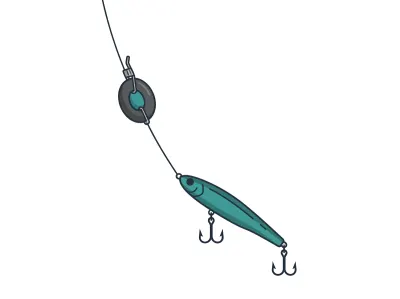
Snap Weights + Stickbaits
4–5" suspending or slow-floating stickbait
Northern pike · Soft plastics
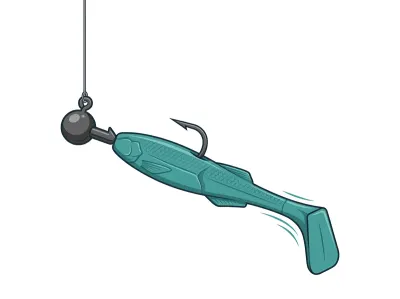
Paddletail Swimbait on Jighead
4–5" paddletail swimbait on a ball-head swimbait jighead
Northern pike · Jigs & bladed
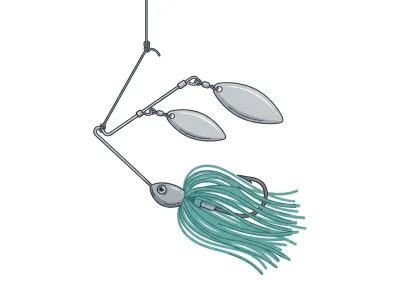
Spinnerbait
3/8–1/2 oz safety-pin spinnerbait with tandem willow-leaf blades
Largemouth bass · Soft plastics
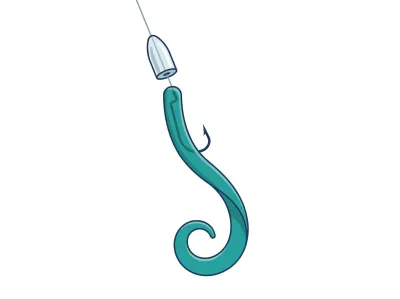
Texas-Rigged Worm
7" ribbon-tail or straight-tail plastic worm
Largemouth bass · Jigs & bladed
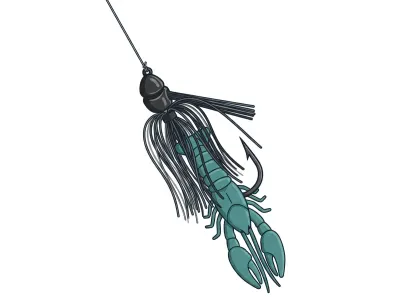
Skirted Casting Jig + Craw Trailer
3.5–4" craw-style trailer on a skirted casting/flipping jig
Full setups, including hooks, weights and line, are on the live map. As an Amazon Associate I earn from qualifying purchases.
DNR stocking records
Stocking history
| Year | Species | Stocked |
|---|---|---|
| 2025 | Muskellunge | 97 yearlings |
| 2025 | Walleye | 8,765 fingerlings · 5,870 yearlings · 410 adults |
| 2024 | Muskellunge | 517 fingerlings |
| 2023 | Muskellunge | 227 fingerlings |
| 2023 | Walleye | 30,889 fingerlings |
| 2022 | Muskellunge | 517 fingerlings |
| 2021 | Muskellunge | 439 fingerlings |
| 2021 | Walleye | 25,517 fingerlings |
| 2019 | Muskellunge | 1,054 fingerlings |
| 2019 | Walleye | 34,344 fingerlings |
| 2017 | Muskellunge | 517 fingerlings |
| 2017 | Walleye | 26,860 fingerlings |
Stocking records before 2017 omitted.
MN DNR · in their words
From the 2024 survey
East Rush Lake is a 1,481-acre lake in northern Chisago County located four miles west of Rush City, MN, and is within the Lower St. Croix River Watershed. The lake has a maximum depth of 24 feet, an average depth of 8 feet, and 70% of the lake is 15 feet or less (1,033 acres). East Rush has four inlets, three small ones from adjacent wetlands and a larger connection to West Rush Lake. It has one outlet, Rush Creek, which flows downstream into the St. Croix River. Recent aquatic vegetation surveys have indicated species diversity was average, which is influenced by low water clarity (2-3 feet) and the presence of non-native plants including Curlyleaf pondweed and Eurasian watermilfoil. Floating and emergent vegetation is limited and mainly located in the southeast bay. Sand is the most common substrate followed by clay and gravel. A high amount of shoreline development is present. There is a state administered concrete access on the northeast shore of the lake with space for 30 rigs.
A netting survey using 15 large frame traps nets to target Muskie was conducted on East Rush Lake from April 9 -29, 2024. There were 4 older style trap nets used (4 x 5 foot frames) and 11 (5 x 6 foot frames) large trap nets used. The four older style nets are shorter and were used in very shallow areas in an attempt to get the nets closer to the shoreline. These nets still had to be out from the shoreline to get the throats under water. Some nets were moved during the survey for a total of 18 different net locations. Initial sets were placed where most of the fish had been caught in previous surveys.
Read the full DNR narrative
In addition to Muskies, data was collected from all Northern Pike and Walleye sampled. Data was also collected from a subsample of Black Crappie for a research project. Water temperatures ranged from 50-60 degrees during this survey. Muskies spawn at temperatures within this range, with peak spawning activity typically occurring around 55 degrees. This was the eighth spring Muskie assessment on East Rush Lake, with previous surveys that occurred in 1987, 1992, 1997, 2001, 2006, 2011, and 2017. Nets were checked daily for 20 consecutive days. All Muskie, Northern Pike, and Walleye were measured, while Muskie were weighed, and examined for a tag. If a tag was not present, Muskies were tagged with an individual PIT (Passive Integrated Transponder) tag. A subsample of Black Crappies were measured and ageing structures were collected.
A total of 47 Muskies were caught in 2024, 11 females, 34 males, and 1 immature fish. The catch rate in 2024 was 0.17/net, compared to the catch rate of 0.15/net in 2017. The number of Muskies caught between the eight surveys has varied due to spring sampling conditions, sampling effort, changes in population size, and other variables. The number of Muskies sampled throughout the various surveys was: 1987 (38), 1992 (18), 1997 (44), 2001 (82), 2006 (32), 2011 (39), 2017 (22), and 2024 (47).
Females ranged in length from 41.8-52.0 inches and had an average length of 47.0 inches. Female average weight was 25.8 pounds, with a range from 16.2 to 37.2 pounds. Males ranged in length from 33.4-43.3 inches and had an average length of 38.9 inches. Male average weight was 14.8 pounds, with a range from 8.7 to 23.9 pounds.
In addition to the Muskies sampled in 2024, 1,431 Walleyes and 667 Northern Pike were also sampled and measured. Walleye ranged in length from 12.6-31.9 inches and had an average length of 20.4 inches. Northern Pike ranged in length from 12.7-39.0 inches and had an average length of 28.6 inches. A special regulation is present for Northern Pike which requires all pike from 26-40 inches must be immediately released. The possession limit is 3, which can only include 1 over 40 inches. Overall, 31% of pike sampled were less than 26 inches and available for harvest, while 44% were 30-39 inches.
Data was also collected from 158 Black Crappies. Past standard surveys on East Rush Lake have occurred in August, which is not the most appropriate time to evaluate an adult crappie population. A Muskellunge survey from mid-April through mid-May 2011 measured 241 Black Crappies, which was the first adult crappie survey during the spawning season. The second spawning survey occurred in 2024, when 158 Black Crappies were measured during the Muskellunge survey and aging structures were collected.
In 2024, Black Crappie ranged from 2.8 inches to 11.8 inches and had an average length of 7.8 inches. Crappies in 2011 ranged from 4.8 to 11.2 inches and had an average length of 7.9 inches. In 2024, 7.4 percent of crappie measured were greater than 10 inches in length compared to 5.4 percent in 2011. In 2024, crappies from twelve age classes were sampled based on estimated otolith ages and ranged from age-1 through age-13. Ages 2-5 were most frequently sampled. On average, it took six years to attain 10 inches.
Overall, the Muskie, Northern Pike, and Walleye populations are very healthy and balanced in East Rush Lake. This fishery provides great opportunities for anglers to catch a diversity of species. Trophy Muskies, pike, and Walleyes are available for photo opportunities, while there are lots of pike and Walleyes available for harvest. Additionally, East Rush Lake has excellent Black Crappie and Bluegill fisheries.
Narrative text from the Minnesota DNR lake survey.
Recent reports
East Rush Lake fishing reports
Recent reports on East Rush Lake from guides, tournaments and regular anglers. Anything posted in the last two weeks also bumps the matching spots on the live map, so you'll see a "matches a recent report" tag on them.
Public water access
Getting on the water
- Rush Lake (E) (trailer launch)
DNR bathymetry
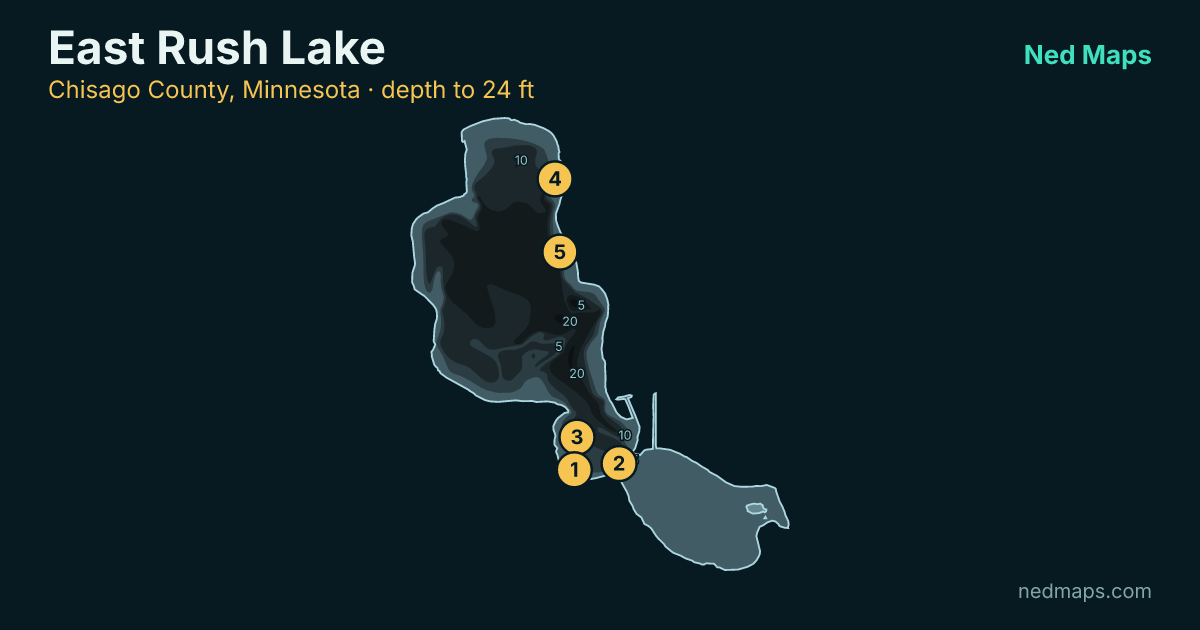
East Rush Lake depth map
Within 30 miles
Nearby lakes
- West Rush Lake · 1,594 ac · 1.8 mi
- Neander Lake · 57 ac · 4 mi
- Goose Lake · 732 ac · 4.5 mi
- Mandall Lake · 47 ac · 5.9 mi
- Krans Lake · 35 ac · 6 mi
- Rabour Lake · 53 ac · 6.3 mi
- Horseshoe Lake · 224 ac · 6.4 mi
- Fish Lake · 319 ac · 7.3 mi
Quick answers
Frequently asked questions
How deep is East Rush Lake?
East Rush Lake reaches 24 ft at its deepest point; about 69% of the lake is littoral (15 ft or shallower).
How big is East Rush Lake?
East Rush Lake covers 1,494 acres with about 11 miles of shoreline.
How clear is the water in East Rush Lake?
DNR Secchi readings on East Rush Lake average 2.2 ft of visibility, on the stained end for a Minnesota lake.
What fish are in East Rush Lake?
Minnesota DNR surveys (most recently 2024) record walleye, largemouth bass, smallmouth bass, northern pike, muskellunge, bluegill, crappie, yellow perch.
Is East Rush Lake stocked?
Yes. The DNR stocked muskellunge and walleye in 2025; the stocking table on this page lists every year back to 2017.
Does East Rush Lake have a public access?
Yes. East Rush Lake has one public access site: Rush Lake (E) (trailer launch).
How big do walleye get in East Rush Lake?
The biggest walleye measured in recent DNR surveys taped 31"; the size-history table on this page tracks the biggest fish in each survey back to 1997.
When was East Rush Lake last surveyed?
The Minnesota DNR last surveyed East Rush Lake in 2024, the most recent of 15 surveys on record.
Page updated .

Featured guide spot
Your guide service here
One featured guide per lake, with your photo, your writeup and a link straight to your booking page. Free through December 31, 2026.
Then $20 a month from January. Cancel any time.
The live map adds today's conditions and ranked spots for East Rush Lake, plus a trip plan you can share:
Open East Rush Lake on the live map → Fished it lately? Write a report