Minnesota · Le Sueur County
East Jefferson Lake Fishing guide
East Jefferson Lake sits in Le Sueur County, Minnesota, and covers 685 acres, reaching 37 ft at its deepest point. Average water clarity runs about 2.2 ft. The Minnesota DNR has surveyed the lake 12 times, most recently in 2024, with walleye, largemouth bass, northern pike and bluegill in the nets.
DNR survey data
Fish species
WalleyeLast stocked 2019Fair numbers1.6per gill net22"Typical28"Biggest
Lengths measured · 34 fish
Recent · 2021 + 2024Lengths measured · 12 fish
2024Lengths measured · 22 fish
2021Lengths measured · 13 fish
2018Lengths measured · 13 fish
2008Largemouth bassJust a few18.4per hr (electrofishing)13"Typical19"Biggest
Lengths measured · 58 fish
Recent · 2021 + 2024Lengths measured · 21 fish
2024Lengths measured · 37 fish
2021Lengths measured · 72 fish
2018Lengths measured · 4 fish
2008Only 4 fish measured that year — too few to read as a shape.
Northern pikeJust a few5.8per gill net21"Typical34"Biggest
Lengths measured · 121 fish
Recent · 2021 + 2024Lengths measured · 80 fish
2024Lengths measured · 41 fish
2021Lengths measured · 48 fish
2018Lengths measured · 5 fish
2008Only 5 fish measured that year — too few to read as a shape.
BluegillFair numbers36.7per trap net6"Typical8"Biggest
Lengths measured · 1022 fish
Recent · 2021 + 2024Lengths measured · 475 fish
2024Lengths measured · 547 fish
2021Lengths measured · 431 fish
2018Lengths measured · 450 fish
2008CrappieGood numbers26.3per trap net7"Typical14"Biggest
Lengths measured · 1426 fish
Recent · 2021 + 2024Lengths measured · 427 fish
2024Lengths measured · 999 fish
2021Lengths measured · 375 fish
2018Lengths measured · 94 fish
2008Yellow perchGood numbers7.4per gill net7"Typical10"Biggest
Lengths measured · 141 fish
Recent · 2021 + 2024Lengths measured · 56 fish
2024Lengths measured · 85 fish
2021Lengths measured · 148 fish
2018Lengths measured · 229 fish
2008White bassGood numbers2.1per gill net16"Typical17"Biggest
Lengths measured · 18 fish
Recent · 2021Lengths measured · 18 fish
2021Lengths measured · 5 fish
2018Only 5 fish measured that year — too few to read as a shape.
Lengths measured · 8 fish
2008Only 8 fish measured that year — too few to read as a shape.
Lengths measured · 6 fish
2002Only 6 fish measured that year — too few to read as a shape.
Rates come from standard DNR survey gear (gill nets, trap nets, electrofishing), judged against statewide benchmarks for the same gear, so the same number of fish per net can read differently for two species. Where the standard gear can't count a species reliably, only presence and size are listed. Typical is the middle fish of those measured. Open a row for the full length spread, survey by survey.
How to fish East Jefferson Lake through the year
Walleye
- Spring
- Walleye are shallow, on and just off the spawning flats and the first green weeds. In 2.2 ft of visibility, they sit shallower than you think.
- Early summer
- Walleye are setting up on the outside weed edge, points and shallow structure.
- Summer
- Walleye are working the weed edge, points and any wind-blown structure.
- Fall
- Walleye are packing onto the sharpest breaks and points as the water cools, in big schools with short windows.
Largemouth bass
- Spring
- Largemouth are moving up into the warming bays and flats, staging around wood, docks and new weeds to spawn. In 2.2 ft of visibility, they sit shallower than you think.
- Early summer
- Largemouth are on the shallow spawning flats and protected bays, where beds go on firm bottom next to isolated cover.
- Summer
- Largemouth are in and along the weeds: cabbage and milfoil edges, matted cover and shade.
- Fall
- Largemouth are chasing bait back onto the flats and into the remaining green weeds, feeding hard and shallow before the freeze.
Season patterns for each species. Open the live map for today's wind, light and water temp.
Size history
Biggest fish by survey year
| Survey year | Walleye | Largemouth bass | Northern pike |
|---|---|---|---|
| 2024 | 28" | 17" | 34" |
| 2021 | 26" | 19" | 34" |
| 2018 | 27" | 18" | 35" |
| 2008 | 23" | 12" | 31" |
| 2002 | 23" | 11" | 27" |
| 1997 | 26" | 17" | 32" |
Longest fish measured by DNR survey crews in each year's nets. Survey gear samples the population, so the lake usually holds larger fish than any survey measured.
Suggested tackle
What to bring
Top presentations for this lake's structure and clarity:
Walleye · Live bait
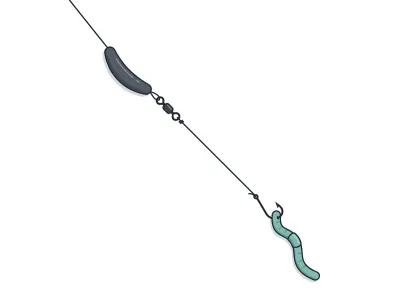
Live-Bait (Lindy) Rig + Leech/Crawler
jumbo leech or half a nightcrawler
Walleye · Soft plastics
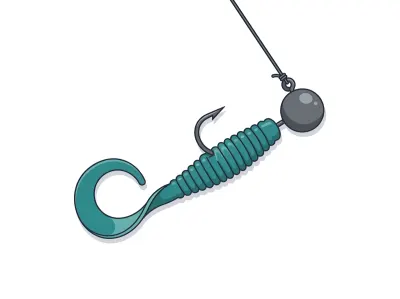
Curly-Tail Grub on Jig
3" curly-tail grub threaded on a round jighead
Largemouth bass · Hardbaits
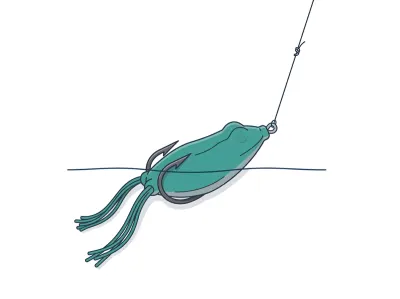
Hollow-Body Frog
3–3.5" hollow-body frog
Largemouth bass · Soft plastics

Texas-Rigged Worm
7" ribbon-tail or straight-tail plastic worm
Northern pike · Soft plastics
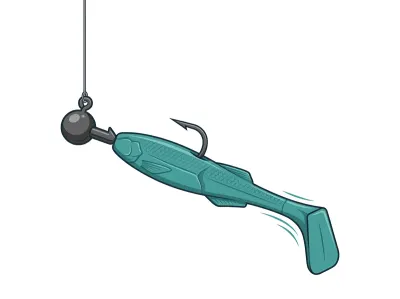
Paddletail Swimbait on Jighead
4–5" paddletail swimbait on a ball-head swimbait jighead
Northern pike · Muskie & pike
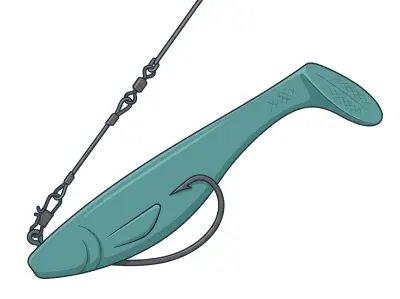
Soft Rubber (Bull Dawg / Medusa)
10" soft rubber body bait
Full setups, including hooks, weights and line, are on the live map. As an Amazon Associate I earn from qualifying purchases.
DNR stocking records
Stocking history
| Year | Species | Stocked |
|---|---|---|
| 2019 | Walleye | 338,000 fry |
| 2017 | Walleye | 338,408 fry |
MN DNR · in their words
From the 2024 survey
East Jefferson Lake is a 700-acre lake located approximately 4.5 miles southeast of the town of Cleveland in Le Sueur County. A DNR-maintained public access is located on the east side of the lake off Beaver Dam Road. The maximum depth is 37 feet with 48% of the lake less than 15 feet deep. East Jefferson Lake has generally poor water clarity and frequent algae blooms caused by elevated nutrient levels. East Jefferson Lake is designated as an infested water body due to the establishment of Eurasian Watermilfoil. East Jefferson Lake is primarily managed for Black Crappie and Bluegill and secondarily for Northern Pike and Largemouth Bass. Northern Pike fry are stocked periodically in West Jefferson Lake and Middle Jefferson Lake - most recently in 2023. Walleye are stocked in West Jefferson Lake and German Lake as a chain wide stocking strategy, most recently in 2024. East Jefferson Lake is managed along with Middle Jefferson Lake, West Jefferson Lake, and German Lake as part of a chain of lakes known collectively as the Jefferson Chain. Since these lakes are openly connected to one another, fish migration must be considered, and management is coordinated as such.
East Jefferson Lake was surveyed the week of 29 July 2024 as part of a regularly scheduled monitoring program conducted by the Minnesota DNR. The survey was completed to assess the fish community using 9 gill nets, 10 trap nets, and 85 minutes of boat electrofishing. Water quality parameters were also measured.
Read the full DNR narrative
Black Crappies were the most abundant species in 2024 in gill nets with a catch rate of 22.9/net and a trap net catch rate of 22.2/net. Since 1994, trap net catch rates have increased in each subsequent survey, most recently from 6.6/net in 2013 to 18.1/net in 2018, to 30.9/net in 2021, before a slight drop in 2024. Lengths of Black Crappies sampled with gill nets varied from 4.5 to 10.9 inches with an average of 7.1 inches. Lengths from the trap net sample ranged from 6.9 to 12.4 inches with an average of 9.4 inches. Black Crappies from both gears ranged from age-1 to age-7 with 7 year classes present. On average, Black Crappies exceeded 8 inches by age-4. The increasing abundance, good growth and consistent natural reproduction should lead to excellent angling opportunities for Black Crappies in East Jefferson Lake for years to come.
Bluegill was the most abundant species sampled with trap nets in 2024. A total of 305 Bluegill were sampled for a catch rate of 30.5/net. Catch rates have ranged from 3.9/net in 1997 to 44.8/net in 2002 with an average of 24.1/net since 1994. The three previous surveys yielded catch rates of 16.6/net in 2013, 26.0/net in 2018, and 43.7/net in 2021. Bluegills ranged from 3.0 to 8.4 inches with an average of 7.0 inches. An additional 170 Bluegills ranging from 4.8 to 8.5 inches were sampled with the gill nets. Bluegills ranged from age-2 to age-7 with 5 year classes present. Age-3 and age-5 Bluegills accounted for approximately 70% of the sample and age-4 Bluegills were also well represented. Growth rates were modest, with an average length of 6.6 inches at age-4. The scarcity of Bluegills larger than 8 inches is a concern but Bluegills remain a popular target in East Jefferson Lake.
A total of 61 Northern Pike were sampled with gill nets for a catch rate of 6.8/net was above the long-term average of 4.4/net. Northern Pike ranged from 12.4 to 34.8 inches with an average of 19.8 inches. Approximately 23% of the Northern Pike sampled exceeded the legal minimum length limit of 24 inches. Twenty more Northern Pike ranging from 12.4 to 32.5 inches were sampled with trap nets. The 2024 survey offers strong evidence of natural reproduction and a self-sustaining Northern Pike population without the need for supplemental stocking.
Largemouth Bass were sampled using spring boat electrofishing, yielding 20 fish and a catch rate of 14.1/hour. The 2018 catch rate was 42.0/hour, and the 2021 catch rate was 22.4/hr. Largemouth Bass ranged from 3.6 to 17.6 inches with an average of 11.2 inches. East Jefferson is a popular lake for tournaments. Many are held each year. The typical winning 5 fish limit approaches or exceeds 20 pounds. Our sampling does not seem to sample these larger fish.
A total of 7 Walleyes were sampled in gill nets for a catch rate of 0.8/net. Since 1994 Walleyes have been sampled in low numbers with a peak of just 2.6/net in 1997 and 2021 and an average of 1.6/net. Walleyes sampled in 2024 ranged from 19.3 to 27.8 inches with an average of 23.5 inches. Five additional Walleye were sampled with the trap nets. These fish were similar in size to gill netted fish.
Walleyes ranged from age-4 to age-10 with 2 year classes present. Walleye growth was fast with fish exceeding 18 inches by age-3. Approximately 75% of Walleyes sampled were age-10 and part of the non-stocked 2014 year class. This 2014 year class was also prominent in the 2018 and 2021 surveys and according to genetic analysis, was mostly Lower Mississippi Strain (LMS) and produced naturally within East Jefferson or German Lakes. Due to this finding, efforts should be made through stocking to boost the LMS population with the ultimate hope of creating a self-sustaining Walleye population in the Jefferson Chain.
Yellow Perch were sampled in low abundance in 2024. A total of 51 Yellow Perch were caught for a rate of 5.6/net. The 2021 catch rate was 9.3/net and since 1994 Yellow Perch catch rates have been highly variable with a range of 3.9 to 99.1/net and an average of 32.7/net. Yellow Perch ranged from 5.8 to 9.5 inches and an average of 7.8 inches. Yellow Perch are an important prey species for Northern Pike, Largemouth Bass, and Walleye and hopefully numbers trend toward the higher end of the historical catch range in future surveys.
Freshwater Drum were common in the gill net sample with a total of 38 fish caught for a rate of 4.2/net. Since Freshwater Drum catch rates have ranged from 2.7/net to 17.5/net with an average of 9.1/net since 1994. Freshwater Drum of preferred length were abundant.
Just 5 Black Bullheads were sampled in 2024 for a catch rate of 0.6/net, which falls below the previous all-time low in 2018 of 1.9/net. The decline follows a similar area-wide trend of declining Black Bullhead numbers. Conversely, Yellow Bullheads were common with a catch rate of 5.6/net. This inverse trend in bullhead numbers can be explained by a shift in lake habitat and increased stability that now favor Yellow Bullheads.
Common Carp numbers were low with just 6 fish sampled for a gill net catch rate of 0.7/net. The Jefferson Chain offers plenty of opportunities for Common Carp to spawn and persist, yet they largely remain at sub-nuisance levels in East Jefferson Lake.
Other species sampled in 2024 include Bigmouth Buffalo, Bowfin (dogfish), Longnose Gar, Pumpkinseed, White Crappie, and hybrid sunfish.
Water quality measurements included water temperature, dissolved oxygen, and secchi depth. Water clarity was poor with a secchi depth of 2.5 feet. Dissolved oxygen and water temperature readings ranged from 7.9 ppm and 77.5 degrees Fahrenheit at the surface to 0.1 ppm and 67.3 degrees Fahrenheit at 35 feet. A thermocline was detected around 17 feet.
-Tyler Fellows, fisheries specialist
Narrative text from the Minnesota DNR lake survey.
Recent reports
East Jefferson Lake fishing reports
Recent reports on East Jefferson Lake from guides, tournaments and regular anglers. Anything posted in the last two weeks also bumps the matching spots on the live map, so you'll see a "matches a recent report" tag on them.
Public water access
Getting on the water
- Jefferson Lake (E) (trailer launch)
DNR bathymetry
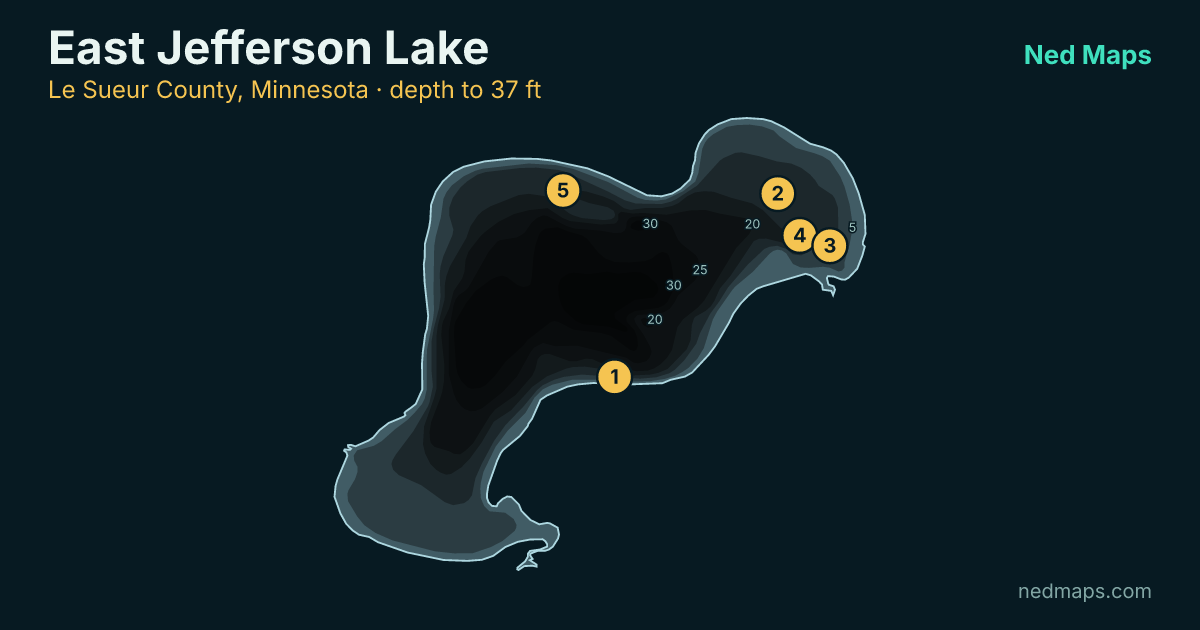
East Jefferson Lake depth map
Within 30 miles
Nearby lakes
- Middle Jefferson Lake · 667 ac · 1.4 mi
- German Lake · 889 ac · 1.8 mi
- Roemhildts Lake · 74 ac · 2.3 mi
- West Jefferson Lake · 439 ac · 3.3 mi
- Scotch Lake · 598 ac · 3.6 mi
- Steele Lake · 76 ac · 3.9 mi
- Duck Lake · 290 ac · 4.7 mi
- Frances Lake · 927 ac · 5.1 mi
Quick answers
Frequently asked questions
How deep is East Jefferson Lake?
East Jefferson Lake reaches 37 ft at its deepest point; about 50% of the lake is littoral (15 ft or shallower).
How big is East Jefferson Lake?
East Jefferson Lake covers 685 acres with about 5.9 miles of shoreline.
How clear is the water in East Jefferson Lake?
DNR Secchi readings on East Jefferson Lake average 2.2 ft of visibility, on the stained end for a Minnesota lake.
What fish are in East Jefferson Lake?
Minnesota DNR surveys (most recently 2024) record walleye, largemouth bass, northern pike, bluegill, crappie, yellow perch, white bass.
Is East Jefferson Lake stocked?
Yes. The DNR stocked walleye in 2019; the stocking table on this page lists every year back to 2017.
Does East Jefferson Lake have a public access?
Yes. East Jefferson Lake has one public access site: Jefferson Lake (E) (trailer launch).
How big do walleye get in East Jefferson Lake?
The biggest walleye measured in recent DNR surveys taped 28"; the size-history table on this page tracks the biggest fish in each survey back to 1997.
When was East Jefferson Lake last surveyed?
The Minnesota DNR last surveyed East Jefferson Lake in 2024, the most recent of 12 surveys on record.
Page updated .

Featured guide spot
Your guide service here
One featured guide per lake, with your photo, your writeup and a link straight to your booking page. Free through December 31, 2026.
Then $20 a month from January. Cancel any time.
The live map adds today's conditions and ranked spots for East Jefferson Lake, plus a trip plan you can share:
Open East Jefferson Lake on the live map → Fished it lately? Write a report