Minnesota · Cook County
Devilfish Lake Fishing guide
Devilfish Lake covers 405 acres in Cook County, Minnesota, reaching 40 ft at its deepest point. Average water clarity runs about 9 ft. The Minnesota DNR has surveyed the lake 12 times, most recently in 2020, with walleye, smallmouth bass, yellow perch and brook trout in the nets. That survey is 6 years old now.
DNR survey data
Fish species
WalleyeLast stocked 2024Fair numbers2.7per gill net15"Typical29"Biggest
Lengths measured · 94 fish
Recent · 2012 + 2016 + 2020Lengths measured · 16 fish
2020Lengths measured · 37 fish
2016Lengths measured · 41 fish
2012Lengths measured · 53 fish
2008Smallmouth bassJust a few6.1per hr (electrofishing)9"Typical15"Biggest
Lengths measured · 166 fish
Recent · 2012 + 2016 + 2020Lengths measured · 26 fish
2020Lengths measured · 91 fish
2016Lengths measured · 49 fish
2012Lengths measured · 22 fish
2008No recent survey rating.
Last recorded in the 1985 survey and not seen since.
Last recorded in the 1955 survey and not seen since.
Rates come from standard DNR survey gear (gill nets, trap nets, electrofishing), judged against statewide benchmarks for the same gear, so the same number of fish per net can read differently for two species. Where the standard gear can't count a species reliably, only presence and size are listed. Typical is the middle fish of those measured. Open a row for the full length spread, survey by survey.
How to fish Devilfish Lake through the year
Walleye
- Spring
- Walleye are shallow, on and just off the spawning flats and the first green weeds.
- Early summer
- Walleye are setting up on the outside weed edge, points and shallow structure.
- Summer
- Walleye are working the weed edge, points and any wind-blown structure. On a lake that drops to 40 ft, check the deep edge of that structure too.
- Fall
- Walleye are packing onto the sharpest breaks and points as the water cools, in big schools with short windows.
Smallmouth bass
- Spring
- Smallmouth are on shallow rock, gravel and sand where they spawn.
- Early summer
- Smallmouth are post-spawn on rock points, gravel bars and the adjacent breaks.
- Summer
- Smallmouth are on rock humps, points and hard-bottom breaks. On a lake that drops to 40 ft, check the deep edge of that structure too.
- Fall
- Smallmouth are bunched tight on deep rock, so find one and you have found the school.
Season patterns for each species. Open the live map for today's wind, light and water temp.
Size history
Biggest fish by survey year
| Survey year | Walleye | Smallmouth bass | Brook trout |
|---|---|---|---|
| 2020 | 27" | 14" | — |
| 2016 | 28" | 15" | — |
| 2012 | 29" | 15" | — |
| 2008 | 16" | 12" | — |
| 2004 | 24" | — | — |
| 1998 | 24" | — | — |
Longest fish measured by DNR survey crews in each year's nets. Survey gear samples the population, so the lake usually holds larger fish than any survey measured.
Suggested tackle
What to bring
Top presentations for this lake's structure and clarity:
Walleye · Live bait

Live-Bait (Lindy) Rig + Leech/Crawler
jumbo leech or half a nightcrawler
Walleye · Trolling
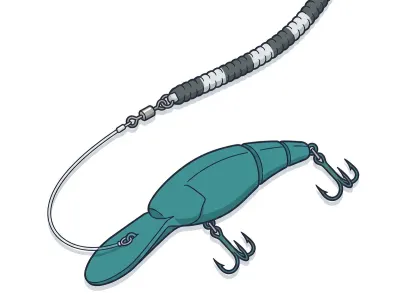
Leadcore Line + Crankbaits
4–5" mid-diving crankbait behind a long leadcore run
Smallmouth bass · Soft plastics
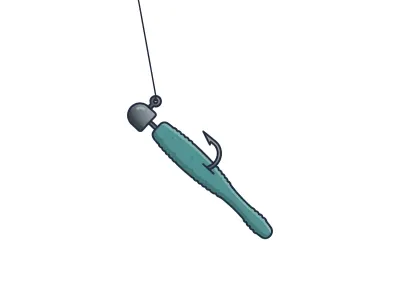
Ned Rig
2.75" finesse stickbait or craw-style Ned bait
Smallmouth bass · Soft plastics
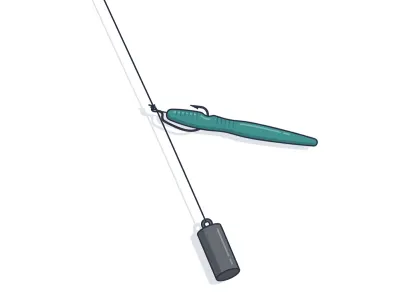
Drop Shot (Finesse Plastic)
4" finesse worm or 3" minnow-profile plastic
Brook trout · Trolling
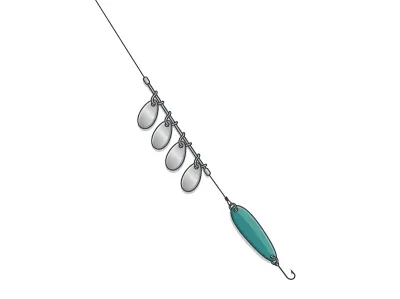
Trout Trolling (spoons/cowbells)
2–3in trolling spoon behind a small cowbell/dodger string
Brook trout · Hardbaits
Casting Spoon (Kastmaster, stream/stocked trout)
1/8–1/4 oz compact casting spoon
Full setups, including hooks, weights and line, are on the live map. As an Amazon Associate I earn from qualifying purchases.
DNR stocking records
Stocking history
| Year | Species | Stocked |
|---|---|---|
| 2024 | Walleye | 200,000 fry |
| 2023 | Walleye | 200,000 fry |
MN DNR · in their words
From the 2020 survey
The 2020 survey of Devilfish Lake was scheduled in the 2018 lake management plan (LMP) revision to determine if the Walleye population goal could be met in the absence of stocking. The long-term goal for Walleye in Devilfish Lake, established in the 1990 LMP, is to maintain a population with a minimum gill net catch of 4.0 fish/net. That goal was met in most surveys done through 2008.
Walleye were present in fair numbers in Devilfish Lake in 2020, with a few larger fish available. However, the 2020 Walleye gill net catch was the lowest ever recorded in this lake, and fell below the normal range for a lake of this type. The 2020 survey gill net catch was the third in a row that failed to meet the long-range goal for the Walleye population, with each catch lower than the previous. The mean weight of Walleye sampled in gill nets in 2020 was the highest observed for this lake, mainly due to a lack of small Walleye in the catch rather than high numbers of large fish.
Read the full DNR narrative
It is clear from results of the 2016 and 2020 surveys that Walleye natural reproduction has been inadequate, and that a resumption of stocking is needed to meet the goal for this population. Aging results in 2020 indicated only relatively weak natural year classes had been produced since stocking ceased in 2010. Although growth for the youngest Walleye taken in this survey appeared to have been adequate (based on a very small sample size), growth for older fish had been slow. The oldest fish sampled was a 19-year-old fish that was just 15.8 inches long when captured. The largest fish taken (27.6 inches) was 16 years old.
Smallmouth Bass, introduced illegally and first documented in Devilfish Lake in 2008, have become well-established since that time. They appeared to have been abundant in 2020, with fair numbers of fish over 12 inches present. Smallmouth Bass collected in all gears in 2020 ranged in length from 6.8 to 14.0 inches. Smallmouth Bass are considered an undesirable species for Devilfish Lake due to the additional competition they impose on Walleye for limited forage. In some lakes where they have been introduced we have seen the nearly complete elimination of small fish species in the nearshore fish community. In addition, deep drops in the production of young-of-year Walleye and Yellow Perch, with reduced Walleye recruitment, have been seen in some cases.
The White Sucker gill net catch in 2020 fell within the normal range for a lake of this type, and was similar to past catches in Devilfish Lake. A majority of the White Sucker sampled were too large to serve as forage for Walleye. White Sucker can compete with Walleye for some types of invertebrate forage, resulting in slower Walleye growth where White Sucker abundance is high.
Yellow Perch, another species that was introduced illegally into Devilfish Lake, have been sampled periodically since 1989. None were found in 2016 or 2020. Rainbow Smelt and Lake Trout were also present at one time in Devilfish Lake, but neither species has been observed since the 1980s.
In 2016 crews from the 1854 Treaty Authority surveyed a number of Cook County lakes for the presence of Spiny Waterflea. They documented the presence of Spiny Waterflea in Devilfish Lake. The lake is now designated an infested water.
Narrative text from the Minnesota DNR lake survey.
Recent reports
Devilfish Lake fishing reports
Recent reports on Devilfish Lake from guides, tournaments and regular anglers. Anything posted in the last two weeks also bumps the matching spots on the live map, so you'll see a "matches a recent report" tag on them.
Public water access
Getting on the water
- Devilfish Lake (trailer launch)
DNR bathymetry
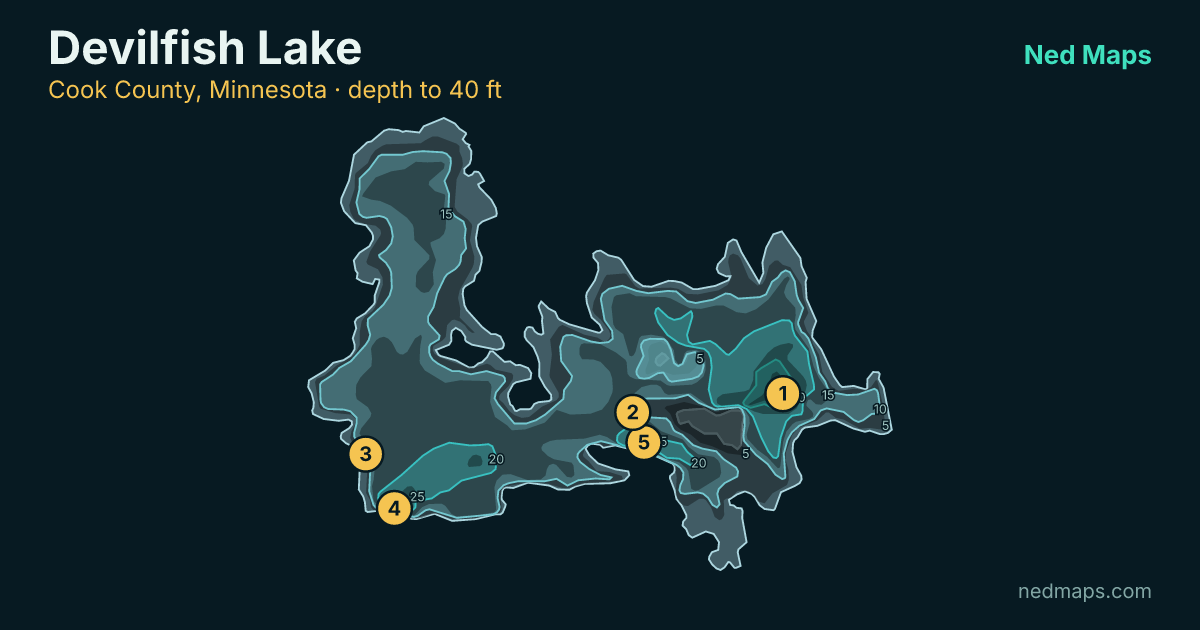
Devilfish Lake depth map
Within 30 miles
Nearby lakes
- Esther Lake · 78 ac · 1.3 mi
- Chester Lake · 52 ac · 1.4 mi
- Edith Lake · 35 ac · 1.5 mi
- Olga Lake · 13 ac · 1.8 mi
- Loft Lake · 14 ac · 1.8 mi
- Margaret Lake · 6 ac · 2.4 mi
- Sunfish Lake · 85 ac · 2.5 mi
- Greenwood Lake · 2,043 ac · 3.1 mi
Quick answers
Frequently asked questions
How deep is Devilfish Lake?
Devilfish Lake reaches 40 ft at its deepest point with a mean depth of 13 ft; about 56% of the lake is littoral (15 ft or shallower).
How big is Devilfish Lake?
Devilfish Lake covers 405 acres with about 7.8 miles of shoreline.
How clear is the water in Devilfish Lake?
DNR Secchi readings on Devilfish Lake average 9 ft of visibility, middling clarity for a Minnesota lake.
What fish are in Devilfish Lake?
Minnesota DNR surveys (most recently 2020) record walleye, smallmouth bass, yellow perch, brook trout, lake trout.
Is Devilfish Lake stocked?
Yes. The DNR stocked walleye in 2024; the stocking table on this page lists every year back to 2023.
Does Devilfish Lake have a public access?
Yes. Devilfish Lake has one public access site: Devilfish Lake (trailer launch).
How big do walleye get in Devilfish Lake?
The biggest walleye measured in recent DNR surveys taped 29"; the size-history table on this page tracks the biggest fish in each survey back to 1998.
When was Devilfish Lake last surveyed?
The Minnesota DNR last surveyed Devilfish Lake in 2020, the most recent of 12 surveys on record. A survey that old is a starting point, not a current reading.
Page updated .

Featured guide spot
Your guide service here
One featured guide per lake, with your photo, your writeup and a link straight to your booking page. Free through December 31, 2026.
Then $20 a month from January. Cancel any time.
The live map adds today's conditions and ranked spots for Devilfish Lake, plus a trip plan you can share:
Open Devilfish Lake on the live map → Fished it lately? Write a report