Minnesota · Todd County
Big Lake Fishing guide
Big Lake is a 297-acre lake in Todd County, Minnesota, reaching 21 ft at its deepest point. Secchi readings average around 5.9 ft of visibility. The Minnesota DNR has surveyed the lake 17 times, most recently in 2024, with walleye, largemouth bass, northern pike and bluegill in the nets.
DNR survey data
Fish species
WalleyeLast stocked 2024Fair numbers1.7per gill net22"Typical28"Biggest
Lengths measured · 10 fish
Recent · 2024Lengths measured · 10 fish
2024Lengths measured · 10 fish
2016Lengths measured · 3 fish
2011Only 3 fish measured that year — too few to read as a shape.
Lengths measured · 11 fish
2011Largemouth bassGood numbers59.2per hr (electrofishing)12"Typical18"Biggest
Lengths measured · 95 fish
Recent · 2024Lengths measured · 95 fish
2024Lengths measured · 66 fish
2019Lengths measured · 97 fish
2017Lengths measured · 78 fish
2016Northern pikeGood numbers13.5per gill net16"Typical34"Biggest
Lengths measured · 82 fish
Recent · 2024Lengths measured · 82 fish
2024Lengths measured · 48 fish
2016Lengths measured · 8 fish
2016Only 8 fish measured that year — too few to read as a shape.
Lengths measured · 2 fish
2011Only 2 fish measured that year — too few to read as a shape.
BluegillJust a few20.8per trap net6"Typical8"Biggest
Lengths measured · 223 fish
Recent · 2024Lengths measured · 223 fish
2024Lengths measured · 1784 fish
2016Lengths measured · 223 fish
2016Lengths measured · 412 fish
2011CrappieJust a few4.3per trap net8"Typical13"Biggest
Lengths measured · 73 fish
Recent · 2024Lengths measured · 73 fish
2024Lengths measured · 150 fish
2016Lengths measured · 7 fish
2016Only 7 fish measured that year — too few to read as a shape.
Lengths measured · 17 fish
2015Rates come from standard DNR survey gear (gill nets, trap nets, electrofishing), judged against statewide benchmarks for the same gear, so the same number of fish per net can read differently for two species. Where the standard gear can't count a species reliably, only presence and size are listed. Typical is the middle fish of those measured. Open a row for the full length spread, survey by survey.
How to fish Big Lake through the year
Largemouth bass
- Spring
- Largemouth are moving up into the warming bays and flats, staging around wood, docks and new weeds to spawn.
- Early summer
- Largemouth are on the shallow spawning flats and protected bays, where beds go on firm bottom next to isolated cover.
- Summer
- Largemouth are in and along the weeds: cabbage and milfoil edges, matted cover and shade.
- Fall
- Largemouth are chasing bait back onto the flats and into the remaining green weeds, feeding hard and shallow before the freeze.
Northern pike
- Spring
- Pike are in the shallow bays and along new weed growth.
- Early summer
- Pike are on the outside weed edge and points.
- Summer
- Pike are on the deep weed edge and points near the coolest water they can find.
- Fall
- Pike are on the last green weeds and the breaks beside them, feeding heavily as the water drops.
Season patterns for each species. Open the live map for today's wind, light and water temp.
Size history
Biggest fish by survey year
| Survey year | Largemouth bass | Northern pike | Walleye |
|---|---|---|---|
| 2024 | 18" | 34" | 28" |
| 2019 | 17" | — | — |
| 2017 | 16" | — | — |
| 2016 | 18" | 30" | 26" |
| 2015 | 19" | — | — |
| 2014 | 20" | — | — |
| 2013 | 18" | — | — |
| 2011 | 15" | 25" | 29" |
Longest fish measured by DNR survey crews in each year's nets. Survey gear samples the population, so the lake usually holds larger fish than any survey measured.
Suggested tackle
What to bring
Top presentations for this lake's structure and clarity:
Largemouth bass · Hardbaits
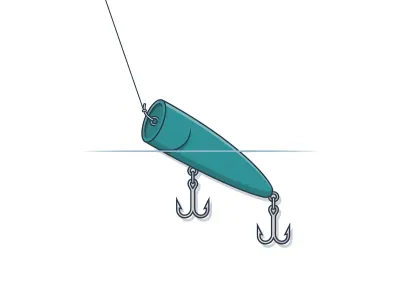
Topwater Popper
2.5–3" concave-face popper
Largemouth bass · Hardbaits
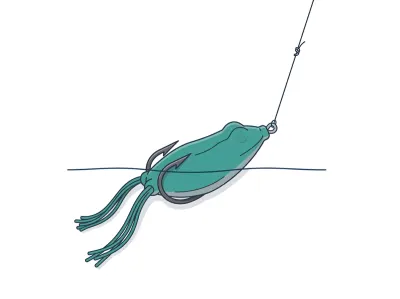
Hollow-Body Frog
3–3.5" hollow-body frog
Northern pike · Soft plastics
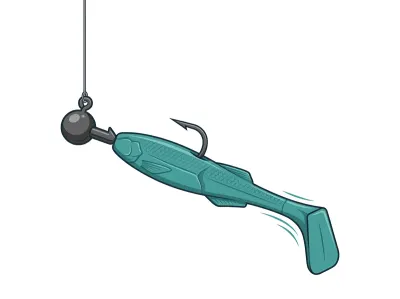
Paddletail Swimbait on Jighead
4–5" paddletail swimbait on a ball-head swimbait jighead
Northern pike · Muskie & pike
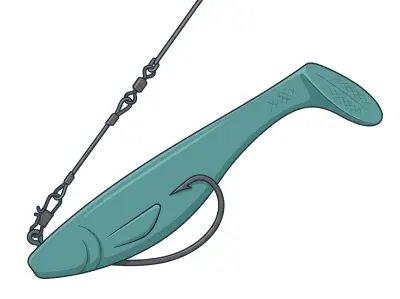
Soft Rubber (Bull Dawg / Medusa)
10" soft rubber body bait
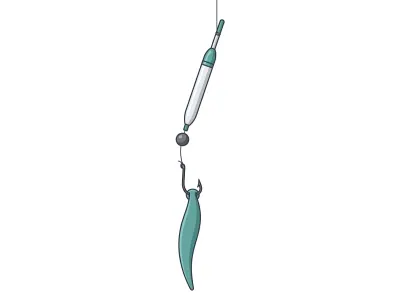
Walleye · Trolling
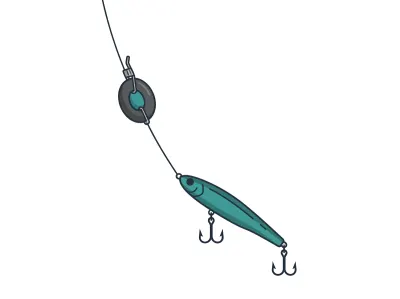
Snap Weights + Stickbaits
4–5" suspending or slow-floating stickbait
Full setups, including hooks, weights and line, are on the live map. As an Amazon Associate I earn from qualifying purchases.
DNR stocking records
Stocking history
| Year | Species | Stocked |
|---|---|---|
| 2024 | Walleye | 150,000 fry |
| 2022 | Walleye | 150,000 fry |
| 2021 | Walleye | 150,000 fry |
| 2018 | Walleye | 150,000 fry |
| 2016 | Walleye | 4,541 fingerlings · 25 yearlings |
MN DNR · in their words
From the 2024 survey
In 2024, a fish survey was completed on Big Lake which included summer gill netting, summer trap netting, and daytime Largemouth Bass Electrofishing. An IBI (Index of Biotic Integrity) survey consisting of Backpack Electrofishing, and 15 foot-wide Siene hauls was also completed. The results and interpretation of IBI data collected in 2024 are provided in a separate report.
Largemouth Bass in Big Lake have been relatively consistent in size structure and numbers since 2011, when daytime electrofishing was first introduced. Past daytime catch rates have ranged from 35 to 88 fish per hour with the 2024 catch falling near the middle of that range at 59.2/hour. The 2024 catch rate is considered quite typical for a central Minnesota lake. The average length in 2024 was 11.74 inches compared to a 10.92-inch average of all other surveys. The percent of fish caught over 15 inches was 9% with the largest measuring 18.4 inches.
Read the full DNR narrative
Northern Pike gill net catches continue to demonstrate substantial variation with the 2024 catch rate of 13.5/lift very near the record high of 13.7/lift found in 1999. Catch rates have recently been as low as the 5.3 per lift found in 2016. Northern Pike averaged just 17.2 inches long in 2024 which is smaller than most previous efforts though not unprecedented. Pike longer than 30 inches have been uncommon throughout the lake's gill net history, however a specimen measuring 34.45 inches was captured in 2024 and is the longest fish caught in any survey on Big Lake. Only 13% of pike collected in the gill nets in 2024 surpassed 21 inches providing further indication of a less than optimal size structure.
Walleye gill net catches have been within the expected range since 1993 for lake's similar to Big Lake, including the 2024 catch of 1.67/lift. Fingerling stocking took place regularly through 2016 after which fry stocking was practiced. Based on aging information collected in 2024 fry stocking has failed to contribute to the Walleye population. All the Walleyes sampled in 2024 were Age 8 or older. It is apparent that fingerling stocking will be required to sustain the population. Big Lake is currently under a "surplus" stocking status which means it will only receive fingerlings when they are available after higher priority lakes are stocked.
Black Crappie catches are often highly variable with low sample sizes typical during summer netting efforts. A total of 75 crappies were sampled when combining trap net, gill net, and electrofishing efforts in 2024. Thirty percent of the combined sample exceeded 9 inches long. The largest fish sampled was 13.4 inches long and was 2 inches longer than any other crappie observed in 2024. Historically, Big Lake's Black Crappie size structure has been dominated by fish under 9 inches and is often impacted by variations in year class strength.
Bluegill catch rates in Big Lake are usually high in the summer trap nets. The number of Bluegill trapped in 2024 was the lowest of any survey dating back to 1993. Since the numbers caught in summer trap nets have decreased the size structure has shown improvement. In 1993 there were no documented Bluegills above 7 inches, In the 2016 summer trap net survey there were 38 fish between 7 and 8 inches and 7 Bluegill over 8 inches. The 2024 summer trap net survey showed 66 Bluegill between 7 and 8 inches and 15 over 8 inches, the longest being 8.74 inches, the largest Bluegill ever sampled in Big.
Narrative text from the Minnesota DNR lake survey.
Recent reports
Big Lake fishing reports
Recent reports on Big Lake from guides, tournaments and regular anglers. Anything posted in the last two weeks also bumps the matching spots on the live map, so you'll see a "matches a recent report" tag on them.
Public water access
Getting on the water
- Big Lake (trailer launch)
DNR bathymetry
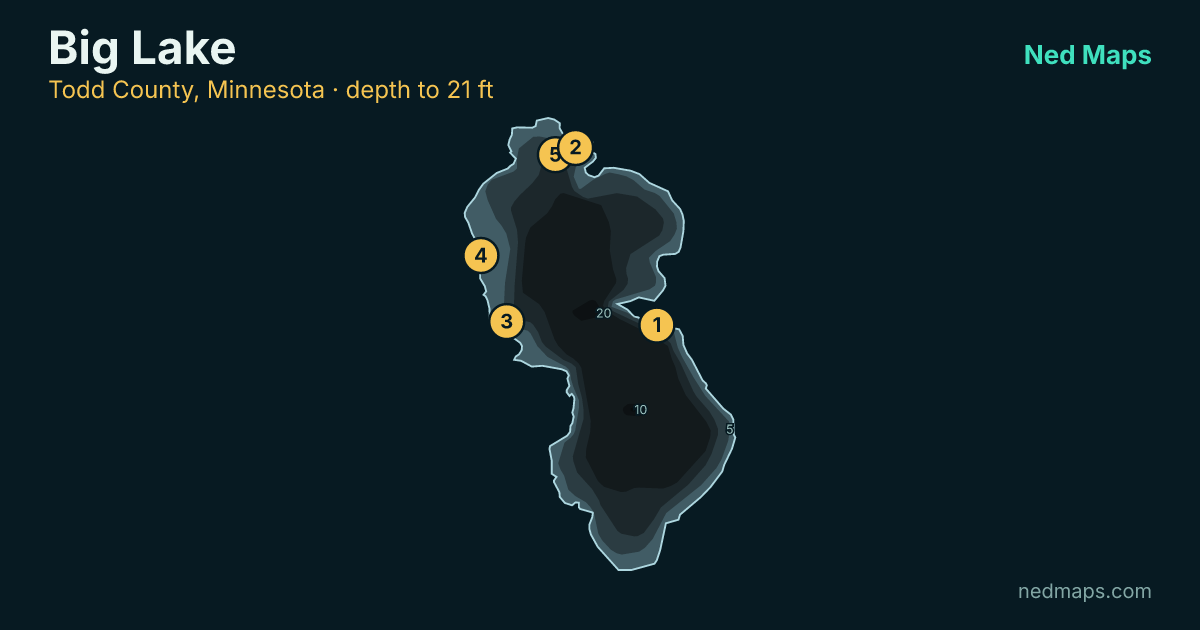
Big Lake depth map
Within 30 miles
Nearby lakes
- Pine Island Lake · 238 ac · 2.4 mi
- Star Lake · 69 ac · 2.9 mi
- Thunder Lake · 214 ac · 3.4 mi
- Turtle Lake · 112 ac · 5.3 mi
- Coal Lake · 171 ac · 5.5 mi
- Fish Trap Lake · 1,164 ac · 5.7 mi
- Fawn Lake · 125 ac · 6.2 mi
- Ham Lake · 42 ac · 6.7 mi
Quick answers
Frequently asked questions
How deep is Big Lake?
Big Lake reaches 21 ft at its deepest point; about 56% of the lake is littoral (15 ft or shallower).
How big is Big Lake?
Big Lake covers 297 acres with about 3.8 miles of shoreline.
How clear is the water in Big Lake?
DNR Secchi readings on Big Lake average 5.9 ft of visibility, middling clarity for a Minnesota lake.
What fish are in Big Lake?
Minnesota DNR surveys (most recently 2024) record walleye, largemouth bass, northern pike, bluegill, crappie, yellow perch.
Is Big Lake stocked?
Yes. The DNR stocked walleye in 2024; the stocking table on this page lists every year back to 2016.
Does Big Lake have a public access?
Yes. Big Lake has one public access site: Big Lake (trailer launch).
How big do largemouth bass get in Big Lake?
The biggest largemouth bass measured in recent DNR surveys taped 18"; the size-history table on this page tracks the biggest fish in each survey back to 2011.
When was Big Lake last surveyed?
The Minnesota DNR last surveyed Big Lake in 2024, the most recent of 17 surveys on record.
Page updated .

Featured guide spot
Your guide service here
One featured guide per lake, with your photo, your writeup and a link straight to your booking page. Free through December 31, 2026.
Then $20 a month from January. Cancel any time.
The live map adds today's conditions and ranked spots for Big Lake, plus a trip plan you can share:
Open Big Lake on the live map → Fished it lately? Write a report