Minnesota · St. Louis County
Armstrong Lake Fishing guide
Armstrong Lake is a 382-acre lake in St. Louis County, Minnesota, reaching 34 ft at its deepest point. Average water clarity runs about 14.4 ft. The Minnesota DNR has surveyed the lake 8 times, most recently in 2021, with walleye, largemouth bass, smallmouth bass and northern pike in the nets.
DNR survey data
Fish species
WalleyeLast stocked 2025Good numbers4.4per gill net19"Typical26"Biggest
Lengths measured · 44 fish
Recent · 2021Lengths measured · 44 fish
2021Lengths measured · 10 fish
2015Lengths measured · 27 fish
2012Lengths measured · 18 fish
2007Largemouth bassGood numbers94.7per hr (electrofishing)11"Typical17"Biggest
Lengths measured · 174 fish
Recent · 2021Lengths measured · 174 fish
2021Lengths measured · 171 fish
2015Lengths measured · 57 fish
2012Lengths measured · 11 fish
2007Smallmouth bassJust a few5.3per hr (electrofishing)7"Typical16"Biggest
Lengths measured · 11 fish
Recent · 2021Lengths measured · 11 fish
2021Lengths measured · 10 fish
2015Lengths measured · 6 fish
2012Only 6 fish measured that year — too few to read as a shape.
Lengths measured · 12 fish
2007Northern pikeJust a few3.3per gill net20"Typical34"Biggest
Lengths measured · 39 fish
Recent · 2021Lengths measured · 39 fish
2021Lengths measured · 81 fish
2015Lengths measured · 61 fish
2012Lengths measured · 43 fish
2007BluegillJust a few16.7per trap net4"Typical8"Biggest
Lengths measured · 169 fish
Recent · 2021Lengths measured · 169 fish
2021Lengths measured · 303 fish
2015Lengths measured · 696 fish
2012Lengths measured · 337 fish
2007Yellow perchFair numbers2.1per gill net6"Typical6"Biggest
Lengths measured · 21 fish
Recent · 2021Lengths measured · 21 fish
2021Lengths measured · 22 fish
2015Lengths measured · 45 fish
2012Lengths measured · 53 fish
2007Rates come from standard DNR survey gear (gill nets, trap nets, electrofishing), judged against statewide benchmarks for the same gear, so the same number of fish per net can read differently for two species. Where the standard gear can't count a species reliably, only presence and size are listed. Typical is the middle fish of those measured. Open a row for the full length spread, survey by survey.
How to fish Armstrong Lake through the year
Walleye
- Spring
- Walleye are shallow, on and just off the spawning flats and the first green weeds. At 14.4 ft of clarity, fish them deeper and lighter than usual.
- Early summer
- Walleye are setting up on the outside weed edge, points and shallow structure.
- Summer
- Walleye are working the weed edge, points and any wind-blown structure.
- Fall
- Walleye are packing onto the sharpest breaks and points as the water cools, in big schools with short windows.
Largemouth bass
- Spring
- Largemouth are moving up into the warming bays and flats, staging around wood, docks and new weeds to spawn. At 14.4 ft of clarity, fish them deeper and lighter than usual.
- Early summer
- Largemouth are on the shallow spawning flats and protected bays, where beds go on firm bottom next to isolated cover.
- Summer
- Largemouth are in and along the weeds: cabbage and milfoil edges, matted cover and shade.
- Fall
- Largemouth are chasing bait back onto the flats and into the remaining green weeds, feeding hard and shallow before the freeze.
Season patterns for each species. Open the live map for today's wind, light and water temp.
Size history
Biggest fish by survey year
| Survey year | Walleye | Largemouth bass | Smallmouth bass |
|---|---|---|---|
| 2021 | 26" | 17" | 16" |
| 2015 | 29" | 18" | 19" |
| 2012 | 25" | 18" | 18" |
| 2007 | 28" | 14" | 16" |
| 2002 | 27" | 18" | 16" |
| 1997 | 29" | 17" | 15" |
Longest fish measured by DNR survey crews in each year's nets. Survey gear samples the population, so the lake usually holds larger fish than any survey measured.
Suggested tackle
What to bring
Top presentations for this lake's structure and clarity:
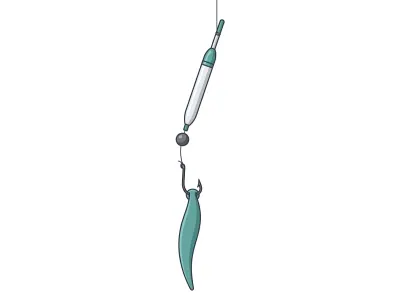
Walleye · Trolling
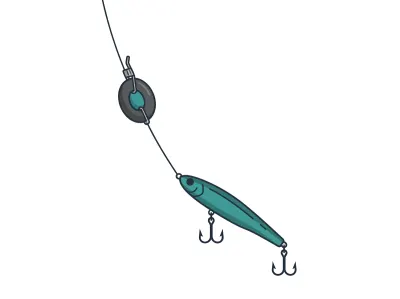
Snap Weights + Stickbaits
4–5" suspending or slow-floating stickbait
Largemouth bass · Soft plastics
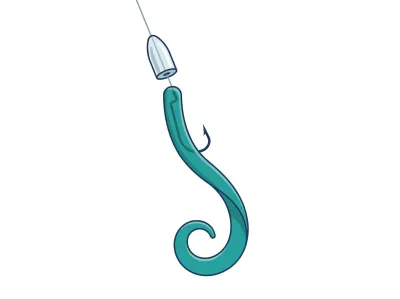
Texas-Rigged Worm
7" ribbon-tail or straight-tail plastic worm
Largemouth bass · Soft plastics
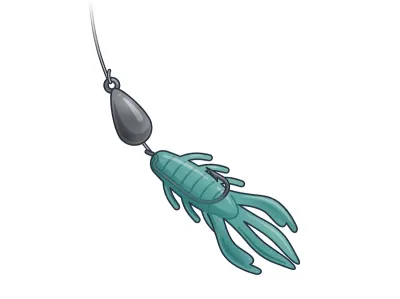
Free Rig
Creature bait or magnum finesse worm
Smallmouth bass · Soft plastics
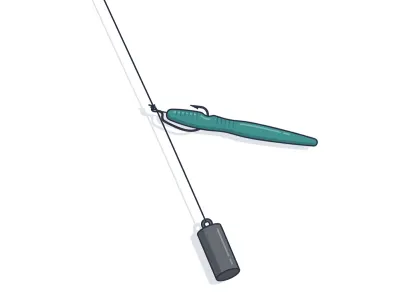
Drop Shot (Finesse Plastic)
4" finesse worm or 3" minnow-profile plastic
Smallmouth bass · Jigs & bladed
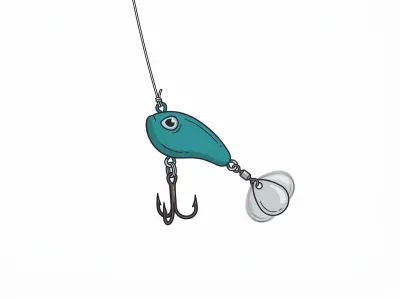
Tail Spinner
Compact lead body with a free-spinning blade on the tail
Full setups, including hooks, weights and line, are on the live map. As an Amazon Associate I earn from qualifying purchases.
DNR stocking records
Stocking history
| Year | Species | Stocked |
|---|---|---|
| 2025 | Walleye | 4,182 fingerlings |
| 2023 | Walleye | 5,918 fingerlings |
| 2021 | Walleye | 6,183 fingerlings |
| 2019 | Walleye | 7,467 fingerlings |
| 2017 | Walleye | 5,304 fingerlings |
| 2016 | Walleye | 200,000 fry |
MN DNR · in their words
From the 2021 survey
Armstrong Lake is a 382 acre lake located 10 miles west of Ely. It is accessed by a concrete ramp off Hwy 169. The lake has a maximum depth of 34 feet and clear water at the time of this survey.
On August 9, 2021 the lake was thermally stratified with a surface temperature of 72 F and a bottom temperature of 54 F. Oxygen levels were adequate for gamefish to a depth of 27 feet where the temperature was 57 F. Lake bottom substrates along the shoreline are mostly gravel, rubble, and sand. Aquatic plants grow to a depth of 14 feet.
Read the full DNR narrative
The overall gillnet catch rate for all fish combined was 15.8 fish/net which was the lowest catch rate on record for the lake. Yield was 24.5 lbs/net which was the second lowest of past surveys on the lake. Fish species sampled were walleye, northern pike, yellow perch, bluegill, largemouth bass, white sucker, black crappie, rock bass, smallmouth bass, and pumpkinseed. Trap nets caught fish at an overall rate of 21.4 fish/net which was the second lowest on record for the lake. Yield was 6.1 lbs/net which was average compared to past catches on the lake. The catch was dominated by bluegill with no additional species sampled in trap nets that weren't also sampled in gill nets.
Forty walleye were sampled in gill nets for a catch rate of 4.4 fish/net, which was just below average compared to other similar lakes but the highest catch rate since the 1997 survey. Walleye lengths ranged from 10 to over 26 inches with an average of nearly 19 inches. The average weight was impressive at over 2 pounds which was better than most other similar lakes in the state. Walleye growth was good with the average fish measuring 16 inches at four years old. Ages ranged from 2 to 9 years with the 2016 year class representing 55% of the total catch. When stocked years were compared against non-stocked years, 32 of the 38 aged fish (84%) came from a year class where stocking occurred.
The northern pike gillnet catch was 3.3 fish/net which was the lowest since the 1987 survey but just above average compared to other similar lakes. Lengths ranged from 16 to 34.5 inches with an average over 21 inches. Sizes were on par with previous surveys.
Spring night electrofishing was used for the second time on Armstrong for bass sampling. On the night of June 2nd, three electrofishing stations were sampled with each station being fished for 30 minutes. One-hundred fifty total bass were captured in 1.5 hours of on-time for a total catch rate of 100.0 fish/hour.
Eight smallmouth were captured in the 1.5 hours of fishing for a catch rate of 5.3 fish/hour. This was below average compared to other area smallmouth lakes. Lengths ranged from 4 to nearly 17 inches with an average of 10 inches. Growth rates appeared relatively slow compared to other area smallmouth populations.
One-hundred forty-two largemouth bass were captured during electrofishing for a catch rate of 94.7 fish/hour. This ranked 5th out of 29 recent electrofishing surveys on area largemouth lakes. Fifteen additional largemouth were captured in gill nets (1.7 fish/net) and 17 were also caught in trap nets (1.9 fish/net). Both of these catch rates were very good when compared to other similar largemouth lakes. The widest range of sizes came from the elctrofishing sample with a range from 6 to 17 inches and an average of 12 inches. Like the smallmouth, growth rates appeared relatively slow compared to other area largemouth populations.
The bluegill trapnet catch was 16.7 fish/net which was above average compared to other similar lakes but below average compared to past surveys on Armstrong Lake. Sizes ranged from 3 to over 8 inches with an average of 5 inches. Ages ranged from 3 to 11 years with strong representation (over 48% of the total catch) coming from the 2016 year class. Growth was quite slow with the average fish taking 8 years to reach 6 inches long.
Nineteen yellow perch were sampled in gill nets for a catch rate of 2.1 fish/net which was below average compared to other similar lakes and below average for Armstrong Lake. Sizes were small but similar to past surveys with a maximum size of 7 inches and an average of 6 inches.
Narrative text from the Minnesota DNR lake survey.
Recent reports
Armstrong Lake fishing reports
Recent reports on Armstrong Lake from guides, tournaments and regular anglers. Anything posted in the last two weeks also bumps the matching spots on the live map, so you'll see a "matches a recent report" tag on them.
Public water access
Getting on the water
- Armstrong Lake (trailer launch)
DNR bathymetry
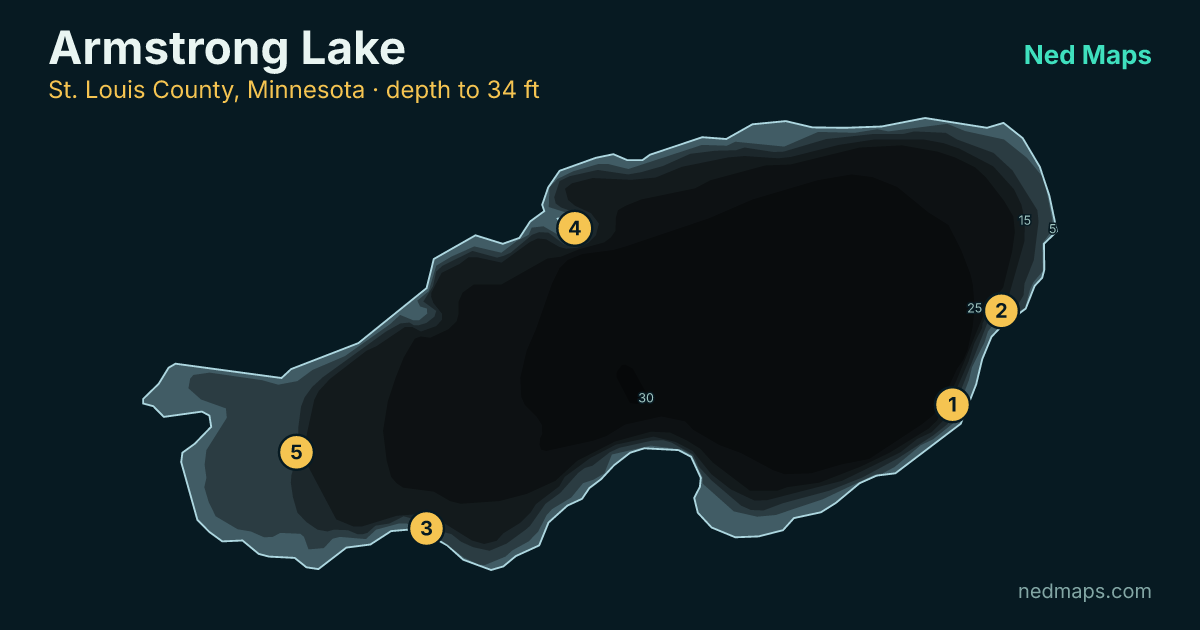
Armstrong Lake depth map
Within 30 miles
Nearby lakes
- Pickerel Lake · 40 ac · 1.1 mi
- Little Armstrong Lake · 70 ac · 1.1 mi
- West Robinson Lake · 121 ac · 1.6 mi
- Eagles Nest #1 Lake · 324 ac · 1.7 mi
- Eagles Nest No. Four Lake · 178 ac · 1.7 mi
- Eagles Nest #3 Lake · 1,028 ac · 2.6 mi
- Mud Lake · 176 ac · 2.6 mi
- Six Mile Lake · 109 ac · 2.7 mi
Quick answers
Frequently asked questions
How deep is Armstrong Lake?
Armstrong Lake reaches 34 ft at its deepest point; about 27% of the lake is littoral (15 ft or shallower).
How big is Armstrong Lake?
Armstrong Lake covers 382 acres with about 4.5 miles of shoreline.
How clear is the water in Armstrong Lake?
DNR Secchi readings on Armstrong Lake average 14.4 ft of visibility, clear water for a Minnesota lake.
What fish are in Armstrong Lake?
Minnesota DNR surveys (most recently 2021) record walleye, largemouth bass, smallmouth bass, northern pike, bluegill, crappie, yellow perch, rock bass.
Is Armstrong Lake stocked?
Yes. The DNR stocked walleye in 2025; the stocking table on this page lists every year back to 2016.
Does Armstrong Lake have a public access?
Yes. Armstrong Lake has one public access site: Armstrong Lake (trailer launch).
How big do walleye get in Armstrong Lake?
The biggest walleye measured in recent DNR surveys taped 26"; the size-history table on this page tracks the biggest fish in each survey back to 1997.
When was Armstrong Lake last surveyed?
The Minnesota DNR last surveyed Armstrong Lake in 2021, the most recent of 8 surveys on record.
Page updated .

Featured guide spot
Your guide service here
One featured guide per lake, with your photo, your writeup and a link straight to your booking page. Free through December 31, 2026.
Then $20 a month from January. Cancel any time.
The live map adds today's conditions and ranked spots for Armstrong Lake, plus a trip plan you can share:
Open Armstrong Lake on the live map → Fished it lately? Write a report